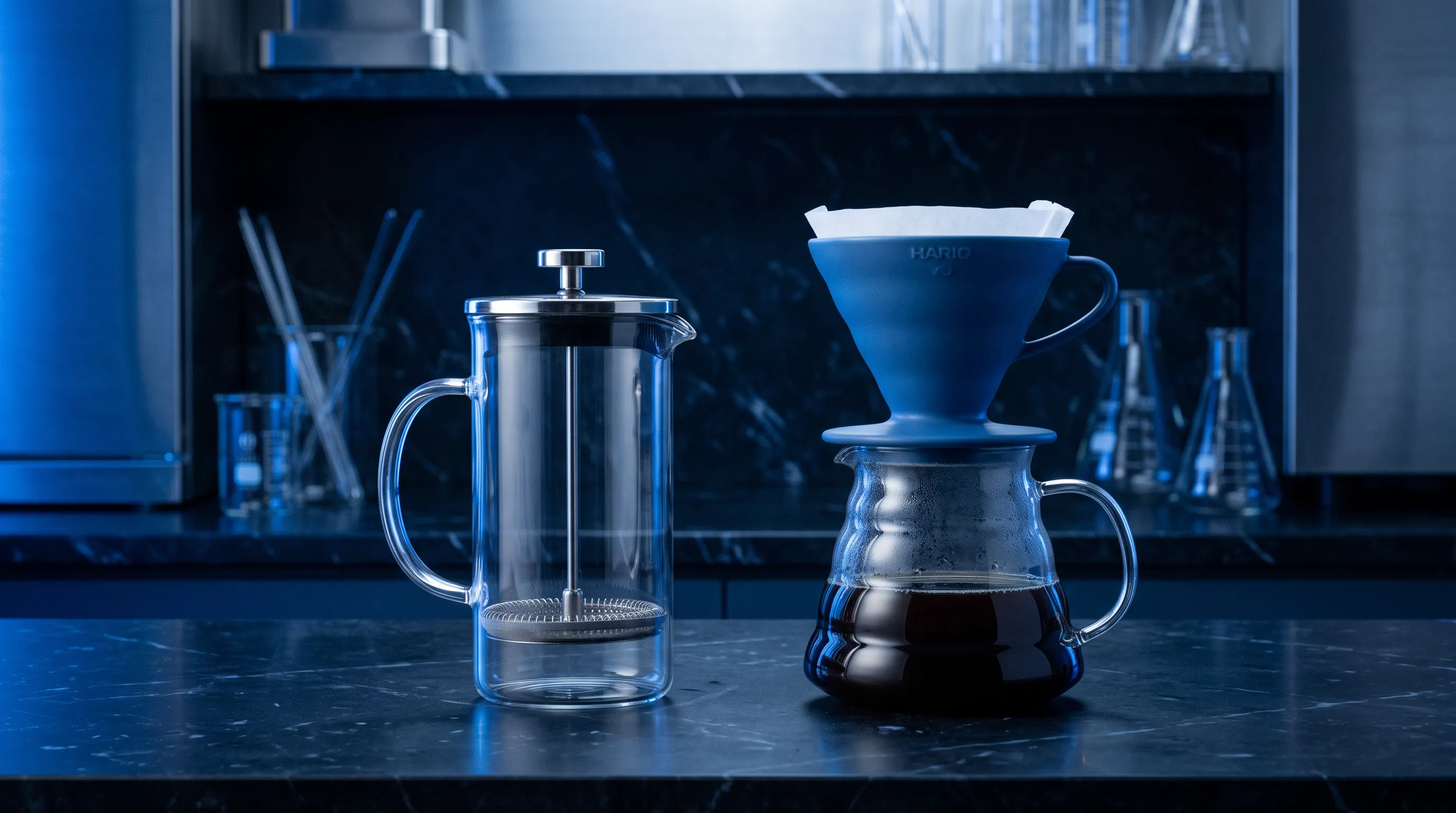
French press and pour over produce noticeably different cups from identical coffee. French press steeps coarsely ground coffee in water for 4 minutes, leaving oils and fine particles in the cup — a heavier, more textured drink. Pour over drips hot water through a paper filter, removing those oils — a cleaner, lighter cup.
The primary measurable difference is cafestol — the diterpene in unfiltered coffee that raises LDL cholesterol. Urgert and Katan (Wageningen University, reviewed 2012) found regular unfiltered coffee consumption raises LDL by approximately 0.13 mmol/L per cup. French press is unfiltered; pour over through a paper filter removes cafestol almost entirely. For drinkers managing LDL at three or more cups daily, pour over is the physiologically safer method.
At the same 500ml output volume, the Bodum Pour Over ($32.26) costs $2.31 more than the Bodum Chambord French Press ($29.95). Both make excellent coffee; the cup character differs more than the price does.
This article contains affiliate links. We earn a commission if you purchase through our links, at no extra cost to you. Our rankings are never influenced by commissions. Full disclosure →
How Each Method Works
French press is an immersion brewer. Coarsely ground coffee (800–1000 microns) steeps in water at 92–96°C for 4 minutes. The stainless steel mesh filter — typically with 150–200 micron openings — physically separates the spent grounds from the brewed coffee when the plunger is pressed. Critically, the mesh filter does not remove coffee oils, fine particles, or the diterpenes (cafestol and kahweol) that contribute to body and mouthfeel — and, at high consumption volumes, to LDL cholesterol effects. Everything that fits through a 150-micron opening ends up in the cup.
Pour over is a gravity-drip brewer. Hot water is poured over medium-ground coffee (400–600 microns) in a paper filter cone. Water passes through the grounds under gravity alone — no pressure, no immersion — and drips into a server or cup below. The paper filter is the key difference: it absorbs the coffee oils and traps fine particles and cafestol, producing a cup that is physically lighter and chemically cleaner. The bloom — an initial small pour that allows CO2 to escape from fresh coffee — is the technique variable that distinguishes good pour over from great pour over.
The practical implication is that these two methods cannot substitute for each other if you care about cup character. A person who wants the rich, viscous, full-bodied quality of French press will find pour over thin by comparison. A person who wants to taste the acidity and floral notes of a light-roast single origin will find French press mutes them. The cup is the choice, not the method.
The cafestol question is frequently overstated in both directions. French press does not cause cardiovascular disease at two cups per day in a healthy adult. Pour over is not a medical intervention. The effect becomes clinically relevant only at three or more cups daily over sustained periods, and primarily in individuals already managing elevated LDL. Context matters.
Side-by-Side Comparison
| Factor | Bodum Chambord French Press 500ml | Bodum Pour Over 500ml |
|---|---|---|
| Price (Amazon AU) | $29.95 | $32.26 |
| Mechanism | Immersion + mesh plunger | Gravity drip through paper filter |
| Filter type | Stainless mesh (150–200 micron) | Paper filter (removes oils + fines) |
| Output volume | ~450ml | ~450ml |
| Grind size | Coarse (800–1000 micron) | Medium (400–600 micron) |
| Brew time | 4 minutes steep + 30s press | 3–4 minutes drip (+ 30s bloom) |
| Cafestol retention | High (unfiltered) | Very low (paper removes it) |
| Cup character | Heavy, oily, full body, sediment possible | Clean, light, bright, no sediment |
| Ongoing cost | None after purchase | Paper filters (~$5–8 per 100 filters) |
| Cleaning | Dishwasher-safe (disassembled) | Rinse cone + discard used filter |
| Requires kettle type | Any kettle | Any kettle (gooseneck recommended) |
The Products
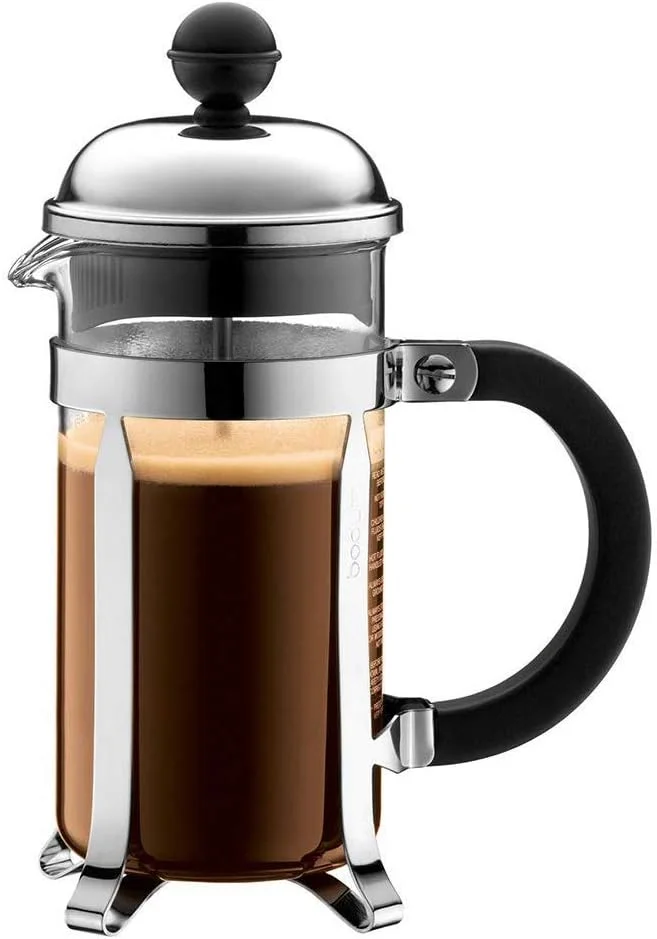
The Bodum Chambord is the default reference point for French press in Australia — and for good reason. At $29.95 it is among the best-value glass French press options on Amazon AU, with over 21,000 reviews at 4.6 stars. The borosilicate glass carafe resists thermal shock; the stainless steel frame is durable; the three-part filter disassembles completely for cleaning and goes into the dishwasher.
The 500ml size produces approximately 450ml of brewed coffee — enough for one large mug or two smaller cups — at a 1:15 coffee-to-water ratio (approximately 30–33g of coarse coffee per brew). It is the correct size for one or two people. Bodum also makes the same model at 1L for two to four people, and at 350ml for a single strong cup.
The primary limitation is the mesh filter. At 150–200 microns, it passes fine coffee particles and all coffee oils into the cup. This produces the characteristic French press body and mouthfeel — which is a feature for most buyers — but also means cafestol and kahweol are fully present in every cup. For one to two cups daily, this is not a clinical concern for most people. At three or more cups daily, the cumulative cafestol intake may become relevant for LDL management.
Check price on Amazon AU →Pros
- $29.95 — $2.31 cheaper than the comparable Bodum Pour Over
- No ongoing filter cost — mesh filter lasts years with care
- Dishwasher-safe when fully disassembled
- 4.6 stars across 21,000+ Amazon AU reviews — statistically strong quality signal
Cons
- Unfiltered — retains cafestol and kahweol (relevant at 3+ cups/day)
- Glass carafe breaks on hard impact or rapid temperature change
- Sediment in the cup if coffee is not poured promptly after pressing
- Heavy body may mask delicate flavours in light-roast single-origin beans
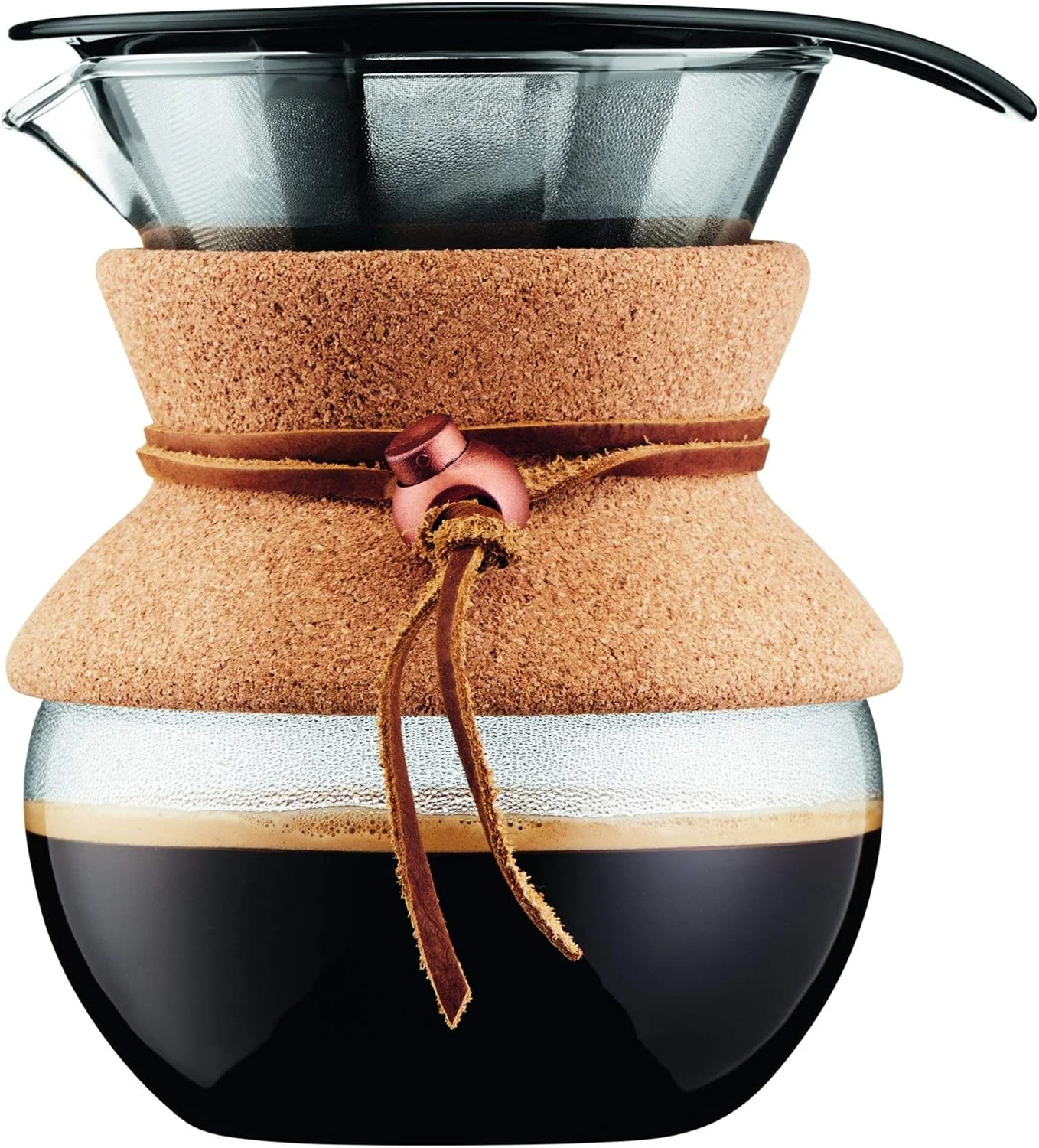
The Bodum Pour Over is the logical companion comparison to the Chambord: same brand, same 500ml capacity, $2.31 more expensive, fundamentally different cup. The plastic cone sits directly on the glass server; a paper filter (standard #4 cone) sits inside the cone and does the actual filtration work. Bodum does not include paper filters; they are available separately (100 filters for approximately $5–8).
The pour over method rewards technique more than the French press does. The bloom — pouring 50–60ml of hot water over the grounds and waiting 30 seconds before continuing — allows CO2 to degas from the coffee, which improves extraction evenness. Subsequent pours in steady circular patterns maintain consistent saturation across the coffee bed. A gooseneck kettle (like the Fellow Stagg EKG) makes this significantly easier, though it is not required for the Bodum's wider cone opening.
The output is a demonstrably different cup to the Chambord. Paper filtration removes cafestol, removes fine particles, and reduces the oils that give French press its characteristic heaviness. The result is brighter acidity, cleaner finish, and better expression of origin characteristics in high-quality beans. For light-roast single-origin coffees, pour over is the more revealing method. For dark-roast commodity blends where body is the preference, French press competes better.
Check price on Amazon AU →Pros
- Paper filter removes cafestol — the most relevant health differentiator
- Cleaner, brighter cup — better for light-roast and single-origin beans
- No sediment in cup — paper catches fine particles
- Same 500ml output and compact size as the Chambord
Cons
- Ongoing paper filter cost — approximately $5–8 per 100 filters
- Requires more attention during brewing than set-and-wait French press
- $2.31 more expensive than the Chambord at current pricing
- Gooseneck kettle not included — recommended for best results
How to Choose Between Them
Preferred cup character
This is the primary decision. French press: heavy, oily, full-body, rich mouthfeel, possible fine sediment. Pour over: clean, light, bright acidity, no sediment. If you drink dark roast with milk, French press likely suits your preference. If you drink light-roast single-origin black, pour over expresses those beans better. Neither is objectively superior — they suit different preferences.
Dark roast with milk → French press; light roast black → pour overLDL cholesterol management
If you drink three or more cups of coffee daily and are managing elevated LDL, pour over is the more prudent choice. Paper filtration removes cafestol almost entirely. Urgert and Katan (Wageningen University) found unfiltered coffee raises LDL by ~0.13 mmol/L per cup — at three cups daily this becomes clinically meaningful over months. One to two cups daily of French press in a healthy adult is unlikely to be clinically significant.
3+ cups/day + elevated LDL → pour overOngoing cost and simplicity
French press has no ongoing consumable cost after purchase. Bodum Chambord at $29.95 is all-in; the mesh filter lasts years with basic care. Pour over requires paper filters — approximately $5–8 per 100 filters, which at one brew per day translates to $18–30 per year. Over 5 years: French press total cost $29.95; pour over total $61.95. Budget-sensitive buyers should factor this in.
5-year cost: French press $29.95 vs pour over ~$62Technique and hands-on time
French press is more forgiving. Add coarse grounds, add hot water, set a timer for 4 minutes, press, pour. Variables are limited. Pour over rewards attention: bloom timing, pour rate, pour pattern, and water temperature all affect the result. If you want a consistent result with minimal thought at 6am, French press is more reliable. If you enjoy the ritual of a controlled, precise brew, pour over is more satisfying to master.
Minimal morning effort → French press; enjoy brewing ritual → pour overDecision Matrix
| Situation | Best Pick | Why |
|---|---|---|
| Prefer a heavy, full-body cup with natural coffee oils | Bodum Chambord French Press | Immersion extracts oils freely; mesh filter does not remove them |
| Managing LDL cholesterol at 3+ cups daily | Bodum Pour Over | Paper filter removes cafestol and kahweol almost entirely |
| Want a clean, bright cup from single-origin beans | Bodum Pour Over | Paper filtration reveals origin characteristics masked by oils in French press |
| Prefer lowest upfront cost with no ongoing costs | Bodum Chambord French Press | $29.95 all-in; mesh filter lasts years; no paper filter expense |
| Making coffee for 2 people each morning | Either (same output) | Both produce ~450ml at 500ml capacity — enough for 2 standard cups |
| Want the easiest consistent morning brew | Bodum Chambord French Press | Set timer, press, pour — fewer variables than pour over technique |
| Enjoy the brewing process as a ritual | Bodum Pour Over | Bloom, controlled pours, aroma — more engaging process than a 4-minute steep |
| Travelling or minimal kit needed | Bodum Chambord French Press | No paper filters to carry; simpler to use with any hot water source |
| Want best espresso-like result | Neither — use a moka pot instead | Both methods produce standard-strength filter coffee; concentration requires pressure |
Frequently Asked Questions
Does pour over taste better than French press?
Neither is objectively better — they produce different cups. Pour over, filtered through paper, produces a cleaner, brighter cup where origin characteristics and acidity are more pronounced. French press, unfiltered, produces a heavier, fuller-bodied cup with natural coffee oils and a richer mouthfeel. Specialty coffee drinkers often prefer pour over for single-origin, light-roast beans. People who prefer a robust morning coffee with milk often prefer French press. The better cup is whichever you prefer to drink.
Is French press coffee bad for your cholesterol?
At high consumption levels, it can be. French press is an unfiltered method — the stainless mesh does not remove cafestol and kahweol, the diterpene compounds in coffee oil associated with LDL cholesterol elevation. Urgert and Katan (Wageningen University, reviewed 2012) found unfiltered coffee consumption raises LDL by approximately 0.13 mmol/L per cup. For one to two French press cups daily in a healthy adult, the effect is modest. At three or more cups daily over months, it may be clinically relevant for individuals already managing elevated LDL. Paper-filtered pour over removes cafestol almost entirely.
What grind size do I use for French press vs pour over?
French press requires a coarse grind — approximately 800–1000 microns (large, chunky particles similar to coarse sea salt). This prevents the mesh filter from clogging and allows proper immersion extraction in 4 minutes. Pour over requires a medium grind — approximately 400–600 microns (slightly finer than sea salt, coarser than table salt). Using French press grind in a pour over drips too fast and under-extracts. Using pour over grind in a French press clogs the mesh, makes pressing difficult, and produces a bitter, over-extracted cup.
How much coffee do I use for each method?
Both methods use a standard 1:15 to 1:17 coffee-to-water ratio by weight. For the Bodum Chambord 500ml: approximately 30–33g of coarse coffee per 500ml water. For the Bodum Pour Over 500ml: approximately 30–33g of medium coffee per 500ml water. The ratio is similar; the grind size differs. A kitchen scale improves consistency in both methods — volume measurements of coffee beans vary with roast level and bean density.
Which takes longer — French press or pour over?
French press total brew time: 4 minutes steeping plus 30 seconds pressing. Pour over total brew time: 30-second bloom plus 3–4 minutes of drip time. Both are approximately 4–5 minutes from start to cup. Pour over requires more active attention — you pour in controlled stages rather than set and wait. French press is more hands-off once the water is in.
Do I need a gooseneck kettle for pour over?
For the Bodum Pour Over specifically, a standard kettle can work — the Bodum has a wider cone opening than a narrow V60, which makes controlling pour rate easier without a gooseneck. However, a gooseneck kettle gives significantly better control over pour rate and direction, which affects extraction evenness and cup consistency. The Fellow Stagg EKG ($299) is the premium option with 1°C temperature control. For entry-level pour over, a gooseneck is recommended but not strictly required with the Bodum design.
Which method is easier for beginners?
French press is more forgiving. The method is: add coarse coffee, add hot water, wait 4 minutes, press, pour. Variables are limited to grind size and water temperature. Pour over has more variables: grind size, pour rate, pour pattern, water temperature, bloom time, and number of pour stages. Beginners often find French press more consistent initially; pour over rewards practice and produces a higher quality ceiling once technique is mastered.
Can I use the same coffee beans for both methods?
Yes — the same beans work in both methods with different grind settings. The cup character will differ. Many roasters recommend lighter roasts for pour over (the paper filter allows delicate flavours to express) and medium-to-dark roasts for French press (where body and oil presence complement richer, more developed flavours). Light roasts in a French press can taste thin and muddy; dark roasts in a pour over can taste flat and stripped. This is a preference guide, not a rule — experiment with your preferred beans in both methods.
Related Guides
For a ranked comparison of Australian French press options including the Secura Stainless and Bodum Columbia, see our best French press Australia guide. If you decide pour over is the right method and want to invest in a gooseneck kettle, the best electric kettle Australia guide covers gooseneck options including the Fellow Stagg EKG and budget alternatives. For a comparison of French press against a pressure-brewed stovetop method, see moka pot vs French press. The Brew Gear section covers all equipment categories.