Steeping time is the critical variable in functional tea. Beta-glucans require 8–10 minutes at 85–90°C for meaningful extraction. Most instructions say 3 minutes — they're wrong. 6 Australian-available teas ranked. Updated July 2026.
Matcha Maiden Organic Matcha Powder (70g) is the best functional green tea in Australia for daily EGCG intake. Matcha delivers approximately 137mg of EGCG per 1g serve — roughly 3× more than brewed leaf tea — because you consume the whole leaf in suspension rather than just an aqueous infusion. The minimum effective option for the studied cognitive benefit (L-theanine + caffeine) is any quality matcha served at 70–80°C, not boiling.
Kuriyama et al. 2006 (PMID 16968850) is the landmark population study: n=40,530 Japanese adults, 11 years. Those drinking ≥5 cups green tea daily had significantly lower all-cause and cardiovascular mortality. Owen et al. 2008 (PMID 18681988), an RCT in 27 adults, demonstrated L-theanine combined with caffeine — both naturally present in matcha — improved sustained attention and speed of perception versus caffeine alone. Bogdanski et al. 2012 (PMID 22749178) showed standardised EGCG extract reduced blood pressure and inflammatory markers in obese hypertensive adults over 3 months.
The Kuriyama evidence is observational — association, not causation, and specific to lifelong Japanese tea drinkers. Brewing temperature is the most controllable variable: 70–80°C maximises EGCG yield; boiling water degrades it. One to two 1g matcha serves daily (100–275mg EGCG) is the practical functional range without approaching supplemental-dose risk.
Reviews

Roundup

Roundup

Roundup

Comparison

Guide

Review
Brewing Guide
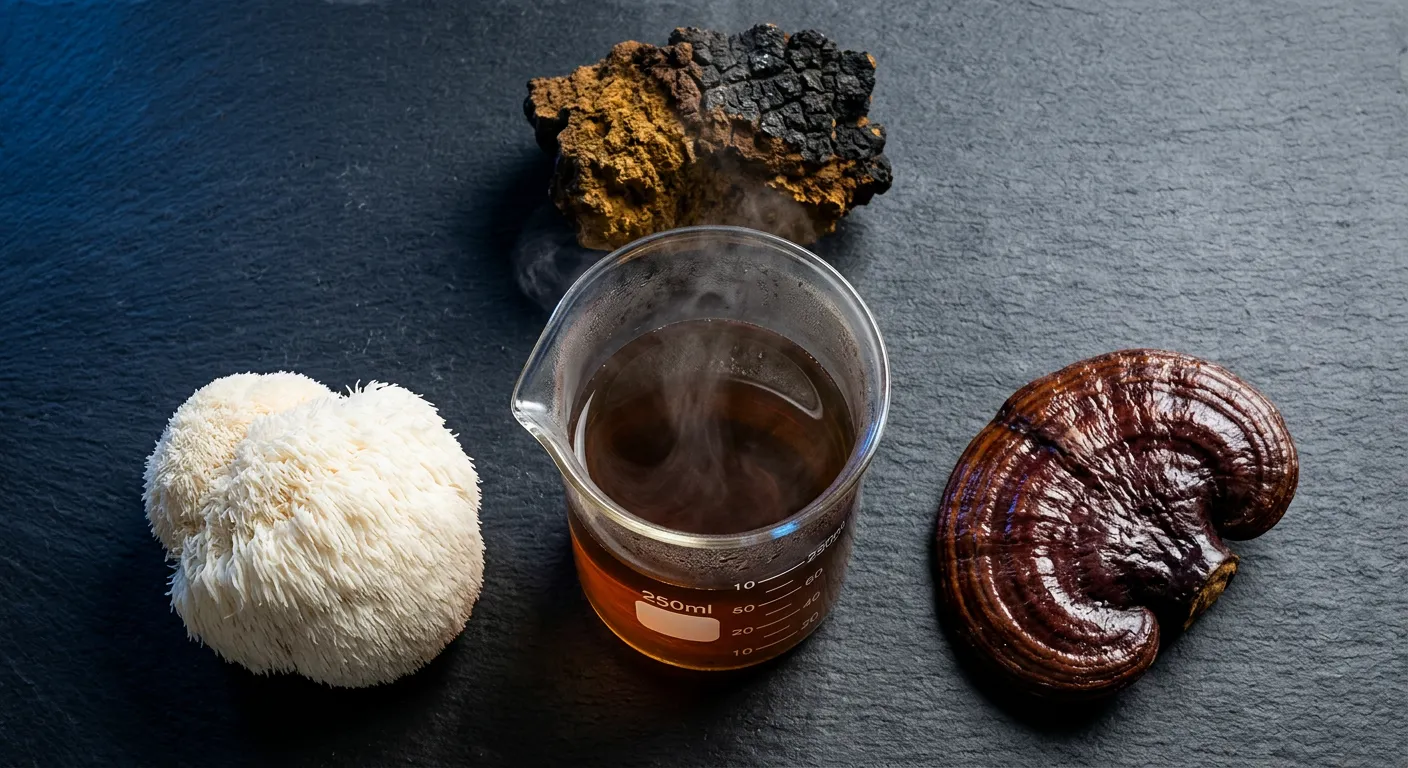
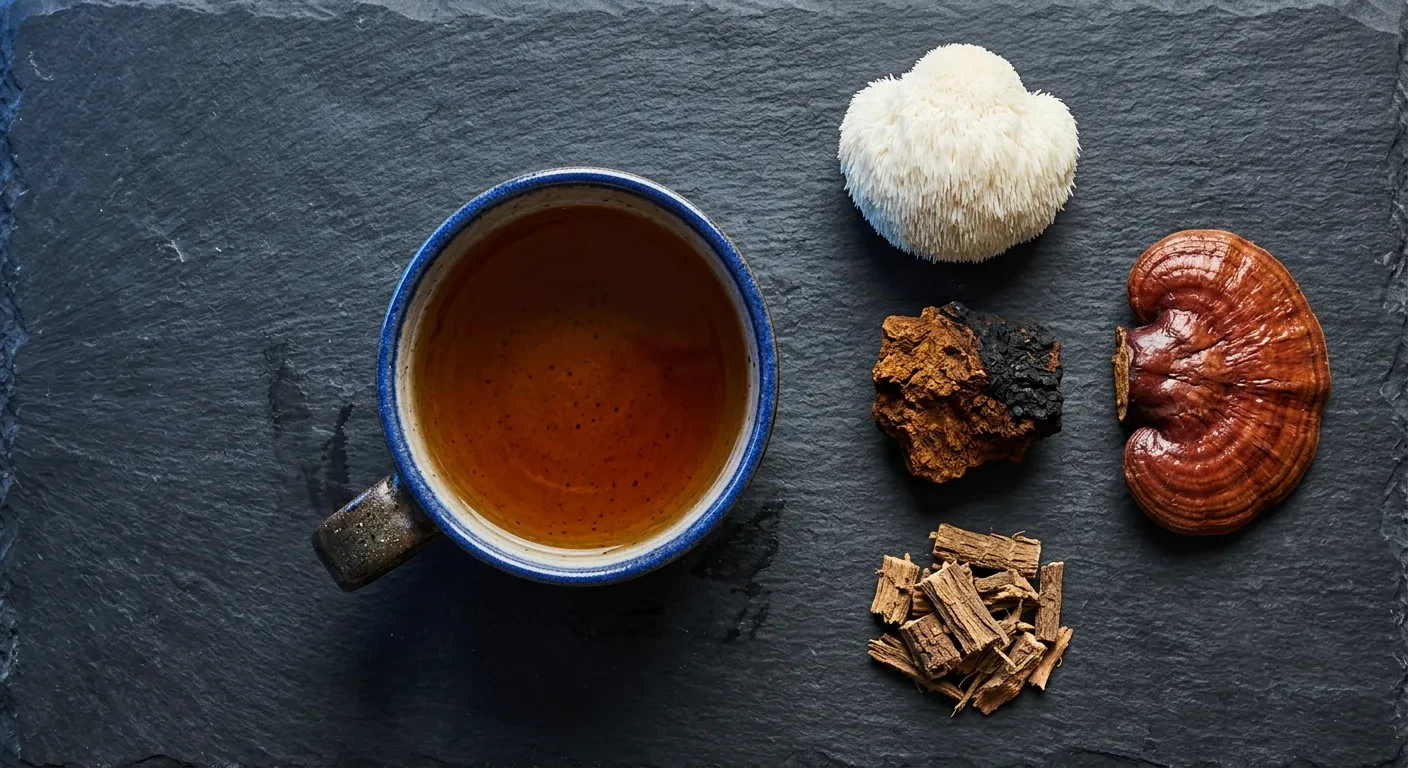
Beta-glucans dissolve slowly. Most commercial functional tea bags are dosed for 3-minute steeping — enough for flavour, not enough for meaningful compound extraction. The same tea steeped for 8–10 minutes at 85°C will extract materially more beta-glucan. It also tastes stronger. Add a lid to your mug to maintain temperature.
→ Steep 8–10 minutes at 85–90°C, coveredHot water extraction only captures water-soluble compounds. Reishi and chaga triterpenoids are fat-soluble — they don't come out in a tea bag. For the full spectrum of adaptogen compounds, a dual-extraction tincture (alcohol + water) is more potent per serve than any tea bag product. If you want maximum potency, add a liquid tincture to your tea rather than relying on the bag alone.
→ Add a tincture to your tea for full-spectrum effectFor a product you're consuming daily in hot water — which increases extraction of any contaminants present in the herb — organic certification matters. Conventional herbs are permitted to use certain pesticides that concentrate in hot water extraction. Australian Certified Organic or USDA Organic is the minimum standard we recommend for daily functional tea use.
→ USDA Organic or ACO certified onlyThe Research
Every citation below was verified via PubMed eSummary API before inclusion. We do not cite review articles as primary sources.
2006
JAMA Internal Medicine — Ohsaki Cohort Study
"Green tea consumption was inversely associated with mortality due to all causes and due to cardiovascular disease." n=40,530 Japanese adults, 11-year follow-up. Dose-response: ≥5 cups/day showed strongest benefit.
2008
Nutritional Neuroscience — Randomised crossover RCT
"L-theanine combined with caffeine significantly improved speed of visual information processing, alertness and reduced susceptibility to distraction." n=27 healthy adults. Doses: L-theanine 100mg + caffeine 50mg — both within range of 2–3 matcha serves.
2012
Nutrition Research — RCT in obese hypertensive adults
"Green tea extract significantly decreased systolic and diastolic blood pressure, as well as total cholesterol, LDL, and TNF-α." n=56 obese hypertensive adults, 3-month intervention at 379mg/day EGCG (≈2.8g matcha daily).
Matcha Maiden Organic Matcha Powder (70g) is the best-value functional green tea in Australia for daily EGCG intake. Matcha delivers approximately 137mg of EGCG per 1g serve — roughly 3× more than brewed leaf tea — because you consume the whole leaf in suspension. See our full guide: Best Green Tea Australia 2026 →
Yes — the strongest evidence is the Kuriyama et al. 2006 cohort (PMID 16968850): n=40,530 Japanese adults, 11 years. Those drinking ≥5 cups green tea daily had significantly lower all-cause and cardiovascular mortality. Owen et al. 2008 (PMID 18681988), an RCT in 27 adults, showed L-theanine + caffeine improved sustained attention versus caffeine alone. The cardiovascular evidence is observational, not RCT causal.
EGCG (epigallocatechin-3-gallate) is the primary catechin in green tea — the compound linked to cardiovascular, metabolic, and anti-inflammatory effects. Matcha contains approximately 137mg EGCG per gram. EGCG degrades at temperatures above 85°C — brewing at 70–80°C preserves catechin content.
Ceremonial grade is from youngest, most shaded leaves — sweeter umami flavour, higher L-theanine per gram, finer stone-ground particle size. Culinary grade is more astringent and suited to lattes and baking. Both contain EGCG, but ceremonial grade is best when drinking matcha straight without milk.
One to two 1g serves daily delivers 100–275mg EGCG — a practical functional range without approaching supplemental-dose risk. One 1g matcha serve is roughly equivalent to 3 cups of brewed green tea in catechin content. The Kuriyama observational benefit was strongest at ≥5 cups brewed tea daily, but matcha's higher EGCG density closes this gap at 1–2 serves.
The evidence supports this. Owen et al. (2008, PMID 18681988) found L-theanine + caffeine produced calmer, more focused attention than caffeine alone, with reduced side-effect ratings. Matcha naturally contains both — approximately 30–40mg caffeine and 20–45mg L-theanine per 1g serve. The L-theanine:caffeine ratio in matcha (roughly 1:1) differs meaningfully from coffee, which has caffeine but negligible L-theanine.
70–80°C is optimal for EGCG preservation. Boiling water (100°C) degrades catechins and extracts excess tannins, producing a bitter cup. Without a temperature kettle: pour boiled water into a room-temperature ceramic cup and wait 3–4 minutes — this drops water to approximately 75°C before whisking or steeping.
Yes — brewed green tea and matcha at 1–5 serves per day have an excellent safety record. Safety concerns arise at high-dose EGCG supplementation (>800mg/day in extract form). Whole matcha at 1–2g daily delivers 100–275mg EGCG — well below supplemental-dose thresholds of concern. Those with iron-deficiency anaemia should consume green tea between meals as catechins inhibit non-haem iron absorption.