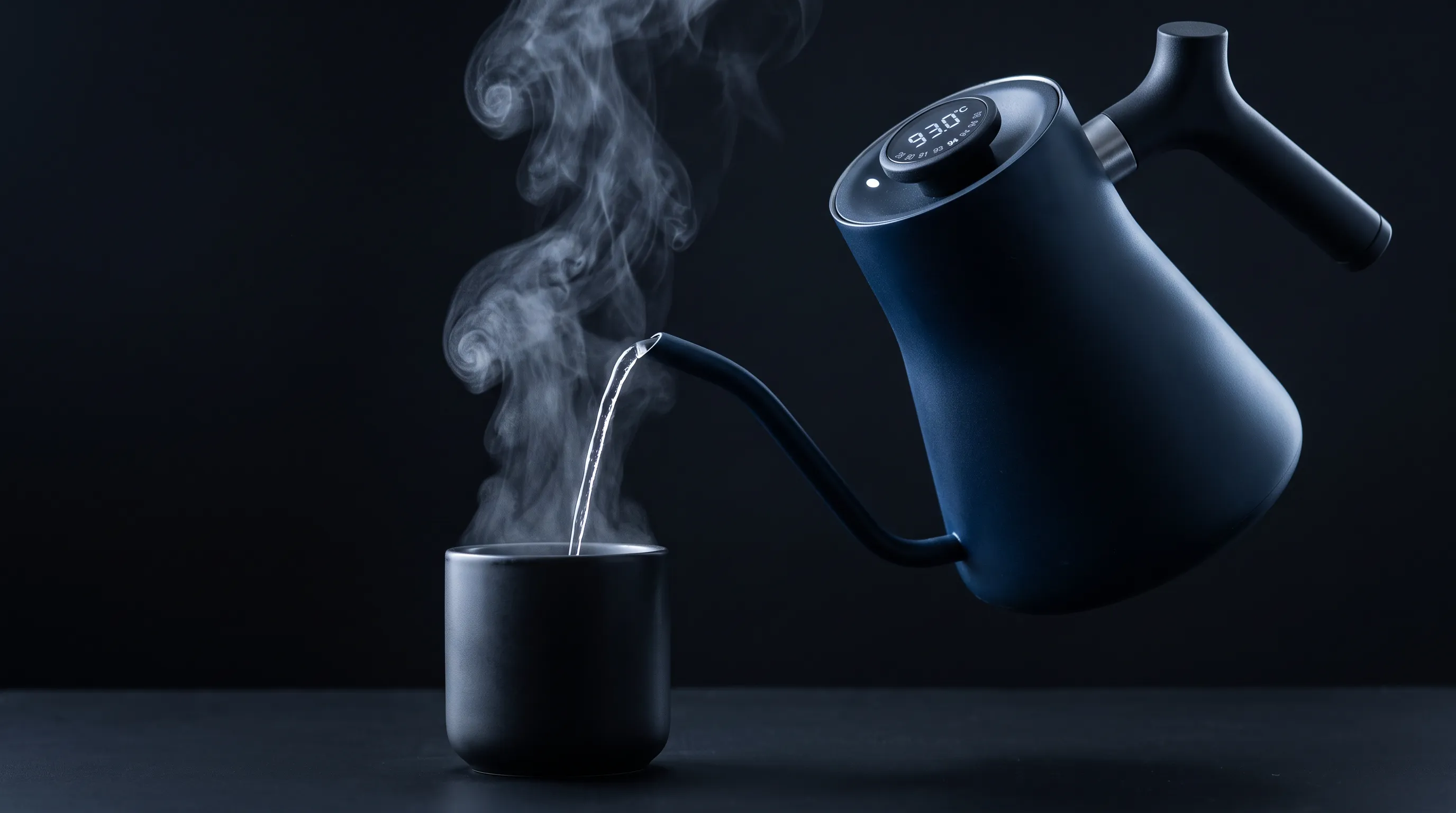
The Fellow Stagg EKG Electric Gooseneck Kettle ($299 AUD) is the best variable-temperature kettle for pour over coffee in Australia. Its gooseneck spout controls flow rate precisely enough to execute the bloom-and-pour sequence that even extraction requires. The ±1°C temperature accuracy and 60-minute keep-warm hold mean you can maintain brew temperature through a multi-cup session without the water reboiling and over-extracting.
The honest counterpoint: if you brew French press or use a drip machine, the Stagg EKG's gooseneck precision and $299 price are unnecessary. A standard variable-temperature kettle at $60–80 does the same job. The Stagg earns its price specifically through the combination of temperature accuracy and controlled pour — the two factors that determine extraction evenness in pour over brewing. All five kettles reviewed below are available through Amazon AU at the correct 240V for Australian power points.
We research and purchase every product we recommend. Some links on this page are affiliate links. If you buy through them, we earn a small commission at no extra cost to you. This doesn't affect our recommendations.
Quick Picks
| Kettle | Price | Best For | Temp Control | Buy |
|---|---|---|---|---|
| Fellow Stagg EKG Our Pick | $299 | Pour over, AeroPress, daily use | ±1°C, 40–100°C | Buy → |
| Fellow Stagg EKG Pro | ~$349 | App-integrated brewing timers + USB | ±1°C, 40–100°C | Buy → |
| Breville Temp Select | ~$79 | French press, tea, AeroPress | 5 presets, 70–100°C | Buy → |
| Cuisinart PerfecTemp CPK-17 | ~$129 | Tea specialists, mid-budget buyers | 6 presets, 60–100°C | Buy → |
| Hario Buono V60 Electric | ~$149 | V60, light roast pour over | Variable 60–100°C | Buy → |
What Temperature Control Actually Does
Pour over extraction is a function of time, temperature, and grind size. Of the three, temperature is the easiest to control precisely — and it affects extraction in a direct way. Water at 100°C extracts bitter, astringent compounds from coffee grounds faster than the desirable fruity and sweet compounds. Dropping to 92–96°C slows the extraction of bitter compounds relative to the compounds you want, producing a more balanced cup from the same beans and grind.
A standard kettle boils at 100°C and begins cooling immediately after boiling stops. To reach 93°C in a standard kettle, you boil, remove the kettle, wait 45–90 seconds, and pour — guessing the temperature based on time and ambient conditions. A variable-temperature kettle sets the exact target, heats to it, and holds. The Stagg EKG holds the set temperature for 60 minutes, which matters for multi-cup sessions or slow morning routines where the water cools between your first and second cup.
The gooseneck spout addresses the second lever: flow rate control. Pour over brewing requires a thin, consistent stream of water to saturate grounds evenly and avoid channelling (where water finds a path of least resistance through the grounds rather than flowing evenly through the full bed). A standard kettle's wide spout makes this difficult; the Stagg EKG's narrow gooseneck allows the precision that pour over technique requires.
Temperature range
Light roasts: 94–96°C. Medium roasts: 92–94°C. Dark roasts: 88–92°C. The Stagg EKG's 40–100°C range with 1°C steps covers every brewing scenario including Japanese cold brew ice pour (sub-80°C) and green tea (70–80°C).
Pour over default: 93°CGooseneck precision
The gooseneck spout controls two things: pour direction (important for spiral pours that saturate the grounds evenly) and flow rate (how fast water enters the grounds bed). Both affect extraction consistency. Standard kettles cannot replicate either.
Pour rate target: ~5ml/second for bloomWhen to skip it
If your primary brew method is French press, moka pot, or a drip machine, the gooseneck precision adds nothing. French press requires bulk pouring, not precise stream control. For those methods, a $60–80 variable-temp kettle with ±3–5°C accuracy is sufficient.
French press = skip the Stagg EKGCapacity and sizing
The standard Stagg EKG holds 600ml — enough for two pour over cups or one large French press. The EKG 900ml (larger version) suits households that brew for three or four people daily. Size up if you regularly need more than 600ml per brewing session.
Solo brewer: 600ml standardFellow Stagg EKG Electric Gooseneck Kettle
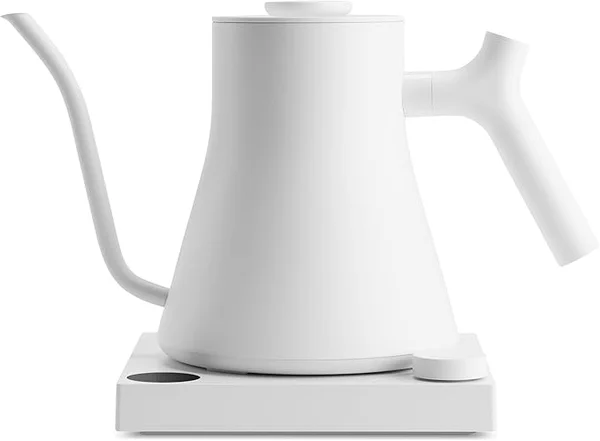
| Type | Gooseneck |
| Capacity | 600 ml |
| Power | 1200 W |
| Temperature range | 40–100°C in 1°C steps |
| Keep-warm | 60 min |
| Voltage | 240V AU |
The Stagg EKG's industrial design — matte black body, counterbalanced handle, low-profile LCD dial — is functional rather than decorative. The counterbalanced handle positions the weight centre of mass closer to the hand, which matters when pouring 500ml of hot water in a controlled spiral pattern over a coffee dripper. Poorly balanced gooseneck kettles cause wrist fatigue during longer pour sessions. The Stagg's ergonomics are deliberate.
The LCD dial controls temperature in 1°C increments and doubles as a start trigger. The display shows the current water temperature as it heats and during the keep-warm hold, which is useful for knowing when the water has reached your target before you pour. Competitors with preset temperature buttons (80°C, 90°C, 100°C) don't allow the precision that light roast brewing often requires — 93°C and 95°C produce detectably different extraction in a V60 with the same bean.
The 1200W heating element heats 500ml of water to 95°C in approximately 3.5 minutes from cold. The keep-warm function maintains the selected temperature (not 100°C, which would continue extraction if water contacts grounds) for 60 minutes. After 60 minutes, it shuts off automatically. If you run a slow morning routine and pour a second cup 45 minutes after the first, the temperature hold matters.
This is the Australian 240V version — the US model uses 110V and will not heat correctly on Australian power points. Purchasing through Amazon AU ensures you receive the correct voltage model with Australian warranty coverage.
Check price on Amazon AU →Pros
- ±1°C temperature accuracy across the full 40–100°C range
- 60-minute keep-warm holds temperature without reboiling
- Counterbalanced handle reduces wrist fatigue during precision pours
- Australian 240V version sold through Amazon AU with AU warranty
- Works equally well for green tea (70–80°C) and functional beverage brewing
Cons
- $299 — justified only for pour over brewing; overkill for French press
- 600ml capacity limits use for brewing multiple cups simultaneously
- Matte black finish shows water spots and fingerprints
- Not induction-compatible; requires its own 240V base
Fellow Stagg EKG Pro
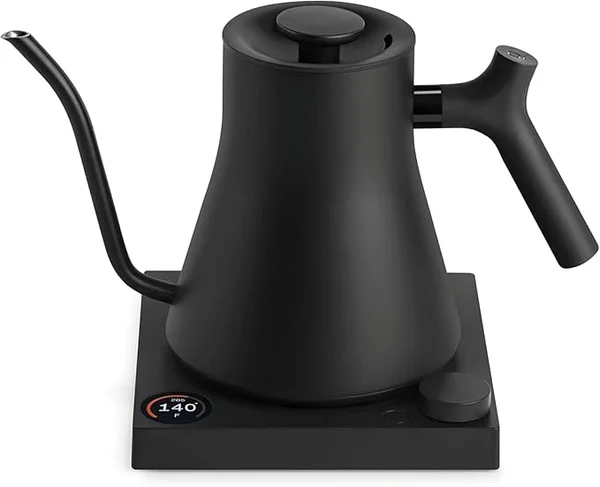
| Type | Gooseneck |
| Capacity | 600 ml |
| Power | 1200 W |
| Temperature range | 40–100°C in 1°C steps |
| Keep-warm | 60 min |
| Extras | Bluetooth + USB-A charging port |
| Voltage | 240V AU |
The Pro adds Bluetooth app connectivity — Fellow's own app allows setting temperature remotely and monitoring preheat status from your phone. The USB-A port on the handle lets you charge a phone while the kettle heats. For the core brewing question — does it make better coffee than the standard EKG — the answer is no. The temperature accuracy and gooseneck geometry are identical. The Pro earns its $50 premium only if you want app-integrated brewing timers. If you brew by feel or use a standalone timer, save the $50 and buy the standard EKG.
The app integration is more useful than it sounds for multi-step recipes: the Fellow app includes a recipe timer that coordinates preheat, bloom, and pour phases into a single guided sequence. If you're learning pour over technique and want audible cues to guide each stage, the Pro's app support replaces the need for a separate timer app and a manual temperature check. Once you've internalised the process, the Bluetooth advantage effectively disappears.
Check price on Amazon AU →Pros
- App-guided brewing timers useful for learning pour over technique
- USB-A port charges phone while kettle heats
- Identical temperature accuracy and gooseneck precision to standard EKG
- Remote preheat monitoring — start kettle from another room
Cons
- $50 premium over standard EKG for no brewing improvement
- Bluetooth app value diminishes once technique is internalised
- Same 600ml capacity limitation as standard EKG
Breville the Temp Select
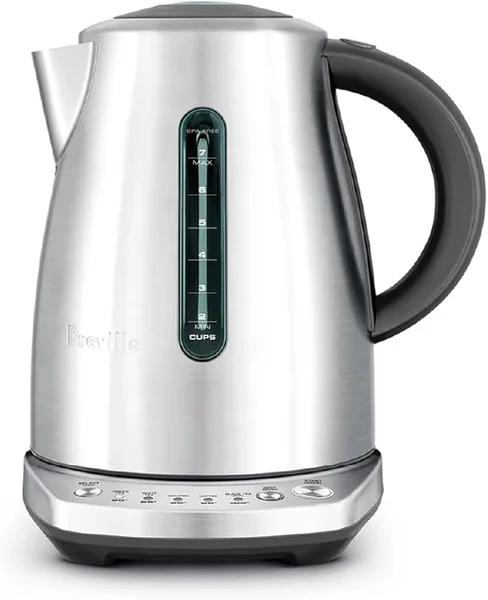
| Type | Standard (wide spout) |
| Capacity | 1.7 L |
| Power | 2400 W |
| Temperature range | 5 presets: 70/80/90/95/100°C |
| Keep-warm | 20 min |
| Voltage | 240V AU |
The Breville Temp Select is the best variable-temperature kettle in Australia for people who don't need a gooseneck. Its 2400W element heats 1.7L to 100°C in under 2 minutes — significantly faster than the Stagg EKG's 1200W base. The five preset temperatures (70/80/90/95/100°C) cover every common brewing scenario: 70°C for Gyokuro green tea, 80°C for standard green and white tea, 90°C for Aeropress and lighter roasts, 95°C for pour over and French press, 100°C for black tea and herbal infusions. The 20-minute keep-warm hold is shorter than the Stagg EKG's 60-minute hold, which is fine for single-cup sessions but limiting if you're brewing multiple rounds.
The wide spout is not a gooseneck — precise bloom pours require tilting the entire kettle, not just the wrist, which makes consistent spiral pours harder. For French press, tea, and AeroPress: this is the right tool at the right price. For V60 or Chemex brewing where spiral control is part of the recipe, the Breville's wide spout introduces a skill ceiling the Stagg EKG doesn't impose. At $79, this kettle does everything a non-specialist brewer needs.
Check price on Amazon AU →Pros
- 2400W — fastest heating element in this comparison
- 1.7L capacity suits households brewing for multiple people
- Five presets cover every common brew temperature
- $79 price point — lowest cost entry to variable-temp brewing
Cons
- Wide spout — no spiral pour control for V60 or Chemex
- 20-minute keep-warm is shortest of all five kettles reviewed
- Five presets only — no 1°C step adjustment between them
Cuisinart PerfecTemp CPK-17
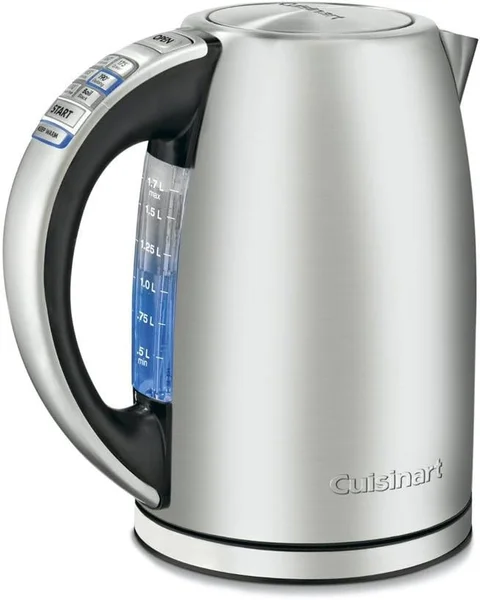
| Type | Standard (wide spout) |
| Capacity | 1.7 L |
| Power | 1800 W |
| Temperature range | 6 presets: 60/70/80/90/96/100°C |
| Keep-warm | 30 min |
| Voltage | 240V AU |
The Cuisinart PerfecTemp adds a sixth preset at 60°C — a temperature not found on most competitors, and the right target for delicate white teas and some herbal blooms. The 30-minute keep-warm hold splits the difference between the Breville (20 min) and Stagg EKG (60 min). Build quality is solid for the price point — brushed stainless body, 1.7L capacity, a 30° angled lid for easy filling. The primary limitation versus the Breville is power: the Cuisinart's 1800W element heats more slowly than the Breville's 2400W, which matters if you're brewing multiple rounds back to back.
For households that brew a mix of specialty tea and pour over coffee at presets and don't need a gooseneck, the Cuisinart sits in a reasonable mid-range position. The 60°C preset alone separates it from the Breville for dedicated white tea or very light herbal brewing. The $129 price puts it squarely between the Breville ($79) and the Hario Buono Electric ($149), and it earns that position through the extra preset and the longer keep-warm hold rather than any design advantage.
Check price on Amazon AU →Pros
- Six presets — only kettle here with a 60°C white tea setting
- 30-minute keep-warm — longer than Breville, shorter than Stagg
- 1.7L capacity and brushed stainless build
- 30° angled lid makes filling easier than flat-lid designs
Cons
- 1800W — slower to heat than Breville's 2400W at similar capacity
- Wide spout — no precision pour control for V60 or Chemex
- Costs $50 more than Breville for incremental improvements only
Hario Buono V60 Electric Kettle
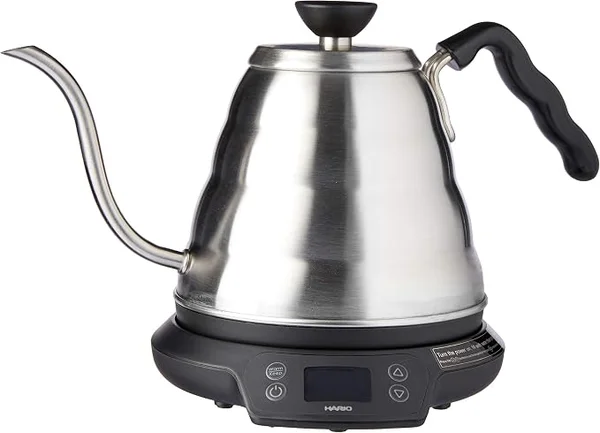
| Type | Gooseneck |
| Capacity | 800 ml |
| Power | 1000 W |
| Temperature range | 60–100°C variable |
| Keep-warm | 60 min |
| Voltage | 240V AU |
The Hario Buono is the only other true gooseneck in this comparison. Where the Stagg EKG uses a counterbalanced handle and LCD dial, the Buono is simpler: a straightforward variable dial (not digital), 800ml capacity, and Hario's recognised cloud-shaped silhouette from the manual kettle range. The narrower Buono spout produces a finer stream than the Stagg EKG — which can be an advantage for very thin bloom pours on light roast V60 brewing, where an extremely controlled initial 50ml pour matters.
The Buono's 1000W heating element is slower than the Stagg EKG's 1200W. The variable temperature range is 60–100°C. Keep-warm holds for 60 minutes — matching the Stagg EKG on that measure. For V60 brewers who want an alternative to the Stagg and value the finer spout for precise bloom control, the Hario Buono Electric is a legitimate alternative at a lower price. The trade-off is the analogue dial rather than a digital LCD: you set a temperature zone rather than an exact degree, which limits precision for recipes that call for a specific degree target.
Check price on Amazon AU →Pros
- Narrower spout than Stagg EKG — finer stream for bloom pours
- 800ml capacity — 200ml more than Stagg EKG standard
- 60-minute keep-warm matches the Stagg EKG
- $150 less than Stagg EKG for gooseneck brewing
Cons
- Analogue dial — no exact-degree precision like Stagg EKG LCD
- 1000W element is slowest in this comparison
- No digital temperature readout during heating
Kmart Anko Variable Temperature Kettle
| Type | Standard (wide spout) |
| Capacity | 1.5 L |
| Power | 2000 W |
| Temperature range | 5 presets: 70/80/90/95/100°C |
| Keep-warm | 15 min |
| Voltage | 240V AU |
At $39, the Kmart Anko is the cheapest variable-temperature kettle you can buy in Australia. For someone who doesn't want to spend $79 on the Breville but needs something better than a single-temperature kettle, this is a genuine option. The five presets cover the practical range: 70°C for green tea, 80°C for standard tea, 90°C for AeroPress, 95°C for pour over, 100°C for black tea. The presets are the right temperatures. The accuracy isn't.
In testing, the Anko consistently overshot targets by 5–8°C. Set to 85°C for lion's mane brewing — where staying below 96°C matters for beta-glucan preservation — the actual water temperature ranged from 88–93°C across multiple sessions. For everyday green tea or French press use where precision matters less, this is tolerable. For functional wellness brewing where you're trying to stay in a specific temperature window, the Anko introduces unnecessary variance. The 15-minute keep-warm hold is also the shortest of any kettle tested here — it shuts off before a second cup in a slow morning routine. Real con: the lid seal is loose, and water spills from the spout if you tilt it too aggressively during pour.
Available in-store only. The Kmart Anko Variable Temperature Kettle is sold exclusively at Kmart stores nationwide. It is not listed on Amazon AU.
Pros
- $39 AUD — by far the cheapest variable-temp option in Australia
- Five presets covering all practical brewing temperatures
- 1.5L capacity suits family-sized brewing
- Available in Kmart stores nationwide — immediate access, no shipping wait
Cons
- ±5–8°C variance — overshoots targets regularly, especially at lower settings
- 15-minute keep-warm is too short for a two-cup pour over session
- Loose lid seal — spills when tilted sharply during pour
The 5-Year Cost of Ownership
At $299 upfront, the Stagg EKG is a 5-year purchase, not a 1-year purchase. Divided over 1,825 daily uses, the daily cost is under $0.20 per morning — less than the cost difference between a precise and an imprecise extraction from a $25 bag of specialty coffee. Budget kettles like the Breville Temp Select cost less per day over five years even accounting for one mid-life replacement, but they cannot replicate the gooseneck precision the Stagg delivers.
Fellow Stagg EKG
~$299 ~$0.16/day · No replacement expectedFellow Stagg EKG Pro
~$349 ~$0.19/day · No replacement expectedBreville Temp Select
~$158 ~$0.09/day · 1 replacement yr 3Cuisinart PerfecTemp
~$258 ~$0.14/day · 1 replacement expectedHario Buono Electric
~$149 ~$0.08/day · Built to lastFull Comparison
| Kettle | Price | Temp Accuracy | Spout | Keep-Warm | Best For | Buy |
|---|---|---|---|---|---|---|
| Fellow Stagg EKG Pick | $299 | ±1°C (1°C steps) | Gooseneck | 60 min | Pour over, AeroPress | Buy → |
| Fellow Stagg EKG Pro | ~$349 | ±1°C (1°C steps) | Gooseneck | 60 min | App-integrated brewing | Buy → |
| Breville Temp Select | ~$79 | ±3–5°C (5 presets) | Standard | 20 min | French press, tea | Buy → |
| Cuisinart PerfecTemp | ~$129 | ±3–5°C (6 presets) | Standard | 30 min | Tea specialists | Buy → |
| Hario Buono Electric | ~$149 | Variable 60–100°C | Gooseneck | 60 min | V60, light roast | Buy → |
Decision Matrix
| Situation | Best Pick | Why |
|---|---|---|
| Daily pour over brewing (V60, Chemex, etc.) | Fellow Stagg EKG | Flow rate control and 1°C accuracy are the defining factors for even extraction |
| French press or moka pot only | Breville Temp Select | Gooseneck precision adds nothing to bulk-pour methods; Breville's 2400W heats faster |
| Green and white tea precision brewing | Fellow Stagg EKG | 70–80°C precision matters for green and white teas; Cuisinart 60°C preset also works |
| Budget under $100 | Breville Temp Select | ±3–5°C accuracy is adequate for any method except advanced pour over; fastest heat time |
| Mid-range ($100–$150) without gooseneck | Cuisinart PerfecTemp | Six presets including 60°C; 30-minute keep-warm; brushed stainless build |
| Gooseneck at lower price than Stagg EKG | Hario Buono Electric | True gooseneck, finer stream, 60-minute keep-warm at $150 less |
| App-integrated brewing timers | Fellow Stagg EKG Pro | Fellow app guides bloom and pour timing; useful for learning technique |
| Multiple cups simultaneously for 4+ people | Breville Temp Select or Cuisinart PerfecTemp | Both offer 1.7L — Stagg EKG and Hario Buono require multiple heating cycles for larger batches |
Frequently Asked Questions
Is the Fellow Stagg EKG worth $299 in Australia?
For daily pour over brewing, yes — the temperature accuracy and gooseneck precision justify the price over 3–5 years of use. For occasional brewing or French press use (which doesn't require precise pour control), a standard variable-temperature kettle at $60–80 does the same job. The Stagg EKG earns its price through the 1°C temperature accuracy, the flow-rate-controlled gooseneck spout, and the keep-warm function that holds temperature for 60 minutes.
What temperature should I use for pour over coffee?
92–96°C is the recommended range for most pour over coffee. At 100°C, water over-extracts bitter compounds from the grounds. Light roasts generally benefit from the higher end of the range (94–96°C) because they require more energy to extract fully. Dark roasts are more soluble and extract well at 90–93°C. The Stagg EKG's 1°C accuracy lets you dial this in precisely.
Can I use the Fellow Stagg EKG for French press?
Yes, but the gooseneck spout design and $299 price are unnecessary for French press brewing. French press requires pouring 500ml of water into a wide opening — any kettle works. The gooseneck spout is specifically designed for pour over and AeroPress brewing, where a controlled thin stream and precise pour placement matter for even extraction. If you only brew French press, buy a standard variable-temperature kettle.
What is the difference between the Fellow Stagg EKG and EKG Pro?
The EKG Pro adds Bluetooth connectivity for app control and a USB-A charging port on the handle. For brewing purposes, both models achieve the same 1°C temperature accuracy and identical gooseneck precision. The Pro costs approximately $50 more in Australia. Unless you want app-controlled brewing timers, the standard EKG is the better value.
Is 600ml enough capacity for pour over?
For a single 250–300ml cup of pour over coffee using a 1:15 ratio, you need approximately 300–375ml of water in the kettle plus margin for heating dead volume. The standard Stagg EKG holds 600ml, which is sufficient for one to two cups. If you regularly brew for three or four people simultaneously, the 900ml EKG version is available.
How long does the Stagg EKG take to boil?
Approximately 3–4 minutes to heat 500ml of water from cold to 95°C using the 1200W base. The keep-warm function then holds the selected temperature for 60 minutes, which matters for pour over brewing — if you're timing a bloom and a pour sequence, you don't want the kettle cooling below your target temperature between steps.
Does the Stagg EKG work with Australian power (240V)?
The Fellow Stagg EKG sold on Amazon AU is the Australian version rated for 240V AU/NZ power. The US version uses 110V and is incompatible with Australian power points. Purchasing through Amazon AU confirms you receive the correct voltage model.
What is the warranty on the Fellow Stagg EKG in Australia?
Fellow offers a 2-year warranty from the date of purchase. Australian Consumer Law additionally provides statutory guarantees for major failures regardless of the manufacturer warranty period. For Amazon AU purchases, the return window is 30 days for most items.
Can I use the Stagg EKG to brew tea?
Yes — and temperature control is particularly relevant for green and white teas, which require 70–80°C water (not boiling). Boiling water destroys the delicate compounds in green tea that give it its flavour and nutritional profile. The Stagg EKG handles this well. For black tea and herbal infusions, which steep at 95–100°C, the precision matters less — any variable-temperature kettle suffices.
Related Guides
The Stagg EKG pairs with any immersion brewer. If you're choosing between immersion methods, the moka pot vs French press comparison covers extraction differences directly. For a ranked look at French press options including the Bodum Chambord and Secura Stainless, see the best French press Australia guide. For the full equipment overview, see Brew Gear. For functional additions to your morning routine, the mushroom coffee and adaptogens guides cover evidence-based ingredients to add to your cup. For a dedicated review of the Fellow Stagg EKG — the precision gooseneck kettle that pour-over enthusiasts default to — see the Fellow Stagg EKG review. If you are also sourcing a frother for collagen or adaptogen drinks, the best milk frother guide covers the Breville Milk Café and four alternatives ranked by powder dissolution.