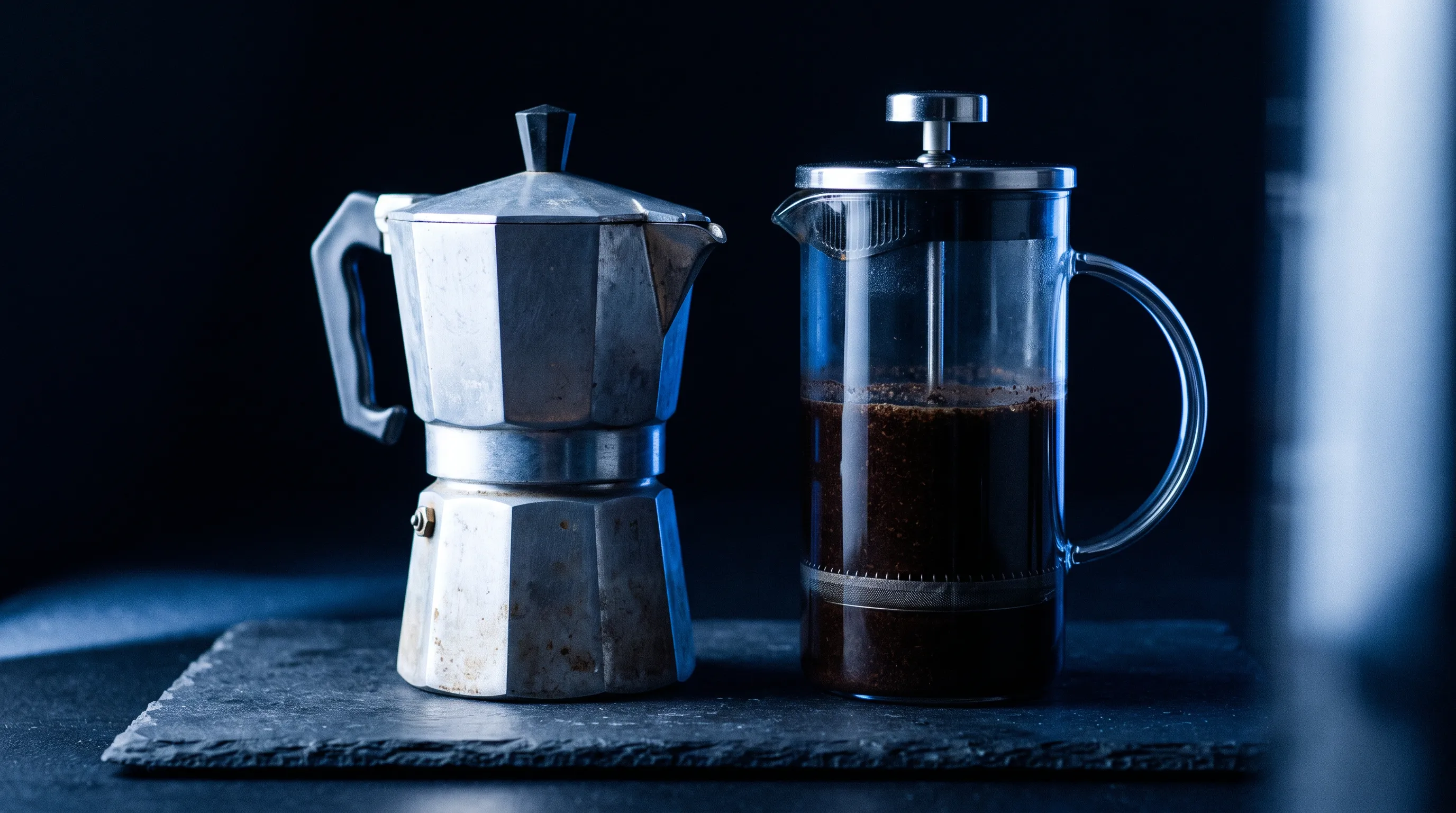
Moka pot and French press produce fundamentally different drinks. The Bialetti Moka Express ($48.85) brews under 1–2 bar of pressure, producing a concentrated, espresso-adjacent cup at 6–7x extraction strength. The Bodum Chambord French Press ($29.95) steeps coarse grounds in hot water for 4 minutes and produces a full-bodied, oil-rich coffee at 1:15 dilution.
Choose moka if you want a small, concentrated cup to drink straight or add milk to — the mechanism suits anyone who prefers intensity over volume. Choose French press if you want a full mug, naturally rich with the oils and body that paper-filtered methods remove. The two methods are not interchangeable. They extract differently, present differently, and suit different moments in the day. The right choice depends entirely on the drinking experience you want, not the price difference between them.
We research and purchase every product we recommend. Some links on this page are affiliate links. If you buy through them, we earn a small commission at no extra cost to you. This doesn't affect our recommendations.
How Each Method Works
The mechanism difference is everything. A French press steeps coarsely ground coffee in water at 92–96°C for 4 minutes; the plunger pushes a mesh filter through the liquid to mechanically separate grounds from brew. No pressure is involved. The water-to-coffee ratio is approximately 1:15 (67g per litre of water). All oils, compounds, and fine particles that pass through the 150–200 micron mesh end up in the cup.
A moka pot works differently. Water in the sealed bottom chamber is heated on the stovetop. Steam pressure — typically 1 to 2 bar — forces water upward through a basket of medium-fine ground coffee, through a filter plate, and into the upper chamber. The resulting liquid is 40–60ml of concentrate, not a diluted cup. It is not espresso: a commercial espresso machine operates at 9 bar and uses substantially finer grounds. Moka pot coffee is closer to strong filter coffee with a thicker body, produced through steam pressure rather than true pump pressure.
The immediate practical implication: these two methods require different grind sizes, different water volumes, and produce different quantities of different-strength coffee. You cannot replace one with the other and get a similar result.
Side-by-Side Comparison
| Factor | Bialetti Moka Express 1-Cup | Bodum Chambord 500ml |
|---|---|---|
| Price (Amazon AU) | $48.85 | $29.95 |
| Mechanism | Steam pressure (1–2 bar) | Immersion + plunger |
| Output volume | ~40–50ml concentrate | ~450ml drinkable liquid |
| Grind size | Medium-fine (300–450 micron) | Coarse (800–1000 micron) |
| Brew time | 3–5 minutes on stovetop | 4 minutes steeping |
| Cafestol (LDL risk) | Lower (partial filter) | Higher (mesh only) |
| Heat source | Gas or electric (not induction) | No heat source needed |
| Cleaning | Hand-wash only, no detergent | Dishwasher-safe (disassembled) |
| Material | Aluminium + rubber gasket | Borosilicate glass + stainless |
| Amazon AU reviews | 4.5★ (7,891 reviews) | 4.6★ (21,916 reviews) |
The Products
The Bialetti Moka Express is the original stovetop moka pot, in continuous production since 1933. The octagonal aluminium body is not an aesthetic choice: the eight sides create turbulence in the water as it passes through the grounds, improving extraction evenness relative to a round carafe. The design has remained substantively unchanged for 93 years because it solves the pressure-brewing problem effectively with four parts: bottom chamber, grounds basket, filter plate, and upper carafe.
The 1-cup model produces 40–50ml of concentrated coffee — enough for one small strong drink. It is the right size if you make coffee for one person who wants intensity over volume. The 3-cup model (120–150ml) suits one person who wants a larger volume or two people sharing. Moka pot sizing is defined by espresso-cup volumes (approximately 50ml each), not by standard 250ml cup volumes, which confuses buyers who expect a "6-cup" moka pot to fill six mugs.
The rubber gasket between the two chambers requires attention. It seals under pressure, and over 12–18 months of daily use it softens and may allow steam to escape from the sides rather than through the grounds. Replacement gaskets cost approximately $5–8 and are available from Bialetti directly and on Amazon AU. Monitoring the gasket is the main maintenance task for moka pot ownership.
Check price on Amazon AU →Pros
- Produces concentrated coffee suited to drinking straight or with milk
- 93-year production history; spare parts and replacement gaskets widely available
- Lower cafestol retention than French press
- 4.5 stars across 7,891 Amazon AU reviews — reliable quality signal
Cons
- 1-cup model produces 40–50ml only — not suitable for multiple cups
- Cannot go in dishwasher; no detergent cleaning (strips aluminium seasoning)
- Not induction-compatible; standard model gas/electric only
- Gasket replacement required every 12–18 months with daily use
The Bodum Chambord is the default comparison point for moka pot users considering a switch to French press. At $29.95 it costs $19 less than the 1-cup Bialetti and produces ten times the volume. The core trade is obvious: the Chambord makes larger quantities of weaker coffee; the Bialetti makes small quantities of stronger concentrate.
The Chambord's stainless mesh filter (150–200 micron openings) retains more cafestol and kahweol than the moka pot's filter plate — this is relevant for regular drinkers with elevated LDL cholesterol. A 2012 systematic review by Urgert and Katan (Wageningen University) found regular unfiltered coffee consumption raises LDL by approximately 0.13 mmol/L per cup. At the 500ml size, each brew produces roughly two cups, which puts daily consumption in the range that may affect lipid profiles over months.
The 500ml Chambord is the correct size for one to two people. It brews at a 1:15 ratio (approximately 33g of coarse-ground coffee per 500ml water). Cleaning is easier than the moka pot: the filter disassembles into three components, all dishwasher-safe.
Check price on Amazon AU →Pros
- Produces 450ml of drinkable coffee versus moka's 40–50ml
- $19 cheaper than the 1-cup Bialetti
- 21,916 Amazon AU reviews at 4.6 stars — statistically strong quality signal
- Dishwasher-safe, fully disassembles for cleaning
Cons
- Higher cafestol retention — relevant for ≥3 cups daily + elevated LDL
- Glass breaks on impact or thermal shock
- No pressure mechanism — cannot produce espresso-style concentrate
- Coffee cools within 20 minutes in glass carafe
How to Choose Between Them
Cup size and strength
If you want a small, intense drink (30–50ml) that you drink straight or dilute with milk, moka pot is the mechanism for you. If you want a full mug (250ml+) of moderately strong coffee, French press is the mechanism. Trying to get mug-sized output from a moka pot means buying a 6-cup or 9-cup model — a different product at a higher price.
Rule: moka = intensity, French press = volumeStovetop dependency
The Bialetti Moka Express requires a stovetop — gas or electric, not induction. If you have an induction cooktop, you need the Bialetti Venus or Brikka, not the standard Moka Express. French press requires only hot water; a kettle or microwave is sufficient. For travel or offices without a stovetop, French press is the only option of the two.
Induction cooktop = avoid standard Moka ExpressCleaning tolerance
French press cleans in the dishwasher (disassembled). Moka pot requires hand-washing with warm water only — detergent strips the aluminium's protective oil layer that develops over use and affects flavour. If you tend to put everything in the dishwasher without thinking, buy the Chambord. The moka pot requires deliberate cleaning habits to maintain.
Dishwasher household → Chambord winsLDL and health context
Both methods brew unfiltered coffee. French press retains more cafestol and kahweol due to extended immersion. Moka pot's pressure brewing leaves more oil in the spent puck. If you drink three or more cups daily and have a history of elevated LDL cholesterol, paper-filtered pour over or drip coffee is the more prudent choice over either method — not a reason to choose moka over French press.
3+ cups daily + elevated LDL → paper filter insteadDecision Matrix
| Situation | Best Pick | Why |
|---|---|---|
| Want a small, intense drink to start the day | Bialetti Moka Express | 50ml concentrate at 6–7x strength; the mechanism is built for this |
| Want to fill a 250ml+ mug | Bodum Chambord 500ml | Produces 450ml of drinkable coffee; moka requires a 6-cup model to match this |
| Have an induction cooktop | Bodum Chambord 500ml | Standard Moka Express is gas/electric only; Chambord uses any heat source |
| Make coffee for 2–4 people simultaneously | Bodum Chambord 1L | French press scales easily; scaling moka requires a larger pot at a different price point |
| Want coffee similar to a flat white or latte | Bialetti Moka Express | Moka concentrate + steamed or frothed milk produces a milk-coffee close to café style |
| Prioritise dishwasher-safe cleaning | Bodum Chambord 500ml | Moka Express hand-wash only; no detergent |
| Making coffee in a hotel room or office | Bodum Chambord 500ml | No stovetop needed; any way to boil water works |
| Managing LDL cholesterol at ≥3 cups/day | Pour over instead | Both methods are unfiltered; paper filtration removes cafestol and kahweol entirely |
| Budget under $35 | Bodum Chambord 500ml | $29.95 vs $48.85; $19 cheaper for more volume |
Frequently Asked Questions
Is moka pot coffee stronger than French press?
Yes — moka pot produces a concentrated brew with roughly 3 to 5 times the strength of French press by volume. A standard 1-cup moka pot produces around 40–50ml of concentrate at 6–7x extraction strength, compared to French press which brews at a 1:15 ratio. However, moka pot runs at 1–2 bar, far below espresso machine pressure (9 bar), so it produces concentrated coffee, not true espresso.
Which is easier to clean — moka pot or French press?
French press wins on cleaning if you disassemble the filter properly. The Bodum Chambord filter separates into three parts that all rinse easily. The moka pot has more seams and a rubber gasket that accumulates coffee oils; it cannot go in the dishwasher and requires hand-washing with warm water only — no detergent, which strips the seasoning from the aluminium.
Does moka pot coffee have more caffeine than French press?
Per ml of finished brew, yes — moka pot coffee is significantly more concentrated. But per cup-of-coffee consumed, it depends how you drink it. If you add water to moka concentrate to make an americano, the caffeine content is similar. If you drink the 50ml concentrate straight, it contains roughly 100–150mg of caffeine — comparable to a double espresso.
Can you use the same coffee grind for both?
No. French press requires coarse grinding at 800–1000 microns. Moka pot requires a medium-fine grind at 300–450 microns — finer than drip coffee but coarser than espresso. Using French press grind in a moka pot produces weak, under-extracted coffee. Using moka pot grind in a French press clogs the filter, makes plunging difficult, and produces bitter, over-extracted coffee with excessive sediment.
Which is better for one or two people?
French press is more flexible. The Bodum Chambord 500ml produces 1–2 cups and scales up to 1L without extra equipment. Moka pots are sized in cups (1, 3, 6, 9) and must be filled to capacity or the brew ratio fails — under-filling a 6-cup produces weak, uneven extraction. For one or two people, a 1-cup or 3-cup moka pot is correct; you cannot use a 6-cup for a single serve.
Which retains less cafestol — moka pot or French press?
Moka pot retains significantly less cafestol than French press. Both brew unfiltered coffee, but moka pot's pressure forces water through the grounds more completely, leaving the heavier oils in the spent puck. French press immersion allows full oil extraction into the cup. If you're managing LDL cholesterol, moka pot is a better choice than French press — though paper-filtered pour over eliminates cafestol almost entirely.
Does the Bialetti Moka Express work on induction?
The standard Bialetti Moka Express does not work on induction — it's designed for gas and electric stovetops. Bialetti makes the Brikka and Venus models with induction-compatible stainless bases. The 1-cup Moka Express reviewed here is gas and electric only.
How long does each brew method take?
French press: 4 minutes of steeping plus 30 seconds pressing. Total: 4–5 minutes from pour to cup. Moka pot: 3–5 minutes on the stovetop depending on heat setting, plus pre-heating the water. Total: 5–7 minutes. Both are faster than drip coffee makers. The moka pot requires more attention during brewing — you must remove it from heat immediately when the gurgling sound changes pitch, or the last extract becomes bitter from over-boiling.
Related Guides
For a ranked comparison of the Bodum Kenya, Secura Stainless, and six other models, see our best French press Australia roundup. If temperature precision for pour-overs matters, the best electric kettle guide covers gooseneck options with 1°C increments. The Brew Gear section covers all equipment categories, and the mushroom coffee and adaptogens guides cover what to add to your brew.