Forest Super Foods Australian Grown Lion's Mane is the only lion's mane supplement grown in Australia on Amazon AU. At $89 for 120 capsules (30 servings, $2.97/day), it delivers freeze-dried whole fruiting body — the form containing hericenones, the bioactives studied for nerve growth factor support — without grain filler.
Mori et al. (2009, Phytotherapy Research, PMID 18844328) conducted a 16-week double-blind RCT in 30 adults aged 50–80 with mild cognitive impairment, dosing at 1g powdered Hericium erinaceus three times daily. Cognitive function improved significantly versus placebo; effects reversed at four-week follow-up. No RCT has tested this specific product. The evidence applies to fruiting-body Hericium erinaceus powder as a class.
The human evidence base is small — fewer than ten RCTs — and most trials target older adults with cognitive impairment. Healthy younger adults seeking cognitive enhancement lack direct trial support. In Australia, lion's mane is classified as a food supplement, not a therapeutic good, and carries no TGA-assessed efficacy claims.
Affiliate disclosure: This page contains affiliate links to Amazon AU (tag: thealchemist-22). If you purchase through these links, we may earn a commission at no extra cost to you. We have not been gifted products, paid by brands, or sponsored to write this review. We do not hold brand partnerships. Full disclosure policy.
Why the Australian lion's mane market is thin
If you search for lion's mane capsules on Amazon AU, you will find a short list dominated by Forest Super Foods and a handful of generic imports from China with no ratings, no disclosed capsule weight, and listings that appeared in mid-2026. This is not a gap that overseas brands haven't noticed — it is a reflection of what lion's mane fruiting bodies actually require to grow.
Hericium erinaceus fruiting bodies need cooler temperatures (12–18°C), high humidity, controlled CO₂ levels, and a substrate — typically hardwood — that differs from the grain-based systems used for most commercial mycelium production. These conditions require infrastructure investment that most supplement brands avoid by simply growing mycelium on grain instead.
The result is a split market: genuine fruiting-body products are rare and command a price premium; mycelium-on-grain products are cheap, widely available, and frequently sold using the same marketing language as their fruiting-body counterparts. In the Australian capsule market, that gap is especially visible.
Fruiting body vs mycelium: what you're actually buying
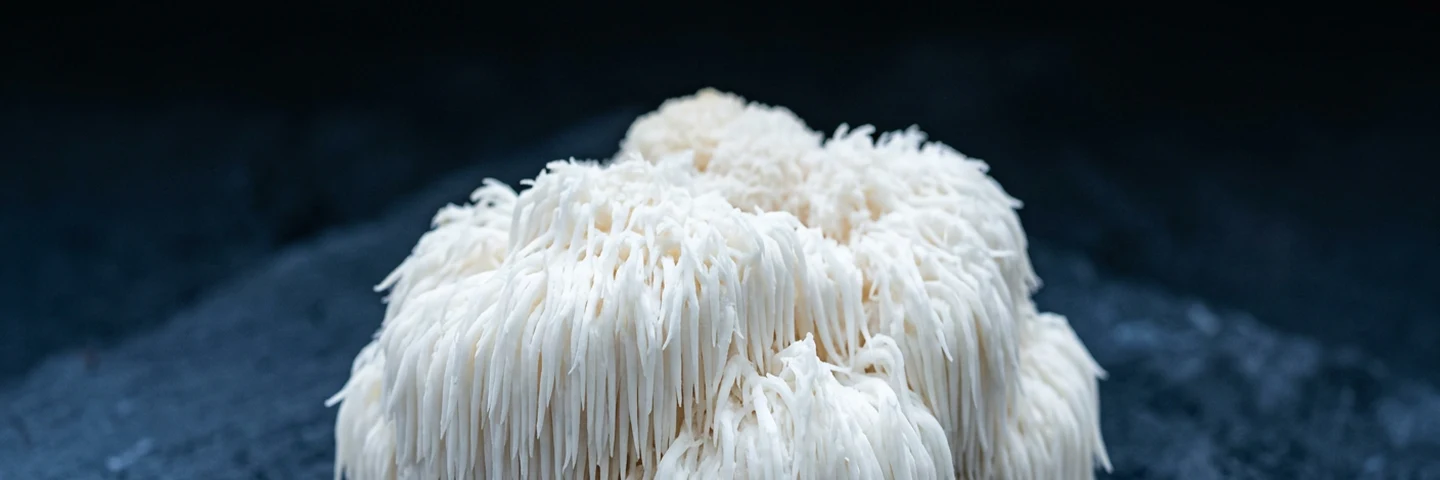
Lion's mane has two distinct parts with different bioactive profiles. The fruiting body — the visible white, icicle-textured mushroom — contains hericenones (a class of aromatic compounds). The mycelium — the root-like network — contains erinacines, a separate class of diterpenoids. Both groups have been shown in laboratory and animal studies to cross the blood-brain barrier and stimulate nerve growth factor (NGF) synthesis. Most human clinical trials have used fruiting body powder.
The problem with mycelium-on-grain products is substrate contamination. When mycelium is grown on grain (typically rice or oats) and then dried and ground, the resulting powder contains both mycelium and residual grain starch. The proportion of actual mushroom material in the final product varies and is rarely disclosed. A 2017 analysis of ten commercially available mycelium-on-grain products by Stamets and Chilton found that beta-glucan content — a key marker of mushroom material — ranged from 1% to 28%, compared to 25–60% in fruiting body products. Products with the lowest beta-glucan content were composed primarily of grain starch.
This does not mean mycelium products are inert — erinacines are still present in some quantity. But a product labelled "lion's mane" that is primarily grain starch is not delivering the dose of bioactives the clinical literature describes. Fruiting body products do not contain this substrate filler by definition.
What to look for on a label: "Fruiting body" or "whole mushroom" indicates the mushroom itself. "Mycelium," "myceliated grain," or "full spectrum" (when grain substrate is listed as an ingredient) indicates a mycelium-on-grain product. "Extract" can refer to either — check the source material.
What the evidence actually shows
The human research on lion's mane is small but consistent in direction. Six RCTs have been published as of July 2026; most involve older adults or specific clinical populations.
| Study | Population | Dose / Duration | Finding |
|---|---|---|---|
| Mori et al. (2009) PMID 18844328 |
n=30, ages 50–80, mild cognitive impairment | 1g fruiting body powder ×3/day, 16 weeks | Significant improvement in cognitive function scale vs placebo; reversed at 4-week follow-up |
| Nagano et al. (2010) PMID 20834180 |
n=30 menopausal women | 0.5g fruiting body ×4 cookies/day (2g total), 4 weeks | Reduced anxiety and irritation scores vs placebo |
| Saitsu et al. (2019) Biomed Res |
n=31, healthy adults aged 50+ | 3.2g fruiting body powder/day, 12 weeks | Improved Mini-Mental State Examination scores; no adverse effects |
| Mori et al. (2021) Sci Rep |
n=41, healthy adults aged 50–80 | 3.2g fruiting body/day, 16 weeks | Improved processing speed on Stroop task; reduced depression and anxiety scores |
The honest read: the direction of evidence favours lion's mane for cognitive support in adults over 50, particularly for mild impairment. Effects appear to require sustained use (8–16 weeks) and reverse after stopping. For healthy adults under 50 seeking nootropic enhancement, the evidence base is thin. The mechanism — stimulation of NGF via hericenones — is well-established in vitro; the human translation is plausible but not robustly demonstrated at lower doses.
Forest Super Foods: the product breakdown
Our Pick — Only Australian-Grown Option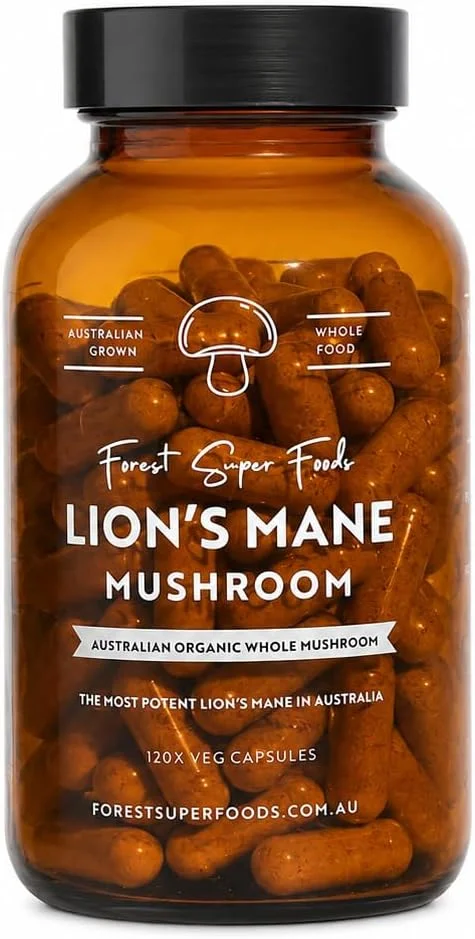
Forest Super Foods has been operating since 2012, initially out of a garage in Australia. Their lion's mane is grown domestically — country of origin listed as Australia on the Amazon AU product page — and processed via freeze-drying, which preserves bioactive content better than heat-drying by preventing oxidation of heat-sensitive compounds.
Format
Capsule
Freeze-dried whole fruiting body
Count / Servings
120 caps / 30 serves
4 capsules = 1 serving (1 day's dose)
Price per serve
$2.97
$89 ÷ 30 servings
Origin
Australia
Listed on Amazon AU product page
Certifications
Organic, Vegan
Non-GMO, gluten-free, dairy-free
Fillers / Grain
None listed
No grain substrate in ingredients
Mg per capsule not disclosed. The Amazon AU listing does not state the milligram weight per capsule. At 30 servings of 4 capsules per day, the daily dose in mg is not derivable from the listing alone. The clinical trials showing cognitive benefit used 1–3.2g of fruiting body powder daily. Whether 4 capsules of this product reaches that threshold is not confirmed by the manufacturer's label. This is a legitimate gap and the primary reason this product cannot be rated against a clinical dose standard.
Strengths
- Genuine Australian-grown fruiting body — not mycelium on grain
- Freeze-dried — better bioactive preservation than heat-dried
- #1 in Mushrooms Herbal Supplements on Amazon AU with 258 verified reviews (4.6★)
- Organic, vegan, no additives or fillers listed
- Established brand since 2012 — not a new-listing drop-shipper
Limitations
- Mg per capsule not disclosed — cannot verify alignment with clinical trial doses
- No certificate of analysis (CoA) publicly available for beta-glucan content
- $2.97/day is a premium over most imported alternatives
- Small brand — no third-party testing disclosure on the listing
How the AU market compares
The Amazon AU lion's mane category in July 2026 consists of Forest Super Foods and a group of generic Chinese-sourced imports that appeared in late 2025 and mid-2026, none of which have accumulated ratings. The comparison below reflects the real purchasing decision available to Australian buyers.
| Product | Origin | Form | Price | Serving cost | Reviews (AU) |
|---|---|---|---|---|---|
| Forest Super Foods Australian Grown Our Pick | Australia | Freeze-dried fruiting body | $89.00 | $2.97 | 4.6★ · 258 |
| Generic import (unbranded, China) | China | Not disclosed | ~$47–54 | Unknown | No ratings |
| International powder brands (e.g. Om Organic) | USA / overseas | Mycelium on grain | $55–80 | $1.50–2.00 | Limited AU stock |
The cheaper imports appear lower cost on sticker price, but serving cost is unknown (the capsule count is not disclosed on the listings we reviewed), and form is not disclosed (the listings do not specify fruiting body or mycelium). A lower sticker price with no disclosed form is not a better deal — it is a different product of unknown composition.
Who this is and isn't for
| Your situation | Recommendation | Why |
|---|---|---|
| Adult 50+ with self-reported brain fog or memory concerns | Yes — this is the evidence-supported use case | Mori et al. (2009) and Saitsu et al. (2019) both show benefit in this population at sustained dosing |
| Healthy adult under 40 seeking nootropic enhancement | Uncertain | No clinical trial has shown benefit in healthy younger adults specifically; mechanism is plausible but not demonstrated at this dose |
| Someone who has tried imported/mycelium products with no effect | Yes — switch to fruiting body first | May have been consuming primarily grain starch; fruiting body is a materially different product |
| Someone with a mushroom allergy | No | Hericium erinaceus can trigger allergic reactions including skin rash and respiratory symptoms in mushroom-sensitive individuals |
| Pregnant or breastfeeding | No | No safety data in pregnancy; avoid until further evidence |
| Looking for the cheapest lion's mane option on Amazon AU | No | $2.97/day is a premium. Cheaper options exist but their form and origin are not disclosed |
Dosing protocol
The most robustly cited clinical trial (Mori et al., 2009) used 1g of whole fruiting body powder three times daily with meals — 3g total per day — over 16 weeks. Saitsu et al. (2019) used 3.2g per day. Forest Super Foods recommends 4 capsules per day; the per-capsule weight is not disclosed, so the total daily dose in milligrams cannot be independently verified from the label.
If consistent with typical freeze-dried mushroom capsules (400–500mg per capsule), 4 capsules would deliver 1.6–2g per day — below the doses used in most positive RCTs. This is a reasonable starting dose and not a reason to reject the product; it is a reason to take the full 4-capsule daily serving and allow 12–16 weeks before assessing effect.
Timing: Take with food to reduce any gastrointestinal sensitivity. Splitting the dose (2 capsules morning, 2 evening) aligns with the three-times-daily protocol used in the Mori (2009) trial, though twice-daily is more practical.
Frequently asked questions
What is the best lion's mane supplement in Australia?
What is the difference between lion's mane fruiting body and mycelium?
Does lion's mane actually work?
What dose of lion's mane should I take?
Is lion's mane regulated by the TGA in Australia?
Can you buy fresh lion's mane mushrooms in Australia?
Are there any side effects of lion's mane?
Why is there so little lion's mane available in Australia?
Related reading
If you're building an adaptogen stack, see our best ashwagandha Australia guide — KSM-66 vs Sensoril compared on clinical dose and AU availability. For mushroom coffee that combines lion's mane with coffee, see best mushroom coffee Australia. For the wider adaptogen category, the adaptogens hub has our full coverage.