
Blackmores Ashwagandha+ Review: Does the Popular AU Brand Deliver?
Blackmores Ashwagandha+ is a solid entry-level ashwagandha option for Australians. It's TGA-listed, widely available at pharmacies and online, and costs just $0.25 per tablet. The honest caveat: Blackmores doesn't disclose the extract type (KSM-66, Sensoril, or standard root powder) or withanolide percentage on Australian packaging. That makes it impossible to confirm the dose matches what clinical trials studied.
The research is clear on what works. Chandrasekhar et al. (2012, Indian Journal of Psychological Medicine) found 300mg KSM-66 ashwagandha extract twice daily for 60 days reduced cortisol by 28% and anxiety by 44% in 64 adults under chronic stress. Wankhede et al. (2015, J Int Soc Sports Nutr) found testosterone and recovery improvements in 57 men. Pratte et al. (2014, Journal of Alternative and Complementary Medicine) found meaningful GAD-7 anxiety reductions in 98 participants over 60 days.
Those results are tied to standardised extracts at known doses. Without Blackmores disclosing their extract, dose equivalence is unconfirmed.
- TGA-listed, $0.25/tablet, available at Chemist Warehouse and Amazon AU
- Extract type and withanolide % are not disclosed on Australian packaging
- Clinical evidence supports ashwagandha for stress and cortisol, but is tied to specified extracts (KSM-66 at 300-600mg/day)
- Chandrasekhar et al. (2012) found KSM-66 reduced cortisol by 28% over 60 days
- Best suited to budget-conscious buyers comfortable with label opacity; not the best-specified option in Australia
Disclosure: Some links on this page are affiliate links. If you buy through them, we earn a small commission at no extra cost to you. This has no effect on our assessment. We do not accept payment for reviews or positive coverage.
Research status: This review is based on published clinical research, publicly available product information, and label analysis. We have not independently laboratory-tested this product. Claims about dose and extract form reflect publicly available Blackmores documentation as of July 2026.
What Blackmores Claims vs What the Evidence Says
Blackmores markets Ashwagandha+ as supporting stress relief and adaptogen benefits, backed by their standing as Australia's most trusted supplement brand. It carries a TGA listing (AUST L number), meaning it meets Australian quality and safety standards. The gap is in the detail: the published evidence for ashwagandha is extract-specific, and Blackmores doesn't share which extract they use.
Blackmores Claims
- Label Supports stress relief and relaxation
- Label Adaptogen — helps the body adapt to stress
- Label TGA-listed supplement
- Label Contains ashwagandha root extract
Published Evidence
- RCT Cortisol reduced 28%, anxiety reduced 44% — KSM-66, 300mg x2 daily, 60 days (Chandrasekhar et al., 2012)
- RCT Testosterone and recovery improvement in men — KSM-66, 8 weeks, n=57 (Wankhede et al., 2015)
- RCT GAD-7 anxiety score reduction — 300mg/day, 60 days, n=98 (Pratte et al., 2014)
- Gap Evidence is attached to specific extracts at known doses — Blackmores does not disclose extract type or withanolide %
Chandrasekhar K et al. (2012, Indian Journal of Psychological Medicine) conducted a randomised controlled trial in 64 adults under chronic stress. Participants receiving 300mg KSM-66 ashwagandha root extract twice daily for 60 days showed a 28% reduction in serum cortisol and a 44% reduction in self-reported anxiety versus placebo, with no significant adverse events.
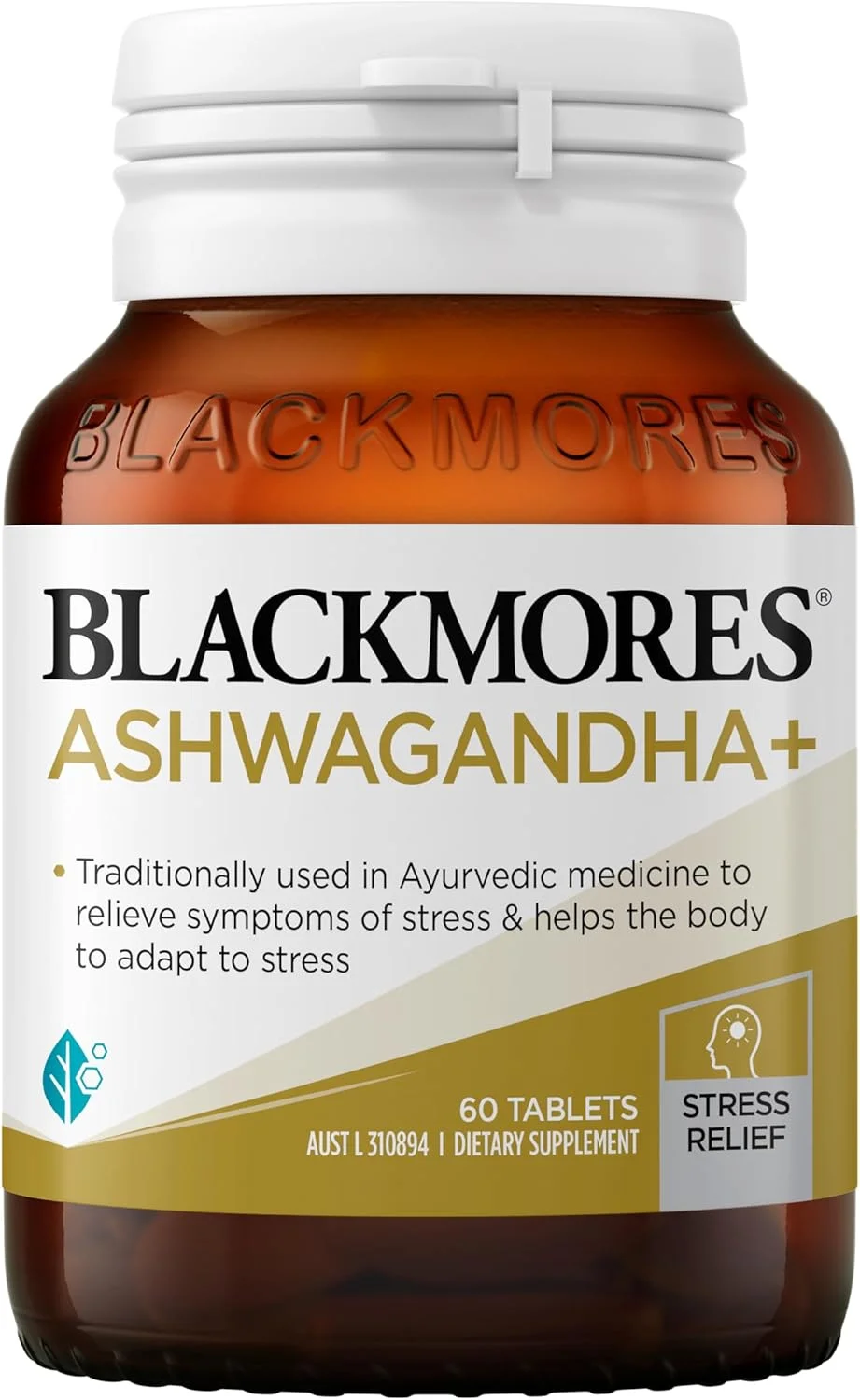
Blackmores Ashwagandha+ comes in a 60-tablet pack at $15.00 AUD, which works out to $0.25 per tablet. At one to two tablets daily, a pack lasts 30-60 days. It's sold at Chemist Warehouse, Priceline, Woolworths, and Amazon AU. The tablet form is convenient, though powder-based capsules may offer marginally faster absorption for some people.
Pros
- $0.25 per tablet — very affordable
- TGA-listed — meets AU quality standards
- Widely available — pharmacies, supermarkets, Amazon AU
- Reputable Australian brand, strong quality manufacturing history
- Easy-to-swallow tablet format
Cons
- No extract type disclosed (KSM-66, Sensoril, or root powder?)
- No withanolide percentage stated on AU packaging
- Tablet form absorbs slightly slower than loose powder capsules
- Cannot benchmark against clinical trial doses
- Better-specified alternatives exist at similar price per serve
Why Does the Extract Type Actually Matter?
The extract type is what connects a supplement to the clinical evidence. Ashwagandha's active compounds are withanolides, steroidal lactones measured as a percentage of the dried extract. Not all ashwagandha products contain the same withanolide concentration — and the difference between a standardised extract and whole root powder is substantial.
KSM-66: The Most Researched Extract
KSM-66 is a patented, full-spectrum ashwagandha root extract standardised to a minimum of 5% withanolides. It has more published human clinical trials than any other ashwagandha extract form. The Chandrasekhar et al. (2012) and Wankhede et al. (2015) studies both used KSM-66 specifically. A 300mg KSM-66 tablet contains at least 15mg of withanolides per dose.
Sensoril: The Alternative Standardised Extract
Sensoril is a full-spectrum root and leaf extract standardised to a higher withanolide content, typically 10% or more, but used at a lower dose — usually 125-250mg per capsule. It has good clinical backing for stress and sleep outcomes. At the right dose, it's broadly comparable to KSM-66, though the research base is smaller. Products using Sensoril will say so on the label.
Whole Root Powder: The Lowest Specification
Unstandardised whole root ashwagandha powder naturally contains approximately 0.1-1% withanolides. A product claiming "10,000mg herbal equivalent" may deliver far fewer withanolides than 300mg of KSM-66. Without standardisation and disclosure, the therapeutic dose is unreliable. This is the central risk with any ashwagandha product that doesn't state an extract form and withanolide percentage.
Blackmores Ashwagandha+ lists "ashwagandha root extract" on Australian packaging without specifying KSM-66, Sensoril, or any withanolide percentage. It's possible the product contains a quality extract. But the absence of disclosure means the buyer cannot verify this independently.
Whole-root ashwagandha powder without standardisation contains approximately 0.1-1% withanolides, compared to a minimum of 5% withanolides in KSM-66 standardised extract. At 300mg of KSM-66, a buyer receives at least 15mg of withanolides per dose — potentially 5-50x more than an equivalent weight of unstandardised root powder (Pratte MA et al., 2014, Journal of Alternative and Complementary Medicine).
| Extract Form | Withanolide % | Typical Dose | Clinical Trials | Label Disclosure |
|---|---|---|---|---|
| KSM-66 | ≥5% | 300-600mg/day | Extensive (multiple RCTs) | Always stated if used |
| Sensoril | ≥10% | 125-250mg/day | Good (stress, sleep) | Always stated if used |
| Standardised extract (unbranded) | Varies, stated | Varies | Moderate | Usually stated |
| Whole root powder | 0.1-1% | High equiv. needed | Minimal direct evidence | Often not disclosed |
| Blackmores Ashwagandha+ | Not disclosed | Not disclosed | Unknown (no label info) | Extract type not stated |
Dosing and Cost Analysis: Does Blackmores Stack Up?
The research consensus for ashwagandha stress and cortisol outcomes sits at 300-600mg of standardised extract per day. Chandrasekhar et al. (2012) used 300mg KSM-66 twice daily. Pratte et al. (2014) used 300mg daily for their anxiety outcomes. These are doses of a standardised extract, not whole root powder. What Blackmores provides per tablet is not publicly disclosed in milligrams of standardised extract.
Cost Per Clinical Serve
At $0.25 per tablet, Blackmores is among the cheapest ashwagandha options in Australia. If one tablet daily is the intended dose, a 60-tablet pack costs $15.00 for a 60-day supply — that's $0.25 per day. If two tablets are needed to approach the 600mg/day clinical range (assuming dose parity with KSM-66), the cost doubles to $0.50 per day and a pack lasts 30 days.
For comparison, clearly-specified KSM-66 products on Amazon AU offering 300mg per capsule typically cost $0.40-0.65 per capsule. At $0.50-0.65 per clinical serve, the price gap between Blackmores and a better-disclosed alternative is small — roughly $9-12 per 30-day supply at equivalent dosing frequency.
The Value Proposition
Blackmores' price advantage is real, but it assumes the dose is adequate. If the extract is whole root powder, you may need considerably more per day to reach clinically relevant withanolide levels. An underdosed cheap product delivers worse value than a correctly-dosed slightly-expensive one. This is the core value-versus-transparency tension with Blackmores Ashwagandha+.
Wankhede S et al. (2015, Journal of the International Society of Sports Nutrition) supplemented 57 male subjects with 300mg KSM-66 ashwagandha extract twice daily (600mg total) for 8 weeks. The treatment group showed statistically significant improvements in muscle strength, testosterone levels, and exercise-induced muscle recovery versus placebo. The trial used KSM-66 specifically, standardised to a minimum 5% withanolide content.
Who Is Blackmores Ashwagandha+ Best For?
Despite the transparency limitations, Blackmores Ashwagandha+ has a genuine use case for a specific type of buyer. Brand trust and pharmacy accessibility matter. For many Australians, buying from Blackmores at a pharmacy offers reassurance that an offshore capsule brand on Amazon cannot easily match.
It's a reasonable choice if: you're new to adaptogens and want a low-cost, low-risk entry point; you prefer buying from a TGA-listed Australian brand over an imported product; you don't want to wait for an online order; or you're comfortable with some label opacity in exchange for lower price and local availability.
It's not the best choice if: you want to match the exact doses used in clinical trials; you're treating a specific goal like cortisol reduction and want evidence-backed assurance; or you've tried Blackmores without noticeable results and are wondering whether a better-specified extract would change the outcome.
The brand trust factor is legitimate. Blackmores has been manufacturing listed medicines in Australia for decades. Their manufacturing standards are generally considered high within the TGA framework. The problem is specifically the label — not the company's overall credibility as a supplement brand.
Honest Assessment: What We'd Change
Blackmores is Australia's most recognised supplement brand. That recognition comes with responsibility. When the clinical evidence for a compound is tied to specific extract forms at specific doses, a quality brand should make it easy for buyers to verify their product matches that evidence. Blackmores doesn't do this with their ashwagandha line.
The irony is that Blackmores' silence on extract type may actually hurt sales to informed buyers. If they're using KSM-66 — which some overseas markets suggest they may be — stating that on the Australian label would be a competitive advantage. The absence of that disclosure creates doubt where there may be none warranted. Transparency costs nothing; its absence costs consumer confidence.
The Tablet Format
Tablets and capsules absorb somewhat differently. Tablets contain excipients (binders, fillers) that can slow dissolution. For most people this makes little practical difference, but capsule-based ashwagandha with no fillers does offer marginally faster gastric release. It's not a disqualifying concern, but worth noting if you're comparing formats side by side.
Better-Specified Alternatives at Similar Price
At $0.40-0.65 per serve, clearly-disclosed KSM-66 products are available on Amazon AU. For 30 days at one serve per day, the premium over Blackmores is roughly $4.50-$12.00. That gap is small enough that the transparency difference arguably justifies the switch for anyone who wants to know what they're taking. See our full guide to the best ashwagandha supplements in Australia for current options.
Frequently Asked Questions
Is Blackmores ashwagandha good?
Yes, with caveats. Blackmores Ashwagandha+ is a solid entry-level option for Australians. It's TGA-listed, affordable at $0.25 per tablet, and available at pharmacies across Australia. The limitation is transparency: Blackmores doesn't disclose the extract type or withanolide percentage on Australian packaging. This makes it impossible to confirm the dose matches clinical trial findings. It's a reasonable budget choice but not the best-specified ashwagandha available in Australia.
What dose is in Blackmores Ashwagandha+?
Blackmores does not publicly disclose the milligram dose of standardised extract per tablet on Australian packaging or their public website. The label lists ashwagandha root extract without specifying the concentration ratio, withanolide percentage, or branded extract form. Without this information, it's not possible to confirm whether one or two tablets match the 300-600mg/day doses used in clinical trials.
Is Blackmores Ashwagandha+ KSM-66?
Blackmores does not state on Australian packaging whether their extract is KSM-66, Sensoril, or an unbranded extract. Products using KSM-66 or Sensoril typically disclose this prominently, as it's a recognised selling point. The absence of any extract type disclosure on the Australian label is the central transparency concern with this product. Some international Blackmores formulations do specify extract forms, but this review applies to the AU market product as available in July 2026.
Does Blackmores ashwagandha work for stress?
Ashwagandha as a compound has strong clinical evidence for stress. Chandrasekhar et al. (2012) found 300mg KSM-66 extract twice daily for 60 days reduced cortisol by 28% and self-reported anxiety by 44% in 64 adults versus placebo. Whether Blackmores Ashwagandha+ replicates this depends on the extract type and dose, which Blackmores doesn't disclose. The ingredient works; whether this specific product delivers the effective dose is unknown.
Can I take Blackmores Ashwagandha+ daily?
Yes. Clinical trials have found standardised ashwagandha extract safe at 300-600mg per day for up to 60-90 days. Ashwagandha is a nightshade — people with nightshade sensitivities should avoid it. Isolated case reports of hepatotoxicity exist but causality is not established. People with thyroid conditions, autoimmune disorders, or who are pregnant or breastfeeding should consult a healthcare provider before use. Follow the manufacturer's recommended dose on the label.
Is Blackmores Ashwagandha+ TGA approved?
Yes. Blackmores Ashwagandha+ is listed on the Australian Register of Therapeutic Goods (ARTG) as a listed medicine. TGA listing means the product meets Australian quality and safety standards — it doesn't mean the TGA verified the efficacy claims. Listed medicines carry an AUST L number and are assessed for safety and quality, not therapeutic effectiveness. This is the standard listing for most Australian supplement products.
How long does Blackmores Ashwagandha+ take to work?
Based on published clinical trials, expect 4-8 weeks of consistent daily use before assessing results. Chandrasekhar et al. (2012) measured outcomes after 60 days. Wankhede et al. (2015) saw significant differences at 8 weeks. Single-dose or week-one effects are not supported by the published evidence. If you're not noticing any difference by week 8, the dose may be insufficient — consider switching to a product with a clearly disclosed and clinically-aligned extract dose.
Is there a better ashwagandha supplement in Australia?
Yes. Products that disclose KSM-66 at 300mg per capsule with a minimum 5% withanolide standardisation are directly benchmarkable against clinical evidence and available on Amazon AU at comparable or slightly higher prices per serve. The price premium over Blackmores is typically $4-12 per 30-day supply — a small cost for significantly better label transparency. See our full guide to the best ashwagandha supplements in Australia for a current comparison of AU-available products.
How We Evaluate Adaptogen Supplements
Every adaptogen review on The Alchemist. follows the same framework. We start with the published clinical evidence for the compound itself — who was studied, what extract was used, at what dose, and for how long. We then compare that evidence profile against what the product's label actually discloses.
Our four evaluation criteria are: extract form and standardisation disclosure; dose alignment with clinical trial parameters; TGA listing or equivalent regulatory status; and cost per clinical serve. A product that scores well on price but fails on transparency receives a lower overall assessment. We do not accept payment for reviews or give higher ratings in exchange for affiliate commission rates.
For this review, Blackmores Ashwagandha+ scores well on price, regulatory status, and brand credibility. It scores poorly on extract disclosure and dose verification. That's the honest summary. The product may be perfectly adequate — we simply can't confirm it from the available label information.