Quick answer
Grass-fed beef tallow is an effective occlusive-emollient moisturiser for dry and sensitive skin. Its fatty acid composition — approximately 44% oleic acid, 26% palmitic acid, and 14% stearic acid — is broadly compatible with the lipid matrix of the human stratum corneum. This compatibility allows tallow to reduce transepidermal water loss without a heavy, greasy residue.
In Australia, one product meets both the rendering quality and ingredient transparency bar: RICHGRAND Grass-Fed Beef Tallow Balm (60ml), available on Amazon AU. Rendered to a nearly odourless finish — the single most reliable quality indicator for any tallow moisturiser — with a single-ingredient list (beef tallow only) and verified Australian grass-fed sourcing.
This article addresses tallow as a moisturiser category — how it compares to conventional emollients and what to look for when buying in Australia. If you have already decided on the balm format specifically and want a sourcing-focused product comparison, see the companion tallow balm review.
This article contains affiliate links. We earn a commission if you purchase through our links, at no extra cost to you. Our rankings are never influenced by commissions. Full disclosure →
How tallow moisturises skin
Beef tallow is rendered fat — predominantly from the suet region around the kidneys — that has been purified by slow heating to remove water, proteins, and connective tissue. The result is a stable, long-chain saturated and monounsaturated fat with a fatty acid profile that bears closer resemblance to human sebum than most plant-derived oils.
Tallow functions as both an occlusive and an emollient. As an occlusive, it forms a semi-permeable lipid film on the skin surface that slows transepidermal water loss (TEWL). Unlike petrolatum (which is entirely occlusive and sits on top of the skin), tallow's shorter-chain saturated fats are small enough to penetrate the outer layers of the stratum corneum. This makes it feel more absorbent while still providing meaningful barrier support.
The emollient function comes from oleic acid (the primary monounsaturated fatty acid, ~44% of tallow). Oleic acid intercalates into the lamellar bodies of the stratum corneum — the same lipid structures that maintain skin barrier function. This is the same mechanism behind the skin benefits attributed to olive oil and avocado oil, which are also oleic acid-dominant. The distinction is that tallow also contributes palmitic acid (~26%) and stearic acid (~14%), which are saturated fats that mirror those found in the skin's own ceramide structures.
The case for tallow is structural, not brand marketing. Its fatty acid profile simply matches what the skin already uses to maintain its barrier. Whether that translates to a meaningful clinical outcome over a well-formulated commercial moisturiser is a different — and not well-studied — question.
Grass-fed tallow differs from grain-fed in two practically significant ways: higher conjugated linoleic acid (CLA) content — approximately 2–3 times more in grass-fed animals — and greater fat-soluble vitamin density (A, D, E, and K2). CLA has demonstrated anti-inflammatory properties in laboratory settings, though topical evidence specifically is limited. The vitamin K2 content of grass-fed tallow is particularly notable given its absence from most plant oils.
What to look for in a tallow moisturiser
Not all tallow products are equivalent. The quality of the final product is determined almost entirely at the rendering stage. Here are the criteria that matter:
Rendering quality
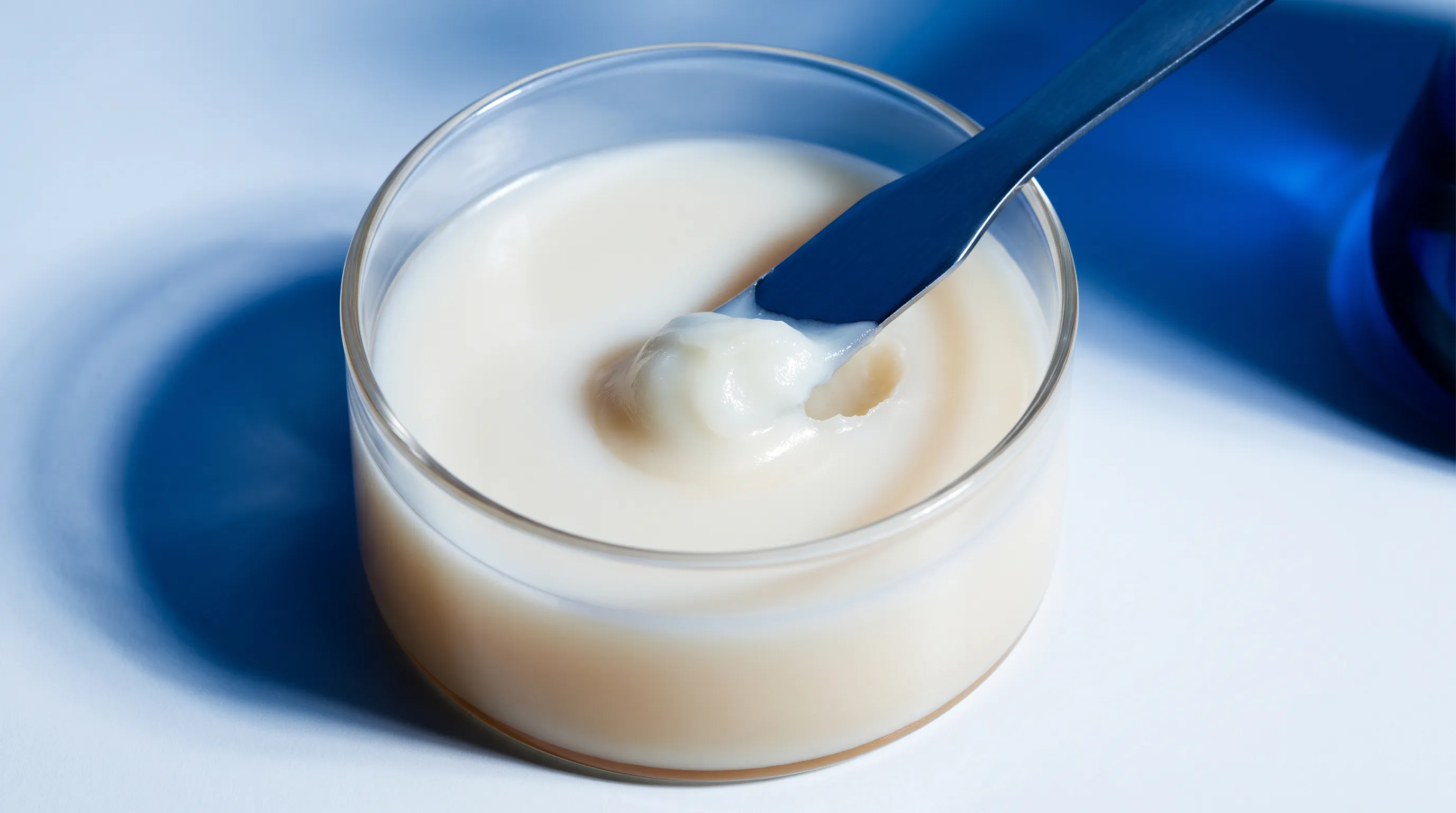
Under-rendered tallow contains residual proteins and water. These oxidise, producing the characteristic "beef" smell and reducing shelf life. Well-rendered tallow is off-white to ivory, has a smooth texture, and is nearly odourless.
Signal: smells neutral, not meatyGrass-fed sourcing
Grass-fed cattle produce fat with higher CLA, vitamin K2, and beta-carotene. For AU products, local grass-fed sourcing also means lower transport time and fresher fat — relevant for a product without synthetic preservatives.
Signal: "AU grass-fed" on labelIngredient list length
The best tallow moisturisers have one ingredient: tallow. Products that add cheap seed oils (canola, sunflower) dilute the fatty acid profile and introduce inflammatory linoleic acid at high concentrations. Beeswax is acceptable as a texture modifier.
Signal: ≤3 ingredientsContainer type
Tallow is a solid at room temperature and a semi-solid in warm Australian conditions. Glass jars are preferred over plastic — saturated fats are less reactive than polyunsaturated oils but long-term plastic exposure is unnecessary.
Signal: glass or dark containerOur pick
#1 — Best tallow moisturiser AustraliaRICHGRAND Grass-Fed Beef Tallow Balm 60ml Our pick
Skip if: you have acne-prone or oily skin (oleic acid content may aggravate congestion), or if you have a beef allergy or sensitivity.
RICHGRAND sources its beef tallow from Australian grass-fed cattle and renders it to a smooth, pale ivory consistency. The product has no added fragrance, no seed oil fillers, and a single-ingredient label. These are not minor aesthetic preferences — they are the three structural requirements for a tallow moisturiser worth using.
Rendering quality is evident in the scent profile: properly rendered tallow smells of nothing, or very faintly of lanolin. Products that smell strongly of beef fat are under-rendered — the protein residue is oxidising. RICHGRAND's product falls into the former category.
At 60ml, the jar provides approximately 60–80 applications used as a face moisturiser (a pea-sized amount is sufficient for the full face and neck). This puts the per-application cost well below most commercial moisturisers, particularly when comparing against products positioned in the "clean beauty" segment.
Available on Amazon AU · Affiliate link · Price may vary
What works
- AU grass-fed sourcing, short supply chain
- Single ingredient — no seed oil dilution
- Clean rendering — minimal scent
- No synthetic preservatives or emulsifiers
- Absorbent texture, not heavy
Limitations
- Not suitable for oily or acne-prone skin
- 60ml jar is small for body use
- No CoA available for fatty acid content
- Melts in hot Australian conditions — store cool
Who should avoid tallow moisturiser
Tallow is not universally appropriate. Three groups should avoid it or proceed with care:
Acne-prone and oily skin: Tallow's high oleic acid content (~44%) is considered comedogenic for skin types that are already producing excess sebum. Oleic acid can disrupt the skin barrier's linoleic-oleic acid balance, potentially worsening congestion. If you typically react to oleic-heavy oils like olive or avocado, do not apply tallow to the face.
Fungal acne (Malassezia): Malassezia yeast — which drives fungal acne — feeds on saturated and monounsaturated fats. Tallow provides both. Anyone with confirmed or suspected fungal acne should avoid tallow and most other oils.
Seborrheic dermatitis: Similar mechanism to fungal acne. Oil-rich occlusives, including tallow, can exacerbate seborrheic dermatitis conditions. Consult a dermatologist before changing your barrier routine if this is relevant to you.
For dry, normal, and combination skin types — particularly those sensitive to synthetic preservatives, emulsifiers, or fragrance in conventional moisturisers — tallow is a well-tolerated option with a long history of use.
What the evidence says
What brands claim
"Tallow matches your skin's natural composition and is therefore superior to any synthetic moisturiser."
Brand specs · Marketing copy"Grass-fed tallow heals eczema, psoriasis, and skin conditions."
Brand specs · Social mediaWhat the evidence shows
The fatty acid similarity to human sebum is structurally accurate. Whether this translates to clinically superior outcomes vs a well-formulated ceramide moisturiser is not established — no comparative RCTs exist.
Published research · Peer-reviewed analysisNo clinical trials support tallow as a treatment for eczema or psoriasis. It may help with dry skin symptoms via its occlusive mechanism, but treatment claims are unsubstantiated.
Published research · Verified AU listingTallow is a legitimate moisturiser with a rational mechanistic basis. The marketing overstates the clinical evidence, as it does for most "ancestral" or "traditional" wellness products. The honest position: it is an effective, minimal-ingredient emollient that works well for dry and sensitive skin, particularly for those reacting to synthetic ingredients in conventional products. It is not a treatment for skin conditions.
Frequently asked questions
Is beef tallow a good moisturiser?
Yes. Beef tallow is an effective occlusive-emollient moisturiser. Its fatty acid profile — oleic ~44%, palmitic ~26%, stearic ~14% — is compatible with human skin lipids, enabling absorption without a heavy residue. Well-rendered, grass-fed tallow is nearly odourless and has a long track record of use as a skin-care ingredient. It is most effective for dry and sensitive skin; oily and acne-prone skin types may find it comedogenic.
What should I look for in a tallow moisturiser?
Three things: rendering quality (odourless, pale ivory, smooth — not meaty-smelling), grass-fed AU sourcing, and a short ingredient list. Products that add canola or sunflower oil are diluting the tallow and adding high linoleic acid concentrations that can irritate some skin types. Beeswax additions are acceptable for firmer texture. Avoid anything with synthetic fragrance, which negates the benefit of using a minimal-ingredient product in the first place.
Is grass-fed tallow better than regular tallow for skin?
Modestly. Grass-fed tallow contains approximately 2–3 times more conjugated linoleic acid (CLA) than grain-fed, along with higher fat-soluble vitamin content (A, D, E, K2). CLA has demonstrated anti-inflammatory properties in laboratory settings, though topical evidence for skin specifically is limited. The more practically significant advantage is quality consistency — well-managed grass-fed operations tend to produce cleaner, better-rendered fat. Australian grass-fed sourcing also means a fresher product with shorter transport.
Can I use tallow on my face?
Most skin types can, with the exception of oily and acne-prone skin. Tallow's oleic acid content (~44%) is moderately comedogenic for skin that is already overproducing sebum. Start with a patch test on the jawline for 1–2 weeks before applying to the full face. People with fungal acne or seborrheic dermatitis should avoid tallow, as Malassezia yeast feeds on the fatty acids it contains.
How does tallow compare to shea butter or coconut oil?
Tallow sits between shea and coconut oil in comedogenic potential. Shea butter is the most widely suitable — high in oleic and stearic acids, with non-comedogenic triterpenes, and appropriate for most skin types including acne-prone. Coconut oil is highly comedogenic and not suitable for acne-prone or oily skin. Tallow is more absorbent than coconut oil and more skin-similar than shea, but not appropriate for all skin types. The "closest to human sebum" claim for tallow is structurally accurate but does not automatically make it the best choice for every individual.
What is the difference between tallow balm and tallow moisturiser?
The terms are used interchangeably in Australian retail. Both refer to rendered beef fat, sometimes with additions such as beeswax or essential oils. A "balm" is typically firmer and more concentrated; a "moisturiser" label often indicates a whipped or emulsified product with a lighter feel. For maximum skin barrier support, unwhipped, non-emulsified tallow is the most concentrated option. Emulsified versions feel lighter but deliver less occlusive protection per gram of product.
Is tallow suitable for eczema or dry skin conditions?
Tallow is used by some individuals with eczema as a conventional moisturiser alternative, primarily because its minimal ingredient list avoids the synthetic emulsifiers, preservatives, and fragrances that often trigger reactions in eczema-prone skin. There are no randomised trials evaluating tallow specifically for eczema management. It should be considered a complementary option — not a clinically validated treatment. Anyone with active eczema should discuss any changes to their skincare routine with a dermatologist.
How long does a 60ml tallow balm last?
Used as a daily face moisturiser, a 60ml jar typically lasts 6–10 weeks. A pea-sized amount is sufficient for face and neck. For body application, the jar depletes significantly faster. Shelf life is 1–2 years when stored in a cool, dark location — properly rendered tallow without added water requires no synthetic preservatives within this window. In warm Australian conditions, store in a cupboard away from direct sunlight to prevent partial melting and re-solidification, which can affect texture.