Vital Proteins Collagen Peptides (284g, Unflavoured) is the best-value collagen supplement available on Amazon AU, currently priced at $50.37. It provides hydrolysed bovine Type I and III collagen peptides — the form most studied for skin and joint outcomes. Hydrolysis breaks intact collagen into smaller peptide chains (typically 2–5 kDa) that can be absorbed through the intestinal wall, which whole-protein collagen cannot do efficiently.
The research base is real but specific. A 2014 randomised controlled trial by Proksch et al. (Skin Pharmacology and Physiology) found 2.5g hydrolysed collagen peptides daily for 8 weeks significantly improved skin elasticity in 69 women. The effective dose for skin outcomes is 2.5–10g daily; higher doses have been used in joint studies. At a standard 5g serve, the 284g tub provides approximately 57 serves — roughly two months of supplementation. The evidence supports collagen for skin and modestly for joint pain in athletes. It does not support it as a muscle-building protein.
We research and purchase every product we recommend. Some links on this page are affiliate links. If you buy through them, we earn a small commission at no extra cost to you. This doesn't affect our recommendations.
Quick Picks
| Product | Price | Type | Buy | |
|---|---|---|---|---|
| Vital Proteins Collagen Peptides 284g #1 Best Overall | $50.37 | Bovine Type I & III, hydrolysed | View on Amazon → | |
| Sports Research Collagen Peptides 454g | Check price | Bovine Type I & III, hydrolysed | View on Amazon → | |
| California Gold CollagenUP Marine + HA + Vit C 464g | Check price | Marine Type I + HA + Vit C | View on Amazon → | |
| Jarrow Formulas Type II Collagen 60 caps | Check price | Type II BioCell, chicken sternum | View on Amazon → | |
| NeoCell Super Collagen + C 270 tabs | Check price | Bovine Type I & III + Vit C + Biotin | View on Amazon → |
What Is Collagen and Why Does It Matter?
Collagen is the most abundant structural protein in the human body, accounting for roughly 30% of total protein content. It functions as the scaffolding that holds skin, tendons, ligaments, cartilage, and bones together. In skin specifically, Type I collagen fibres in the dermis provide the tensile strength and elasticity that keeps skin firm and resilient. When collagen degrades faster than it is replenished — through age, UV exposure, or dietary insufficiency — skin loses density and elasticity, and joints experience increased friction and wear.
There are at least 28 identified types of collagen in human tissue, but three dominate in the context of supplementation. Type I is the most abundant, found in skin, tendons, bones, and corneas, and is the primary target for skin-focused collagen products. Type II is the main structural protein of articular cartilage and is the relevant type for joint-specific applications. Type III co-localises with Type I in skin and blood vessels, particularly in younger tissue, and most bovine collagen supplements provide both Type I and III together.
The absorption problem is central to why collagen supplements exist in a specific form. Intact collagen molecules are triple-helix proteins of very high molecular weight — too large to be absorbed intact through the intestinal epithelium. Eating raw collagen-rich food provides amino acids, but not the bioactive collagen peptides that research has linked to fibroblast stimulation. Hydrolysis — either enzymatic or acid-based — cleaves the triple helix into smaller peptide chains, typically in the 2–5 kDa range, which can cross the intestinal wall and reach circulation. These peptides have been detected in serum following oral supplementation, which is the mechanistic basis for the biological plausibility of collagen supplementation.
Collagen production in the body declines measurably from the mid-twenties. The rate of decline accelerates through the thirties and forties, compounded by UV exposure, smoking, and dietary glycation from high-sugar diets. By age 40, most adults have lost 10–20% of dermal collagen density relative to their peak. By 60, losses can exceed 30%. This is the physiological backdrop against which collagen supplementation is proposed — not as a reversal of ageing, but as a means of partially compensating for a supply deficit.
What the Research Actually Shows
The evidence for collagen supplementation is real but specific. It supports skin elasticity and hydration outcomes at doses of 2.5–10g daily over 8+ weeks. The joint evidence is more modest and concentrated in athletes. The evidence for collagen as a muscle-builder is weak.
The most frequently cited trial in this category is Proksch et al. (2014), published in Skin Pharmacology and Physiology. The study was a randomised, double-blind, placebo-controlled trial of 69 women aged 35–55 who received either 2.5g of hydrolysed collagen peptides (as VERISOL, a bioavailable collagen peptide) or placebo daily for 8 weeks. The collagen group showed statistically significant improvements in skin elasticity compared to placebo at both the 4-week and 8-week assessments. The effect size was meaningful at 8 weeks, and a follow-up measurement 4 weeks after the supplementation ended showed partial but not complete retention of the improvement, suggesting ongoing supplementation is required to maintain the effect. This study is often cited because it is well-designed and used a dose (2.5g) below what most commercial products recommend, establishing a plausible minimum effective dose.
A 2019 systematic review by Choi et al. in the journal Nutrients analysed 11 randomised, controlled trials of oral collagen supplementation on skin outcomes, encompassing 805 patients. The review concluded that oral collagen supplementation was associated with significant improvements in skin hydration, elasticity, and reduction of wrinkles, with a good safety profile. The trials in the review used doses ranging from 2.5g to 10g daily. The authors noted that most studies were of short duration (less than 6 months) and had modest sample sizes, so long-term effects remain less well characterised. Importantly, most trials used branded collagen peptide preparations, not whole-food sources or gelatin, which points to hydrolysis as a necessary processing step for the outcomes observed.
For joint outcomes, Clark et al. (2008) conducted a 24-week, randomised, double-blind, placebo-controlled study in 147 athletes with activity-related joint pain. Participants received 10g of collagen hydrolysate daily or placebo. At 24 weeks, the collagen group showed significantly greater reductions in joint pain at rest and during activity compared to placebo, as well as reductions in pain when carrying objects and when standing. This is a well-cited study in the sports nutrition literature and represents the strongest evidence for the joint application of collagen supplementation, though it should be noted that 10g daily — double what many products recommend at a single serve — was used, and the population was specifically athletes experiencing activity-related joint pain, not people with arthritis or degenerative joint conditions.
What these studies share is a consistent mechanistic story: hydrolysed collagen peptides appear to accumulate in cartilage and skin tissue following supplementation, and can stimulate fibroblasts to increase synthesis of endogenous collagen. The research does not support the idea that collagen supplementation simply adds building blocks that the body directly incorporates — the mechanism is more likely signalling-based, where circulating peptides act as partial agonists for fibroblast activity. This is why the specific form (hydrolysed peptides, not gelatin or whole protein powder) matters.
How to Choose a Collagen Supplement
Hydrolysed peptides vs gelatin vs whole protein
Only hydrolysed collagen peptides have the absorption evidence behind them. Gelatin is partially hydrolysed and less bioavailable. Whole collagen sources (bone broth, connective tissue in food) provide relevant amino acids but not the specific bioactive peptide fractions studied in RCTs. Look for the words "hydrolysed" or "collagen peptides" on the label.
Required: "Hydrolysed" or "Collagen Peptides"Marine vs bovine collagen
Both are primarily Type I. Marine peptides are typically smaller (1–5 kDa) which theoretically improves absorption. Bovine collagen provides both Type I and III. Published research on skin outcomes has used both marine and bovine sources without establishing a clinically meaningful difference at equivalent doses. Choose bovine if you want Type III as well; marine if you prefer a non-bovine source.
Skin: either works. Joint cartilage: seek Type II specifically.Dose transparency
The product should clearly state the quantity of collagen peptides per serve — not just protein content. Some products pad with non-collagen protein or fillers. The minimum effective dose for skin outcomes from the published literature is 2.5g daily. Most products recommend 10–14g per serve. A product at 5g per serve is a cost-conscious approach that still sits within the evidence base.
Minimum dose: 2.5g/day for skin; 10g/day for joint painUnflavoured vs flavoured
Unflavoured powders are more versatile — they dissolve in coffee, water, or smoothies without affecting flavour. Flavoured options contain added sugars or sweeteners, which add cost and calories without affecting the collagen content. If your use case involves mixing into coffee or savoury broths, unflavoured is the correct choice. Flavoured collagen is rarely a better product; it is a more convenient one for specific uses.
Default: unflavoured. Flavour adds cost, not efficacy.What to look for on the label: the ingredient list should show hydrolysed collagen or collagen peptides as the primary ingredient. Avoid products that list collagen after several other ingredients — that indicates a small dose relative to other components. Check whether the product specifies the collagen type (Type I, II, or III) rather than just "collagen protein." Vitamin C is sometimes added to collagen supplements, which is not harmful and is mildly logical given that ascorbic acid is a required cofactor in endogenous collagen synthesis — though dietary vitamin C intake is usually sufficient to fulfil this role for most people.
Price per gram of collagen is a useful metric for comparing products. At $50.37 for 284g, Vital Proteins delivers approximately 18 cents per gram of collagen at the labelled 20 serves of 14g. If you use 5g serves, the cost per gram drops relative to the suggested-use cost. Compared to premium Australian brands selling 300g for $80–$100, Vital Proteins represents better value per gram for an equivalent hydrolysed bovine product.
Which Collagen Format Should You Choose?
Use this matrix to match your goal with the right format. All formats require consistent daily use — the differences are in bioavailability, dose convenience, and cost.
| Format | Bioavailability | Typical Dose | Best For | Watch Out For |
|---|---|---|---|---|
| Hydrolysed Peptides (powder) | High — broken into di/tripeptides for rapid absorption | 5–10 g/day dissolved in liquid | Skin, joints, general collagen support | Flavoured versions often contain added sugars or sweeteners |
| Gelatin | Moderate — requires digestive breakdown to peptides | 10–15 g/day in hot liquid only | Gut health, cooking use | Does not dissolve in cold liquid; harder to dose precisely |
| Marine Collagen | High — smaller peptide size than bovine | 2.5–5 g/day | Skin elasticity; pescatarians | Type I only; higher cost per gram; fishy aftertaste possible |
| Capsules / Tablets | Low volume — most caps deliver 1–3 g per serve | 4–6 capsules/day to reach 5 g | Convenience over efficacy | Expensive per gram; rarely reach researched doses without taking many caps |
What Collagen Won't Do
Expectation check: Collagen is not a muscle-builder and will not reverse established joint disease. These limits are worth understanding before spending $50 a month.
It is not a muscle-building protein. Collagen contains a poor amino acid profile for muscle protein synthesis. It is low in leucine and lacks adequate tryptophan, two amino acids that are rate-limiting for myofibrillar protein synthesis. Studies that have combined collagen supplementation with resistance exercise have shown modest improvements in lean mass in older adults with sarcopenia, but these effects are significantly smaller than those achieved with equivalent doses of whey or casein protein. If muscle building is the primary goal, a high-quality complete protein source with a full essential amino acid profile is more appropriate than collagen.
UV exposure degrades collagen faster than supplementation can keep up. UV radiation activates matrix metalloproteinases — enzymes that break down dermal collagen fibres — and is the primary environmental driver of photoageing. The first-principles approach to this is behavioural and dietary: avoid peak UV hours (10am–2pm AEST) when UVA intensity is highest, and support your skin's defences through dietary antioxidants. Astaxanthin (a carotenoid from krill and algae) has the strongest evidence, with multiple RCTs showing reduced UV-induced skin damage. Lycopene, beta-carotene, and EGCG from green tea also demonstrate measurable photoprotective activity. Collagen supplementation works best alongside this approach — supporting synthesis from the inside while dietary antioxidants defend against UV-driven breakdown.
It will not reverse severe or advanced joint damage. The Clark et al. (2008) study was conducted in healthy athletes with activity-related joint discomfort — not in individuals with diagnosed osteoarthritis or structural joint pathology. The mechanism by which collagen peptides may benefit healthy or mildly stressed cartilage does not extrapolate to reversing established cartilage loss. People managing osteoarthritis should not expect collagen supplementation to replace medical management. Modest adjunct benefit — particularly in joint comfort during activity — is plausible, but this is a different claim from structural regeneration.
Collagen supplementation takes time. The Proksch et al. study showed measurable changes at 4 weeks and more pronounced changes at 8 weeks. The Clark et al. joint study ran for 24 weeks. Collagen is not a fast-acting supplement in the way caffeine or creatine loading protocols are. If you are evaluating a collagen supplement against a benchmark of "something felt different this week," you are operating on a timeline too short to draw a meaningful conclusion.
Top 5 Collagen Supplements Australia 2026
Five products compared on Amazon AU, selected for hydrolysis quality, dose transparency, collagen type, and price. Rankings reflect researched criteria — none have been lab-tested directly by us.
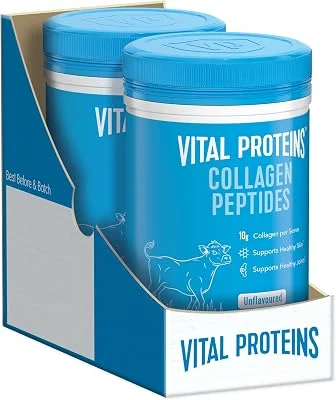
Vital Proteins Collagen Peptides 284g
What it claims:
Grass-fed, pasture-raised bovine Type I and III hydrolysed collagen, 11g protein per 14g serve, NSF certified, unflavoured and odourless.
What the evidence says:
Hydrolysed bovine Type I and III is the form used in Proksch 2014 and the broader skin evidence base. NSF certification independently verifiable. At 5g/day the tub provides ~57 serves (~$0.88/day).
scored
Vital Proteins is the benchmark in this category: single-ingredient hydrolysed bovine collagen with no fillers, no sweeteners, and no secondary ingredients that dilute the collagen dose. The 284g tub delivers Type I and III bovine collagen peptides from grass-fed, pasture-raised bovine hides, hydrolysed to a molecular weight appropriate for intestinal absorption. The label states 11g protein per 14g serve — reflecting actual collagen peptide content, not a blended figure.
At a 5g daily dose, cost is approximately $0.88/day and the tub lasts roughly two months. The unflavoured version dissolves in warm liquids — coffee, tea, water — with no detectable flavour or texture change, which reduces friction on a long-term daily supplementation habit. NSF International certification confirms label accuracy and contaminant absence, including for athletes subject to anti-doping testing.
Skip if: your primary target is joint cartilage. Type II collagen (chicken sternum) is mechanistically more appropriate for cartilage than the Type I and III in this product. See #4 Jarrow below.
Pros
- Single-ingredient — no fillers or sweeteners diluting the dose
- Hydrolysed bovine Type I and III — the most studied form for skin outcomes
- NSF Certified — independently tested for label accuracy
- Unflavoured — mixes invisibly into coffee or water
- ~$0.88/day at 5g dose — competitive on the AU market
Cons
- At the labelled 14g serve, tub lasts only ~20 days
- Bovine source — not suitable for those avoiding beef
- No Type II collagen — not the right choice for cartilage-specific use
- No Vitamin C included
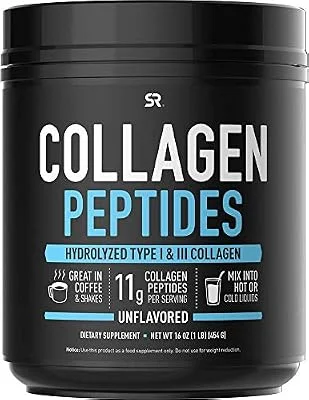
Sports Research Collagen Peptides 454g
What it claims:
11g hydrolysed collagen peptides per serve from pasture-raised, grass-fed bovine. No additives, no artificial ingredients. Certified Paleo-friendly and Whole30 approved.
What the evidence says:
Sports Research uses the same hydrolysed bovine Type I and III form studied in skin RCTs. The 454g tub is more economical for sustained long-term use. Paleo/Whole30 certifications confirm no added sugars or artificial additives.
scored
Sports Research Collagen Peptides is the larger-volume alternative to Vital Proteins, delivering the same hydrolysed bovine Type I and III collagen peptides in a 454g tub. The formula is identical in collagen type and hydrolysis method. For users who have committed to daily collagen supplementation and want to reduce per-gram cost over time, the larger tub is the practical choice.
Paleo and Whole30 approvals confirm the absence of added sugars, artificial sweeteners, and grains. Sports Research has a strong reputation in the US supplement market and this formulation is well-reviewed globally. The unflavoured powder dissolves as readily as Vital Proteins in warm liquids with no detectable flavour impact.
Skip if: you want the lowest upfront cost or haven't confirmed collagen supplementation works for you yet. Start with the smaller Vital Proteins 284g first, then upgrade to a larger format once you've established the habit.
Pros
- Larger 454g tub — more economical for sustained daily use
- Same hydrolysed bovine Type I and III formula as the category leader
- Paleo and Whole30 certified — no additives or sweeteners confirmed
- Unflavoured — mixes into coffee or water without flavour impact
Cons
- Higher upfront cost than the 284g Vital Proteins entry point
- Bovine source — not suitable for those avoiding beef
- Not NSF certified — less formal third-party testing verification than Vital Proteins
- No Type II collagen and no Vitamin C included
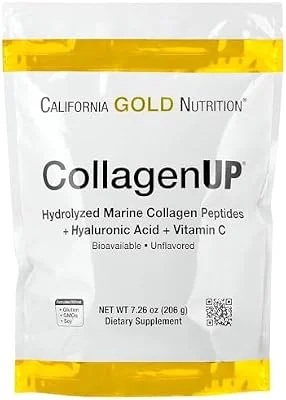
California Gold Nutrition CollagenUP Marine + HA + Vitamin C 464g
What it claims:
5g hydrolysed marine collagen peptides per serve with hyaluronic acid and 60mg Vitamin C from tilapia fish. Unflavoured, NSF certified, 464g tub.
What the evidence says:
Marine collagen provides Type I peptides — the relevant type for skin. Addition of HA and Vitamin C is mechanistically logical. 5g per serve meets the minimum researched skin dose. NSF certification is independently verifiable.
scored
CollagenUP is the marine collagen option in this list, stacking hydrolysed fish collagen with hyaluronic acid and Vitamin C in a single formula. Marine collagen peptides are predominantly Type I and are typically smaller in molecular weight (1–5 kDa) than bovine peptides, which theoretically improves intestinal absorption rates. The 5g serve sits at the minimum effective dose from the skin literature, which means consistent daily use is essential — the margin for missed doses is narrower than with higher-dose bovine powders.
The addition of hyaluronic acid is mechanistically logical for skin hydration — HA is a key component of dermal extracellular matrix and contributes to water-binding capacity. Vitamin C at 60mg per serve is a required cofactor for endogenous collagen synthesis. The combination of these three ingredients covers the main biochemical levers for skin collagen support in one daily scoop. California Gold Nutrition holds NSF certification, providing independent verification of label accuracy.
Skip if: you want the highest collagen dose per serve or are prioritising joint outcomes. The 5g marine dose is on the low end compared to bovine options that can be easily dosed at 10g for joint applications.
Pros
- Marine source — suitable for those avoiding bovine collagen
- Includes HA and Vitamin C — complementary mechanisms in one product
- NSF certified — independent label accuracy verification
- Large 464g tub — economical for long-term daily use at 5g/serve
Cons
- 5g per serve is the minimum researched dose — limited upward flexibility
- Marine Type I only — no Type III (unlike bovine) and no Type II
- Higher cost than bovine options for equivalent collagen content per gram
- California Gold is an iHerb house brand — less global brand recognition
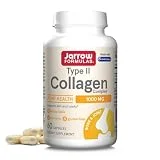
Jarrow Formulas Type II Collagen Complex 60 Caps
What it claims:
BioCell Collagen providing Type II collagen, hyaluronic acid, and chondroitin sulfate naturally co-occurring from chicken sternum cartilage. 500mg per cap, 2 caps per serve.
What the evidence says:
BioCell Collagen has independent clinical evidence for joint discomfort (Danesch et al. 2015, Osteoarthritis and Cartilage). Type II collagen is the mechanistically appropriate target for articular cartilage, distinct from the Type I/III skin-focused evidence base.
scored
Jarrow Formulas Type II Collagen Complex is the only cartilage-specific product in this list. Where the bovine and marine options above target skin with Type I collagen, this product uses BioCell Collagen — a patented extract from chicken sternum cartilage that delivers Type II collagen, hyaluronic acid, and chondroitin sulfate naturally co-occurring in the cartilage matrix. These are the three components most relevant to articular cartilage integrity and joint lubrication.
BioCell Collagen has its own independent clinical evidence base. Danesch et al. (2015) in Osteoarthritis and Cartilage found that BioCell supplementation was associated with reduced joint discomfort scores in participants with knee OA over 12 weeks. For Australians managing active joint discomfort — particularly in the knees and hips — this is the more mechanistically appropriate choice than a Type I/III bovine powder.
Skip if: your primary goal is skin elasticity or hydration. Type II collagen from chicken sternum is cartilage-specific — it is not the form studied in skin elasticity RCTs. For skin, choose Vital Proteins (#1) or California Gold (#3).
Pros
- Type II BioCell Collagen — the mechanistically correct form for cartilage support
- Naturally co-occurring HA and chondroitin sulfate from chicken sternum
- BioCell has its own clinical RCT evidence (Danesch et al. 2015)
- Lower upfront cost than most powder options on this list
Cons
- Capsule format limits flexibility — harder to increase dose than with powder
- Not suitable for skin outcomes — Type II is not the form studied for skin elasticity
- Only 30-day supply per tub (60 caps at 2/day) — more frequent reordering
- Chicken sternum source — not suitable for those with poultry allergies
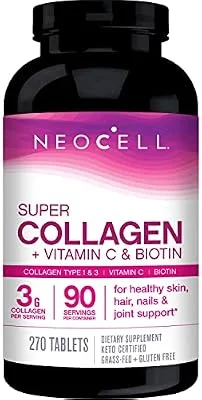
NeoCell Super Collagen + C and Biotin 270 Tablets
What it claims:
Grassfed bovine Type I and III hydrolysed collagen, 3g per 3-tablet serve, with 250mg Vitamin C and 600mcg Biotin. 90-day supply.
What the evidence says:
The collagen + Vitamin C stack is mechanistically logical — ascorbic acid is a required cofactor for collagen synthesis. At 3g per serve, this hits the minimum researched skin dose from Proksch 2014. The 90-day supply is genuinely convenient for sustained supplementation.
scored
NeoCell Super Collagen + C targets the collagen-Vitamin C stack in a tablet format, providing grassfed bovine Type I and III hydrolysed collagen with 250mg Vitamin C per 3-tablet serve. The Vitamin C inclusion is logically sound — ascorbic acid is a required cofactor for hydroxylation of proline and lysine in collagen synthesis, and supplementing these together ensures the synthesis pathway is not limited by ascorbate availability.
The 270-tablet count provides a 90-day supply at 3 tablets per day, reducing the frequency of reordering relative to powder products. At 3g per serve, NeoCell is at the minimum studied skin dose — consistent daily use without missed days matters more here than with higher-dose formats. Biotin is included at 600mcg; its direct contribution to collagen-specific outcomes is weaker than that of Vitamin C, but it adds no harm and complements a general skin-hair-nail protocol.
Skip if: you want flexibility to increase your dose beyond 3g. Tablet format makes upward dose adjustment inconvenient. If you plan to run 5–10g/day, a powder product offers better dose control at lower cost per gram.
Pros
- Collagen + Vitamin C in one tablet — mechanistically logical co-supplementation
- 90-day supply — reduces reorder frequency and per-serve cost
- Grassfed bovine — verified sourcing with higher CLA content
- Tablet format — convenient for travel or those who dislike powder mixing
Cons
- 3g per serve is the lowest dose in this list — difficult to increase without many extra tablets
- Biotin adds cost with weaker collagen-specific evidence than Vitamin C
- Tablet format cannot be mixed into coffee or food the way a powder can
- No Type II collagen — not appropriate for cartilage-specific use
Frequently Asked Questions
What is the best collagen supplement in Australia?
Vital Proteins Collagen Peptides (284g, Unflavoured) is the best-value hydrolysed collagen supplement available on Amazon AU at $50.37. It provides Type I and III bovine collagen peptides — the form most studied in peer-reviewed trials on skin and connective tissue outcomes. At a 5g daily dose, the 284g tub provides approximately 57 serves, or roughly two months of supplementation. The research-supported dose for skin elasticity improvements is 2.5g daily minimum (Proksch et al. 2014); 5g is a cost-efficient position within the evidence range.
Does collagen supplementation actually work?
The evidence for skin outcomes is reasonably strong. A 2014 RCT by Proksch et al. (Skin Pharmacology and Physiology) found 2.5g hydrolysed collagen daily for 8 weeks significantly improved skin elasticity in 69 women. A 2019 systematic review by Choi et al. (Nutrients) of 11 RCTs concluded that oral collagen improved skin hydration, elasticity, and reduced wrinkling. For joints, Clark et al. (2008) found athletes taking 10g collagen daily for 24 weeks reported significant reductions in activity-related joint pain. The evidence is real, but it supports specific outcomes at specific doses over a defined timeframe — it does not support collagen as a general-purpose wellness supplement.
What is hydrolysed collagen and why does it matter?
Hydrolysed collagen (collagen peptides) is collagen that has been broken down through enzymatic hydrolysis into smaller peptide chains, typically 2–5 kDa in molecular weight. Intact collagen molecules are too large to be absorbed through the intestinal epithelium. Hydrolysed peptides cross the intestinal wall, enter circulation, and have been detected in serum after oral supplementation. These circulating peptides are thought to stimulate fibroblast activity and trigger endogenous collagen synthesis — the proposed mechanism behind the skin and joint outcomes in clinical trials. Gelatin is partially hydrolysed and less bioavailable than fully hydrolysed peptides.
What is the difference between Type I, II, and III collagen?
Type I collagen is the most abundant in the body and the primary structural protein in skin, tendons, and bones — the most relevant type for skin supplementation. Type III co-localises with Type I in skin and blood vessels; most bovine supplements provide both. Type II collagen is the main structural protein of articular cartilage and is the mechanistically appropriate target for joint-specific supplementation. If your goal is skin elasticity or general connective tissue support, a bovine Type I and III product like Vital Proteins is appropriate. If cartilage is the specific target, a product providing Type II collagen (typically from chicken sternum) is more aligned.
How much collagen should I take per day?
The research-supported dose ranges from 2.5g to 10g daily. Proksch et al. (2014) used 2.5g daily for skin elasticity. Choi et al. (2019) reviewed trials using 2.5g to 10g daily for skin outcomes. Clark et al. (2008) used 10g daily for 24 weeks for joint pain in athletes. A daily dose of 5g sits within the skin-benefit range while being cost-efficient. There is no strong evidence that higher doses produce proportionally better skin outcomes; for joint benefit in athletes, 10g daily is the studied dose. Higher doses are generally safe but increase daily cost.
Is marine or bovine collagen better?
Both are predominantly Type I. Marine collagen peptides are typically smaller (1–5 kDa), which theoretically improves intestinal absorption. Bovine collagen provides both Type I and III. The published clinical trials on skin outcomes have used both marine and bovine sources without establishing a statistically significant difference between them at equivalent doses. The choice between marine and bovine is more relevant for ethical preferences (avoiding beef, sustainability considerations) than for efficacy. Vital Proteins uses bovine, which is the type most represented in the peer-reviewed literature cited in this article.
When is the best time to take collagen?
The published trials did not identify an optimal time of day. Proksch et al. and Clark et al. did not specify timing as a variable. The practical recommendation is to take it at the same time each day to support consistent adherence — most people find morning in coffee or water the lowest-friction approach with an unflavoured powder. Taking collagen with vitamin C is sometimes recommended because ascorbic acid is a required cofactor in collagen synthesis, but dietary vitamin C intake is typically sufficient for this role. A supplement containing vitamin C alongside collagen is not necessary for efficacy.
How long does collagen take to work?
Proksch et al. (2014) showed statistically significant improvements in skin elasticity at 4 weeks, with more pronounced improvements at 8 weeks. Measurable benefit at 4 weeks does not mean a visible effect most people would notice in a mirror — "statistically significant" and "cosmetically apparent" are different thresholds. Clark et al. (2008) ran 24 weeks for joint outcomes. A fair trial of collagen supplementation for skin is 8–12 weeks of consistent daily use. For joint-related outcomes, 3–6 months is a more appropriate assessment period. Collagen is not a fast-acting supplement.
How does UV exposure affect collagen and what can I do about it?
UV radiation — particularly UVA — activates matrix metalloproteinases that break down dermal collagen fibres. This is the primary environmental driver of photoageing. The first-principles approach is behavioural and dietary: avoid peak UV hours (10am–2pm AEST), and support your skin's natural defences through diet. Astaxanthin has the strongest evidence base for dietary photoprotection, with multiple RCTs showing measurable reduction in UV-induced skin damage. Lycopene, beta-carotene, and EGCG from green tea also reduce UV-driven collagen degradation in human trials. Collagen supplementation works best in this context: supporting synthesis from the inside while dietary antioxidants defend against UV breakdown from within.