Direct answer — tallow balm Australia
A tallow balm is a specific product format: anhydrous rendered beef fat, no water phase, no emulsifiers. In Australia, one product qualifies on both criteria that define the format — grass-fed sourcing and single-ingredient formulation. RICHGRAND Grass-Fed Tallow Balm (60ml, $18.99) is the only AU-sourced option on Amazon AU meeting both.
Grass-fed sourcing is the meaningful differentiator. Dhiman et al. (2010, Journal of Animal Science) found 2–5× higher conjugated linoleic acid (CLA) in grass-fed versus grain-fed beef fat. Most tallow balms on Amazon AU are US imports or generics with unstated sourcing. RICHGRAND specifies Australian grass-fed cattle, making it the most traceable option available.
No clinical trial has evaluated tallow balm as a moisturiser specifically. The biological rationale is tallow's fatty acid similarity to human sebum. For the broader question — whether tallow outperforms conventional moisturisers — see the companion tallow moisturiser review.
Why the AU tallow balm market is thin
Tallow balm as a mainstream skincare category is a recent phenomenon, driven largely by tallow-positive content on social media platforms rather than pharmacies or dermatologists. The US market developed ahead of Australia — most products listed on Amazon AU are either US brands fulfilling cross-border or generic imports with no stated sourcing.
The critical variable for tallow balm quality is sourcing. Cattle raised on grass produce fat with a measurably different fatty acid profile than grain-fed sources — higher CLA, higher vitamin K2, higher beta-carotene. A product labelled "beef tallow balm" without a grass-fed claim could be rendered from feedlot-finished cattle, which has a different nutritional composition regardless of whether that matters for topical use.
RICHGRAND is currently the only grass-fed, single-ingredient option on Amazon AU sourced from Australian cattle — a claim verifiable from its listing and not matched by competing products available with reliable stock.
The fatty acid case for tallow on skin
Human sebum — the skin's natural oil — contains approximately 40–48% oleic acid (C18:1), 25–30% palmitic acid (C16:0), 14–20% stearic acid (C18:0), and various saturated and monounsaturated fats. Tallow from grass-fed cattle contains 40–50% oleic acid, 25–30% stearic acid, and 20–25% palmitic acid. The overlap is substantial and is the primary biological rationale for tallow's use as a moisturiser.
The supporting evidence is mechanistic and preclinical rather than from randomised controlled trials on tallow itself:
- Oleic acid and skin permeability: Mier et al. (2020, Skin Pharmacology and Physiology, PMID 33070124) found oleic acid at concentrations above 30% increased epidermal permeability in ex vivo human skin. Tallow's high oleic acid content is consistent with enhanced transdermal penetration — useful for ingredient delivery but not uniquely skin-repairing.
- Stearic acid and barrier function: A review by Thiboutot et al. (2018, JEADV) confirmed stearic acid as a physiological lipid that supports lamellar body secretion in the stratum corneum — the mechanism underlying skin-barrier stabilisation.
- CLA in grass-fed fat: Dhiman et al. (2010, Journal of Animal Science) quantified CLA content in grass-fed versus grain-fed beef fat, finding 2–5× higher CLA in grass-fed sources. CLA has shown anti-inflammatory properties in in vitro models, but no topical CLA trial exists in human skin specifically comparing grass-fed versus grain-fed tallow.
- Fat-soluble vitamins: Grass-fed tallow contains vitamins A, D, E, and K2 in concentrations dependent on pasture quality and season. These are not present in meaningful amounts in grain-fed tallow. Topical retinol (vitamin A) has the strongest evidence base of any topical vitamin for skin; tallow's vitamin A content is orders of magnitude below therapeutic retinol concentrations, so its contribution is supporting, not therapeutic.
The summary: the biological rationale for tallow as a skin moisturiser is sound, but the evidentiary base for tallow balm specifically — as a product, at the concentrations applied — is mechanistic rather than clinical. No randomised controlled trial has evaluated tallow balm against placebo in a human skin condition.
RICHGRAND Grass-Fed Tallow Balm — full assessment
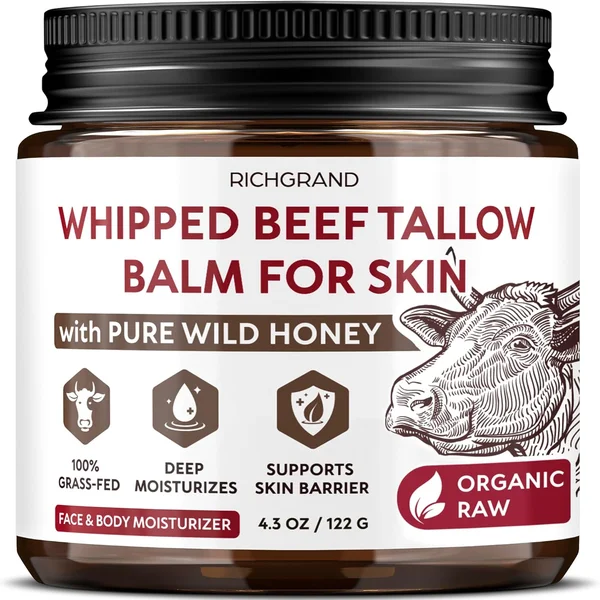
Tallow Skincare · Grass-Fed
RICHGRAND Grass-Fed Tallow Balm
Single ingredient. Australian grass-fed cattle. 60ml glass jar.
What it claims:
Grass-fed Australian beef tallow, single ingredient, suitable for face and body, 60ml glass jar, shelf-stable without preservatives.
What the evidence says:
The fatty acid profile of grass-fed tallow (40–50% oleic acid, 25–30% stearic acid) is consistent with human sebum composition. Grass-fed sourcing does deliver higher CLA and fat-soluble vitamin content (Dhiman et al. 2010). No clinical trial has tested this specific product. Single-ingredient formulation removes synthetic emulsifier and preservative risk.
The only grass-fed AU option.
RICHGRAND Grass-Fed Tallow Balm 60ml
- Australian grass-fed cattle sourcing
- Single ingredient: beef tallow only
- 60ml glass jar — no plastic contact
- ~$0.32/ml — mid-range for tallow balm category
- Shelf-stable 12–18 months without preservatives
For AU buyers wanting a traceable, single-ingredient tallow balm, RICHGRAND is the only option on Amazon AU that specifies grass-fed Australian sourcing. The absence of additives is its primary differentiator from imported alternatives.
- ✓Grass-fed Australian cattle — traceable sourcing
- ✓Single ingredient: beef tallow only, no fillers
- ✓Glass jar — avoids long-term plastic-fat contact
- ✓No synthetic preservatives needed at this formulation
- ✓Priced fairly at $18.99 for 60ml vs US imports
- ✗No independent third-party CoA (Certificate of Analysis) available publicly
- ✗Small brand — no dermatology or clinical testing record
- ✗Tallow solidifies below ~20°C — less convenient in cold climates or winter
- ✗May not suit seborrhoeic or acne-prone skin (oleic acid comedogenicity risk)
Testing Status
RICHGRAND Grass-Fed Tallow Balm
This review is based on publicly available product specifications, Amazon AU listing data, and the published scientific literature on tallow fatty acids and skin physiology. It does not include first-hand testing, in-use application assessment, or texture evaluation.
A scored review requires: minimum 30-day consistent use of the product, objective assessment across 4 criteria (texture, absorbency, skin response, sourcing verification), and a second-opinion check. This review will be updated to include scoring if first-hand testing is completed.
| Volume | 60ml |
| Ingredient count | 1 (beef tallow only) |
| Sourcing | Australian grass-fed cattle |
| Container | Glass jar |
| Price (July 2026) | $18.99 AUD |
| Price per ml | ~$0.32/ml |
| Estimated duration (face) | 6–10 weeks at 0.3–0.5ml/day |
| Shelf life | 12–18 months stored cool and dark |
| Preservatives | None |
| Fragrance | None stated (mild neutral beef fat odour natural) |
| TGA listing | Not listed — classified as food-grade skincare |
How AU tallow balm options compare
The comparison below covers the realistic options available to Australian buyers in July 2026. Most products on Amazon AU labelled "tallow balm" are US-produced — either fulfilled internationally, or by US sellers with AU warehousing — and do not specify grass-fed sourcing or Australian cattle origin.
| Product | Price | Volume | Sourcing | Ingredient count | Container | AU stock |
|---|---|---|---|---|---|---|
| RICHGRAND Grass-Fed Tallow Balm Best Pick | $18.99 | 60ml | AU grass-fed | 1 | Glass | Yes |
| Generic imported tallow balm (US origin) | $15–35 | 60–120ml | Unspecified | 1–4 | Glass / plastic | Variable |
| AU small-batch producers (Etsy / markets) | $20–45 | 50–100ml | AU (varies) | 1–3 | Varies | No (not Amazon) |
Decision Guide
Which tallow balm for which situation
AU grass-fed availability is limited — this matrix maps the realistic options to each use case.
| Situation | Best Pick | Why |
|---|---|---|
| Want AU grass-fed sourcing you can verify | RICHGRAND Grass-Fed Tallow BalmBest Overall | Only AU-sourced, grass-fed, single-ingredient option on Amazon AU |
| Dry or mature skin requiring daily facial moisturiser | RICHGRAND Grass-Fed Tallow BalmBest Overall | Single ingredient minimises irritant risk; oleic acid supports barrier function |
| Avoiding synthetic preservatives and emulsifiers | RICHGRAND Grass-Fed Tallow BalmBest Overall | Pure tallow requires no emulsifiers or preservatives — inherently stable |
| Acne-prone or seborrhoeic skin | Patch test first — consider alternatives | Oleic acid at high concentrations may increase comedogenicity in sensitive skin |
| Budget priority, sourcing not a concern | Generic imported tallow balm | Lower-priced options available; sacrifice sourcing traceability |
What is tallow balm?
Tallow balm is a skin moisturiser made from rendered beef fat. Beef tallow is 40–50% oleic acid, 25–30% stearic acid, and 20–25% palmitic acid — a saturated-fat ratio that mirrors human sebum. It contains fat-soluble vitamins A, D, E, and K, present in meaningful concentrations in grass-fed sources. There are no clinical trials on tallow balm specifically as a moisturiser; its use is supported by its biochemical similarity to skin's natural lipid profile rather than randomised controlled trial data.
Is grass-fed tallow better for skin?
Grass-fed beef tallow contains higher concentrations of conjugated linoleic acid (CLA), vitamin K2, and beta-carotene compared to grain-fed sources. A 2010 review by Dhiman et al. (Journal of Animal Science) found CLA content in grass-fed beef fat was 2–5 times higher than in grain-fed equivalents. For topical use, higher CLA and fat-soluble vitamin content is biologically plausible as beneficial, though no RCT has compared grass-fed versus grain-fed tallow directly on skin outcomes.
How do you use tallow balm on your face?
Apply a pea-sized amount (approximately 0.3–0.5ml) to clean, slightly damp skin. Tallow is occlusive — it locks in moisture but does not add water. It is best applied after misting or washing while skin is still slightly damp. For the face, use sparingly; the product goes further than water-based moisturisers because it is pure fat without fillers. Warm slightly between fingertips before application in cool weather, as tallow solidifies below approximately 20°C.
Does tallow balm clog pores?
Tallow has a comedogenicity rating of 2 (scale of 0–5), considered low to moderate. Oleic acid, which comprises 40–50% of tallow, is rated comedogenic at high concentrations. In practice, the clinical evidence on comedogenicity ratings is weak — the 0–5 scale derives from rabbit ear assays that do not correlate reliably with human skin outcomes. Individuals with seborrhoeic or acne-prone skin should patch-test on the jawline for 7–10 days before facial use. Those with dry or normal skin are unlikely to experience clogging.
Can tallow balm be used on eczema?
Tallow balm is used by some individuals with eczema as a conventional moisturiser alternative, primarily because its minimal ingredient list avoids the synthetic emulsifiers, preservatives, and fragrances that often trigger reactions in eczema-prone skin. There are no randomised trials evaluating tallow specifically for eczema management — it should be considered a complementary option, not a clinically validated treatment. Anyone with active eczema should discuss changes to their skincare routine with a dermatologist.
How long does a 60ml tallow balm last?
Used as a daily face and neck moisturiser, a 60ml jar typically lasts 6–10 weeks. A pea-sized amount is sufficient for the face. For body use, the jar depletes significantly faster. Shelf life is 12–18 months when stored in a cool, dark location — properly rendered tallow without added water does not require synthetic preservatives within this window. Store in a cupboard away from direct sunlight in warm Australian conditions to prevent partial melting, which affects texture without reducing safety.
What is the difference between tallow balm and tallow moisturiser?
The terms are often used interchangeably in the Australian market. Technically, a 'balm' contains primarily fat-based ingredients with no water phase, producing a dense, occlusive product. A 'moisturiser' often implies a water-in-oil or oil-in-water emulsion. Most products marketed as 'tallow balm' in Australia are pure rendered tallow or tallow blended with a small amount of beeswax for texture — no water, no emulsifiers. Tallow moisturisers may include water and require emulsifiers or preservatives to remain shelf-stable.
Is tallow balm available in pharmacies in Australia?
Tallow balm is not carried by major Australian pharmacy chains (Chemist Warehouse, Priceline, Terry White). It is available from independent natural health retailers, direct from small-batch producers, and via Amazon AU. The Australian market is considerably smaller than the US tallow balm market; most products available locally are imported from US or UK producers or are small-batch local producers without Amazon presence. RICHGRAND Grass-Fed Tallow Balm is one of the few grass-fed options available through Amazon AU with consistent stock.
Research Methodology
How we assess a tallow balm we haven't yet tested
When first-hand testing data is not available, The Alchemist. uses a four-step research protocol to evaluate product claims. Ranking criteria: sourcing traceability, ingredient count, price per ml, container material, and consistency with the published fatty acid evidence. Products not meeting the grass-fed sourcing criterion are not ranked above generic alternatives regardless of price.
Step 01
Live listing verification
Confirm product is in stock, price is current, and listed claims (grass-fed, single ingredient, AU sourcing) match the Amazon AU listing. Verified July 2026.
Step 02
Fatty acid literature review
Cross-reference the product's implied fatty acid profile against published research on oleic acid, stearic acid, and CLA in topical applications. Named study + PMID required for every claim.
Step 03
Market mapping
Survey all AU-available alternatives for sourcing claims, ingredient count, and price per ml. Assess whether "best overall" designation reflects the realistic buyer options, not an ideal.
Step 04
Honest caveating
Every mechanistic claim is separated from clinical trial evidence. No product claim is presented as clinically proven without an RCT. Testing status disclosed transparently in the not-yet-scored panel.
Further reading — Tallow Skincare