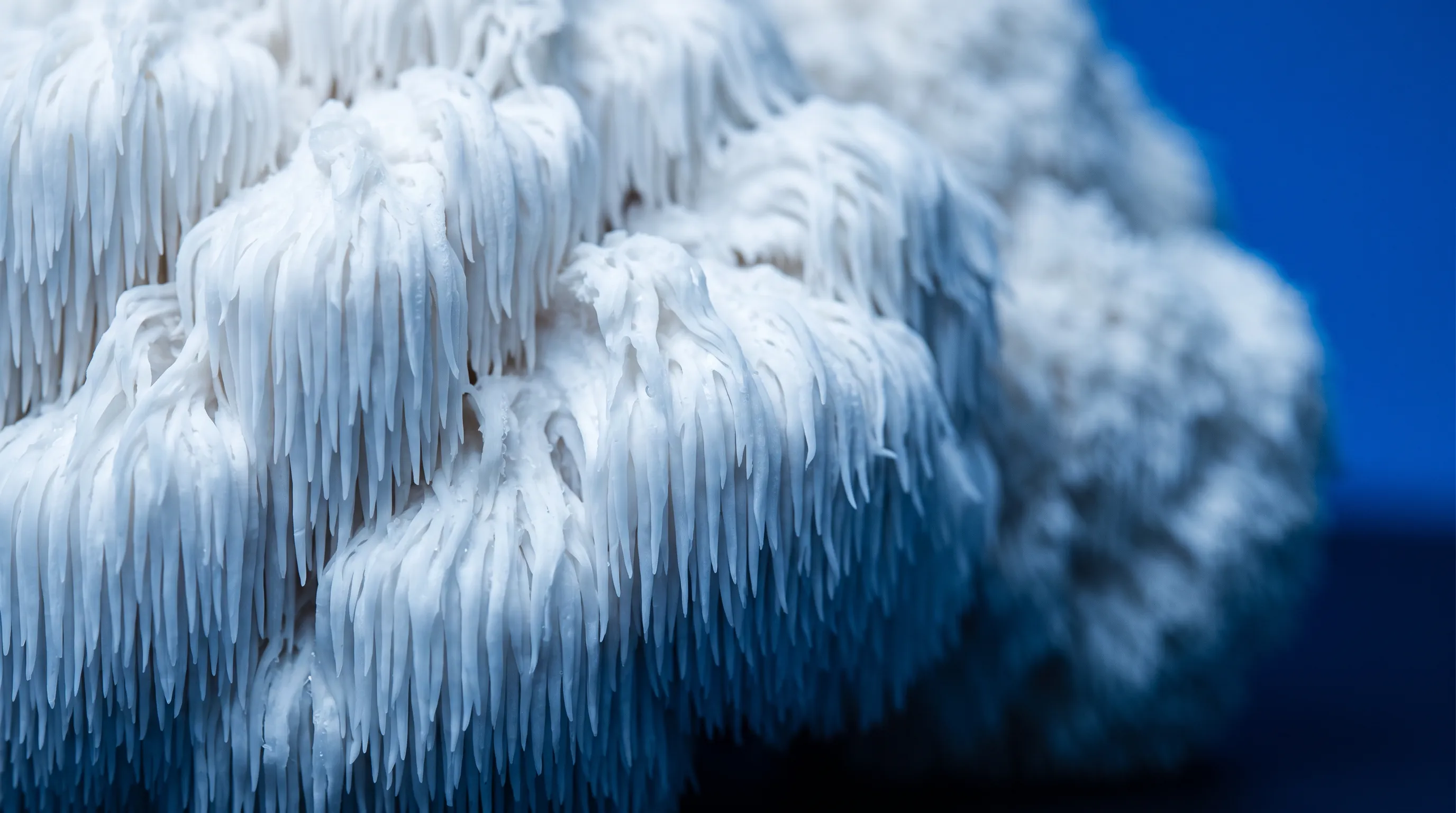
Lion's mane (Hericium erinaceus) is a medicinal mushroom with a distinctive cascading white appearance that has been used in East Asian medicine for centuries. It contains two classes of neuroactive compounds — hericenones (in the fruiting body) and erinacines (in the mycelium) — both of which have been shown in laboratory and animal studies to stimulate the synthesis of nerve growth factor (NGF), a protein essential for the maintenance and growth of neurons.
The most robust clinical evidence comes from a 2009 randomised controlled trial by Mori et al. (Phytotherapy Research), which found that adults aged 50–80 with mild cognitive impairment showed significantly improved cognitive function scores after 16 weeks of daily supplementation with 3g of lion's mane powder, compared to placebo. Lion's mane is available across Australia through health food stores and Amazon AU. Researched daily doses of extracted powder range from 500mg to 3g. Duration of use matters: effects seen in studies required consistent supplementation over weeks, not days.
We research and analyse every product we recommend. Some links on this page are affiliate links. If you buy through them, we earn a small commission at no extra cost to you. This doesn't affect our recommendations.
What Is Lion's Mane?
Lion's mane (Hericium erinaceus) is a culinary and medicinal mushroom with an appearance unlike most fungi — rather than a cap with gills, it grows in cascading white or cream-coloured tendrils resembling a lion's mane or a waterfall of teeth. It is native to North America, Europe, and Asia, and has been used in traditional Chinese and Japanese medicine for centuries, primarily for digestive complaints and neurological support.
What distinguishes lion's mane pharmacologically from most other functional mushrooms is the identity of its active compounds. Most adaptogenic mushrooms derive their proposed benefits from beta-glucan polysaccharides — immunomodulating compounds that influence immune signalling. Lion's mane contains beta-glucans too, but its unique neuroactive profile comes from two compound classes that sit outside this category entirely.
Hericenones are aromatic compounds found specifically in the fruiting body of Hericium erinaceus. They were first isolated and characterised in the early 1990s by researchers at Tohoku University in Japan. In cell culture and animal models, hericenones have been shown to stimulate NGF synthesis in neurons and supporting glial cells. Crucially, they are small enough to cross the blood-brain barrier, meaning they can act directly on brain tissue rather than being limited to peripheral effects.
Erinacines are cyathane diterpenoids found in the mycelium — the underground, root-like network of the fungus rather than the visible mushroom cap. They are considered more potent NGF stimulators than hericenones in preclinical models, with some animal studies showing erinacine A specifically producing measurable increases in NGF levels in the hippocampus and cerebellum. Because commercial lion's mane products are made from either the fruiting body or the mycelium (and sometimes both), understanding which part was used matters for assessing the likely compound profile of a given product.
Nerve growth factor is a neurotrophin — a protein that supports the growth, maintenance, and survival of neurons, particularly in the peripheral nervous system and in brain regions involved in memory and learning. NGF binds to TrkA receptors on neurons, activating signalling cascades that support synaptic plasticity and may promote the growth of new dendritic connections. The theoretical logic for lion's mane's cognitive effects rests on this mechanism: by stimulating NGF synthesis, the mushroom's compounds may support the structural integrity of neurons over time. This is a biologically plausible mechanism, not a speculative one — though translating animal model findings to consistent human clinical effects is always the harder part of that argument.
Lion's mane is not a stimulant and does not produce acute cognitive effects. Its proposed mechanism is cumulative — supporting neuronal health through sustained NGF stimulation over weeks, not hours.
What Does the Research Actually Show?
The human clinical evidence base for lion's mane is small but not negligible. Three studies are frequently cited, and understanding what each actually measured — and in whom — is essential for evaluating whether the compound is relevant to your situation.
Mori et al. 2009 (Phytotherapy Research) — The Flagship RCT
The most methodologically rigorous study to date is the Mori 2009 randomised, double-blind, placebo-controlled trial conducted in Japan. Thirty adults aged 50 to 80 with diagnosed mild cognitive impairment were enrolled. Participants in the treatment group took four 250mg tablets of Yamabushitake (dried lion's mane fruiting body powder), three times daily — totalling 3g per day. The placebo group received identical-looking tablets containing no active ingredient.
At weeks 8, 12, and 16, the lion's mane group showed significantly higher scores on the Hasegawa Dementia Scale — a validated measure of cognitive function — compared to the placebo group. Importantly, the researchers also assessed outcomes at week 28, four weeks after supplementation ended. By that point, the cognitive scores in the treatment group had declined back toward baseline. This finding tells us two things: the compound produced a real effect that was detectable on validated measures, and the effect was not permanent — it required continued supplementation to be maintained. No adverse effects were reported in either group during the trial period.
Nagano et al. 2010 (Biomedical Research) — Mood and Anxiety
A separate 2010 study by Nagano et al. examined lion's mane in a different context: mood and anxiety in menopausal women. Thirty women were enrolled in a four-week trial in which the treatment group consumed cookies containing lion's mane powder daily. Participants completed self-report questionnaires measuring depression, anxiety, sleep quality, and concentration before and after the intervention.
The lion's mane group reported reduced scores on measures of irritability, anxiety, and concentration difficulties compared to the placebo cookie group. The researchers proposed that the effects could be mediated through NGF's role in supporting hippocampal function, an area of the brain involved in emotional regulation as well as memory. This study should be interpreted carefully: it was small, used a self-report design, and the cookie format makes precise dose quantification difficult. It is preliminary evidence that lion's mane may have mood-related effects — not proof of clinical efficacy for anxiety or depression.
Saitsu et al. 2019 (Biomedical Research) — Cognitive Speed in Healthy Adults
The 2019 Saitsu et al. study examined lion's mane in a population of healthy, non-impaired older adults — a meaningful distinction from the Mori study's cognitively impaired participants. Participants aged 50 and older took lion's mane extract for 12 weeks and were assessed on a battery of cognitive tasks. The study found improvements in processing speed tasks in the treatment group relative to placebo. No significant improvements were observed on tests of memory encoding or executive function.
This finding is nuanced. It suggests lion's mane may have measurable effects even in people without existing cognitive decline, but those effects appear to be narrower than is commonly claimed — affecting processing speed rather than memory or problem-solving in this population. The study also involved older adults (50+), so extrapolation to healthy adults in their twenties or thirties requires caution.
| Study | Population | Dose / Duration | Primary Finding | Limitation |
|---|---|---|---|---|
| Mori et al. 2009 Phytotherapy Research |
30 adults, 50–80, mild cognitive impairment | 3 g/day fruiting body · 16 weeks | Significant improvement in Hasegawa Dementia Scale vs placebo; reversed 4 weeks post-supplementation | n=30; effects not permanent |
| Nagano et al. 2010 Biomedical Research |
30 menopausal women | Lion's mane cookies · 4 weeks | Reduced self-reported irritability, anxiety, concentration difficulties | Self-report design; dose unclear |
| Saitsu et al. 2019 Biomedical Research |
Healthy adults, 50+ | Lion's mane extract · 12 weeks | Improved processing speed; no significant improvement in memory or executive function | Older-adult sample; narrow effect |
The clinical evidence supports lion's mane as a real compound with plausible mechanisms and documented effects in specific populations — not as a general cognitive enhancer with broad applicability across all adults.
Who Actually Benefits?
Based on the clinical evidence available, the populations most likely to see meaningful effects from lion's mane supplementation are fairly specific. Understanding this prevents both under-expectation (dismissing it as useless because you're 28 and healthy) and over-expectation (expecting dramatic cognitive transformation in any population).
Mild cognitive impairment, age 50+
This is the population studied in the flagship Mori 2009 RCT. Adults with diagnosed mild cognitive impairment showed statistically significant improvements in validated cognitive scores over 16 weeks at 3g/day. This is the strongest evidence base for lion's mane benefit.
Evidence quality: Strong (RCT, validated measures)Older adults with high perceived stress
The Nagano 2010 study and broader NGF research suggest lion's mane may be more useful when cognitive resources are already under strain — from chronic stress, hormonal changes (as in the menopausal cohort studied), or age-related neuronal attrition. Lower cognitive reserve amplifies the practical significance of NGF support.
Evidence quality: Moderate (small sample, self-report)Adults 50+ seeking processing speed support
The Saitsu 2019 findings in non-impaired older adults suggest modest benefits in cognitive processing speed specifically. Not memory, not problem-solving — speed on timed cognitive tasks. Modest but measurable in this population over 12 weeks.
Evidence quality: Moderate (randomised, healthy adults)Healthy adults under 40
No robust RCT evidence currently demonstrates significant cognitive benefits in healthy, younger adults. The NGF mechanism is theoretically active across age groups, but the clinical signal is either not detectable at these baseline levels or simply hasn't been studied with sufficient rigour in this population yet.
Evidence quality: Insufficient (not studied adequately)There is also the question of duration. None of the studies showing cognitive effects used supplementation periods shorter than four weeks, and the strongest effects were observed after 8–16 weeks of daily use. If you take lion's mane for two weeks and notice nothing, that is consistent with the research rather than evidence that it doesn't work — you haven't waited long enough for the NGF-mediated mechanism to produce detectable changes. Equally, if your primary concern is acute performance in a single cognitive task, lion's mane is not the right tool. It is not a stimulant; it does not work in hours.
How Much Lion's Mane Do You Need?
The dose question is more complicated than most supplement articles acknowledge, because the relevant variables are not just the quantity of lion's mane but the part of the fungus used, the extraction method applied, and the resulting concentration of active compounds.
The Mori 2009 RCT used 3g per day of dried fruiting body powder in tablet form — not an extract, but whole dried mushroom. Most commercial products use hot water extraction or dual (hot water plus ethanol) extraction, which concentrates the active compounds relative to raw dried powder. This means a 500mg extract may contain more hericenones than 500mg of raw powder — but without standardisation data on the specific extract, you cannot make that comparison precisely.
As a practical range: 500mg to 3g per day of extracted powder is the range supported by the existing clinical and preclinical literature. Products that specify beta-glucan content (often 30% or higher in quality extracts) give you a partial proxy for quality, though beta-glucans are not the same compounds as hericenones or erinacines. The distinction between fruiting body and mycelium matters because they contain different compound classes — hericenones versus erinacines respectively — and some mycelium products grown on grain substrates contain significant starch contamination that dilutes the active content.
Heat is a relevant consideration if you're adding lion's mane powder to hot beverages. Hericenones are relatively stable at brewing temperatures, but prolonged high heat (above 100°C for extended periods) can degrade them. Brewing a mushroom coffee by pouring near-boiling water over a powder and drinking it promptly is unlikely to cause significant degradation. Cooking lion's mane at high temperature for extended periods — as you would a conventional mushroom — neutralises more of the heat-sensitive compounds, which is one reason the supplement form is preferred over culinary preparation for those targeting specific doses.
Fruiting body vs mycelium: Check the product label. "Mycelium on grain" products often have significant starch content from the growth substrate, which dilutes the active compound concentration. Dual-extract fruiting body products or mycelium products grown without grain substrates are higher quality options.
Mushroom Coffee vs Capsules
Lion's mane is now available in two mainstream formats in Australia: as an ingredient in mushroom coffee blends, and as standalone capsules or powder. Neither is universally superior — the right choice depends on what you're optimising for.
Mushroom coffee offers the most practical integration into a daily routine. If you're already drinking coffee in the morning, substituting or partially substituting with a mushroom coffee blend adds lion's mane — and often other functional mushrooms — without requiring any additional habit. The trade-off is dose precision: most mushroom coffee products contain approximately 200–500mg of lion's mane extract per serve, which is at the lower end of the range used in clinical studies. For people who want a lower-caffeine coffee alternative with added functional mushroom benefits, mushroom coffee is a rational daily choice. For people targeting the 3g/day dose studied in the Mori RCT, mushroom coffee alone won't get there at standard serving sizes.
Capsules or powders allow precise dosing. A dedicated 500mg or 1g capsule product lets you titrate your intake accurately against the studied dose range, and the format makes it easy to increase dose without changing your beverage habits. Capsules also make it easier to ensure consistent daily intake — there's less variability in how much active compound you're actually consuming each day compared to measuring powder into a drink.
A practical middle path: use mushroom coffee daily for the ritual and the functional mushroom baseline, and add a dedicated lion's mane capsule product if you want to reach the higher end of the studied dose range. The two formats are complementary rather than competing.
Product Recommendations
Wild Brew is the most practical lion's mane format available on Amazon AU for daily use — an organic mushroom coffee blend that integrates lion's mane, cordyceps, and reishi into a morning ritual without requiring a new habit.
Primary Pick — Mushroom CoffeeWild Brew's Organic Mushroom Coffee is the most direct entry point for Australians wanting a daily lion's mane mushroom coffee. It combines certified organic Arabica coffee with lion's mane extract, making it a practical swap for regular coffee rather than an add-on supplement. The organic certification is meaningful here because mushroom fruiting bodies concentrate heavy metals and pesticides from their growth substrate — an organic certified product reduces that risk.
The format is the core strength. If you're trying to build a consistent lion's mane habit, integrating it into your existing morning coffee routine is lower friction than adding a separate supplement step. Each serve delivers lion's mane extract alongside a moderate caffeine load — lower than straight espresso, which makes it suitable for people sensitive to caffeine or trying to reduce their daily intake without giving up the ritual entirely.
As with all mushroom coffees, the lion's mane dose per serve is at the lower end of the range studied clinically. For people whose primary goal is the cognitive-support evidence from Mori 2009, this alone will not reach 3g/day. For people who want a functional coffee upgrade with meaningful lion's mane content as part of a broader wellness approach, this is a practical and well-formulated option.
Skip if: You need precisely controlled lion's mane dosing above 1g per day. Mushroom coffee is a convenient format, not a precision dosing vehicle. For targeted supplementation at the higher end of the studied range, dedicated capsules are the right format.
Pros
- Organic certified — reduces heavy metal and pesticide contamination risk
- Integrates into existing morning coffee routine without additional habit
- Lower caffeine than standard espresso — suitable for caffeine-sensitive individuals
- Available on Amazon AU with standard fulfilment and returns
Cons
- Per-serve lion's mane dose below the 3g/day used in the flagship RCT
- Does not specify beta-glucan content or extraction method on label
- Not a substitute for dedicated lion's mane supplementation at clinical doses
Frequently Asked Questions
What is lion's mane mushroom?
Lion's mane (Hericium erinaceus) is a medicinal mushroom native to North America, Europe, and Asia. It contains two classes of neuroactive compounds — hericenones (found in the fruiting body) and erinacines (found in the mycelium) — that can cross the blood-brain barrier and stimulate nerve growth factor (NGF) synthesis. NGF is a protein essential for the growth and maintenance of neurons in the brain and peripheral nervous system.
Does lion's mane actually work for cognition?
The evidence is promising but limited to specific populations. A 2009 randomised controlled trial by Mori et al. (Phytotherapy Research) found that adults aged 50–80 with mild cognitive impairment who took 3g of lion's mane powder daily for 16 weeks showed significantly improved cognitive function scores compared to placebo. Critically, scores declined after supplementation stopped. This tells us the compound has a real but transient effect in people with existing cognitive decline — the evidence for healthy younger adults is much weaker.
What dose of lion's mane is effective?
Researched doses range from 500mg to 3g per day of extracted powder. The Mori 2009 RCT used 3g/day over 16 weeks. Most mushroom coffee products contain approximately 200–500mg per serve, which is at the lower end of the range studied. For cognitive effects, duration matters more than single-dose size — studies showing results used continuous supplementation over at least 8–16 weeks.
What are hericenones and erinacines?
Hericenones are aromatic compounds found in the fruiting body (the visible mushroom cap) of Hericium erinaceus. Erinacines are cyathane diterpenoids found in the mycelium (the root-like structure). Both compound classes have been shown in laboratory and animal studies to stimulate NGF synthesis. Erinacines are considered more potent NGF stimulators; hericenones are more commonly present in commercial fruiting body products.
Is lion's mane safe?
Lion's mane has a strong safety profile in the studies conducted to date. The Mori 2009 RCT reported no adverse effects in participants taking 3g/day over 16 weeks. Some individuals report mild gastrointestinal discomfort at higher doses. There are isolated case reports of allergic skin reactions, particularly in people with mushroom or shellfish allergies. It should be used with caution by anyone on blood thinners or immunosuppressants, and avoided during pregnancy where safety data is absent.
Can lion's mane help with anxiety and depression?
A 2010 study by Nagano et al. (Biomedical Research) found that menopausal women who consumed lion's mane cookies for four weeks reported reduced scores on measures of depression and anxiety compared to a placebo group. The mechanism proposed involves NGF's role in supporting hippocampal neurogenesis. The study was small and the format (cookies) makes dose comparison difficult, so it should be considered preliminary evidence rather than a clinical recommendation.
What is the difference between fruiting body and mycelium lion's mane?
Fruiting body products are made from the visible mushroom cap and contain primarily hericenones along with beta-glucans. Mycelium products (often grown on grain) contain erinacines, which may be more potent NGF stimulators, but many commercial mycelium products also contain significant starch from the grain substrate. The most rigorous products specify the source (fruiting body or mycelium), the extraction method (hot water or dual extraction), and the beta-glucan content as a quality marker.
How long does lion's mane take to work?
Based on the available RCT evidence, meaningful cognitive effects required at least 8 weeks of daily supplementation, with the Mori 2009 study running for 16 weeks. Single-dose or short-term use (under four weeks) has not demonstrated significant cognitive effects in controlled trials. NGF stimulation is a cumulative process — the compound needs sustained exposure to produce measurable changes in nerve growth factor levels and the downstream effects on cognition.
Is mushroom coffee a good way to get lion's mane?
Mushroom coffee is a convenient delivery format but typically contains 200–500mg of lion's mane extract per serve — below the 3g/day dose used in the key RCT. For general wellness and a lower-caffeine coffee alternative, mushroom coffee is a practical choice. For targeted cognitive support at clinically studied doses, dedicated capsules allow more precise dosing. The two approaches are not mutually exclusive: mushroom coffee for the daily ritual, capsules for dose top-up if needed.