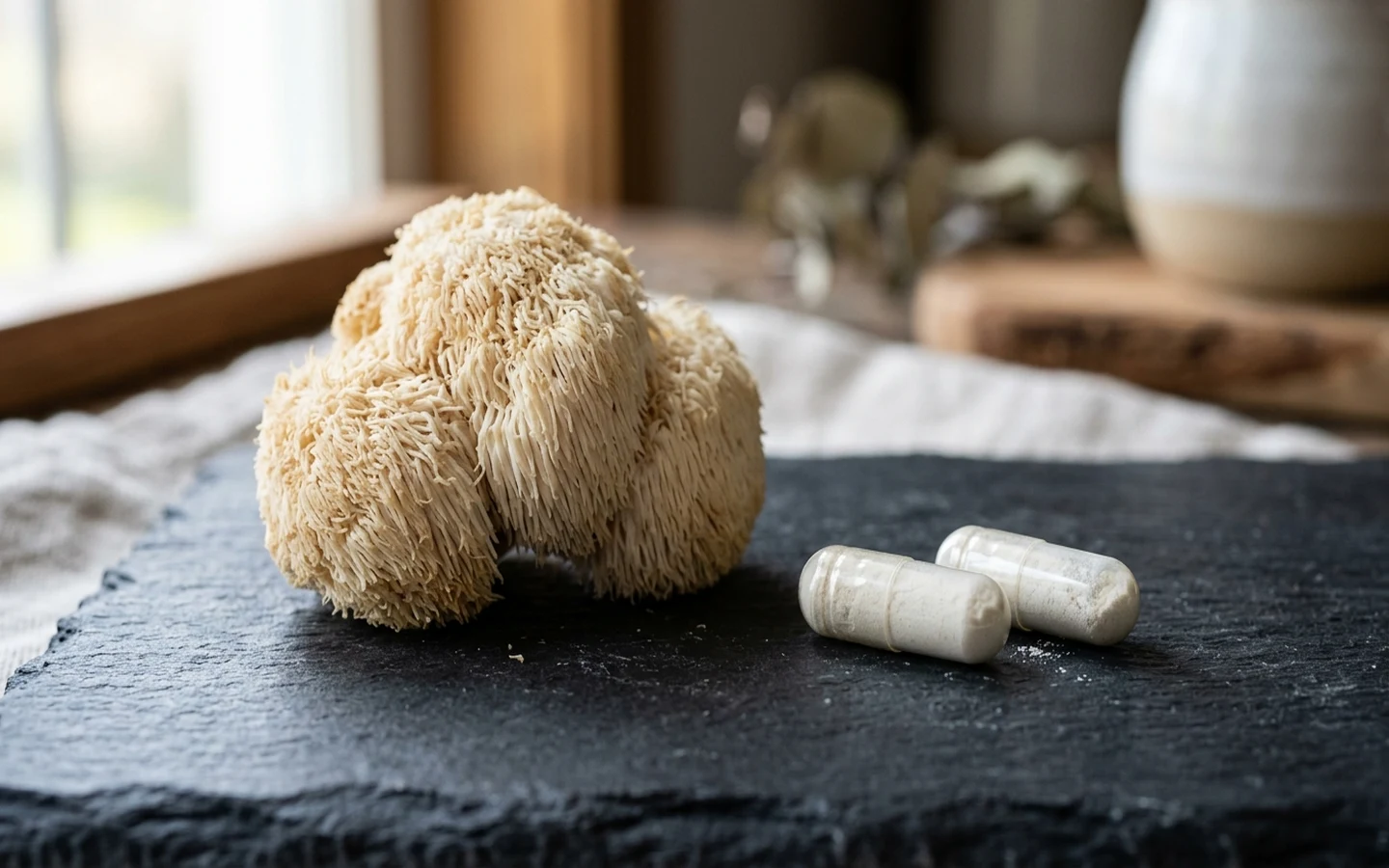
The dose that consistently produced cognitive benefit in human trials is one thousand milligrams of lion's mane dry extract per day, taken with food, over a minimum of eight weeks. Mori and colleagues used this exact dose in the primary trial — thirty participants aged fifty to eighty with mild cognitive impairment showed statistically significant MMSE improvement versus placebo at week eight and maintained it through week sixteen. Forest Super Foods Australian Grown Lions Mane Mushroom Capsules deliver five hundred milligrams per capsule, so two capsules daily replicates the studied protocol. Higher doses of two thousand milligrams were used in a separate anxiety trial by Nagano and colleagues and produced benefit over four weeks. The honest caveat: lion's mane is not an acute cognitive enhancer. Its mechanism — stimulating nerve growth factor synthesis — operates over weeks, not hours, and improvements reverse within four weeks of stopping. Effects are real but modest.
Alchemist Wellness participates in affiliate programmes including Amazon Associates. If you purchase through a link on this page, we may earn a commission at no extra cost to you. This does not influence our editorial recommendations. Full disclosure.
Review status: This article is evidence-based, drawing on brand specifications, published clinical research, and verified Amazon AU listing data.
Products Reviewed
Forest Super Foods Australian Grown Lions Mane Mushroom Capsules
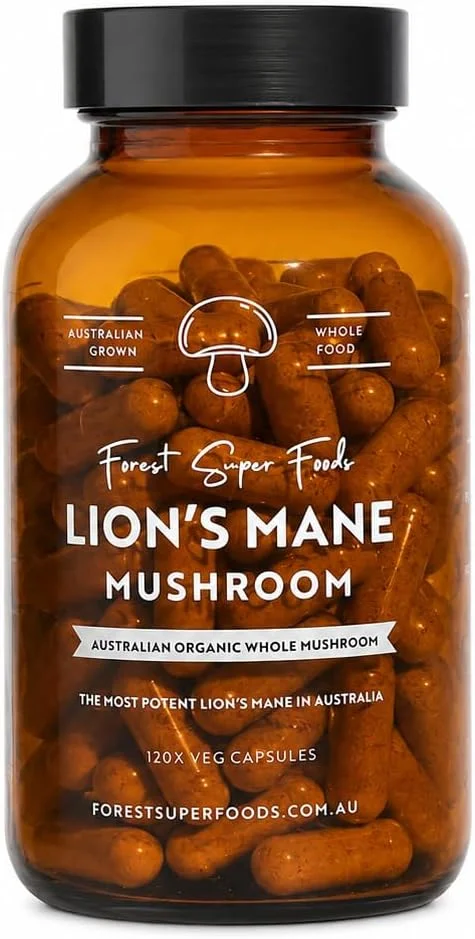
Forest Super Foods Australian Grown Lions Mane Mushroom Capsules
What it claims:
Lion's mane supports cognitive function, promotes nerve growth factor (NGF), and may reduce anxiety through Hericenone and Erinacine compounds in the fruiting body.
What the evidence says:
Mori K et al. (2009, Phytother Res) — 1,000mg/day, n=30, 16 weeks, statistically significant MMSE improvement vs placebo (p<0.001) at weeks 8 and 16. Nagano M et al. (2010, Biomed Res) — 2,000mg/day, n=30, 4 weeks, significant reduction in depression/anxiety symptoms in perimenopausal women. NGF-stimulation mechanism documented in vitro: Kawagishi H & Zhuang C (2008, Chem Rec). Note: these are small trials; effects are real but effect sizes are modest.
scored
Australian-grown lion's mane at the clinically studied dose — the most accessible way to replicate the Mori et al. (2009) protocol on Amazon AU.
Forest Super Foods Australian Grown Lions Mane Mushroom Capsules
- 120 capsules × 500mg = 60-day supply at 1,000mg/day dose
- Australian-grown Hericium erinaceus fruiting body
- 500mg per capsule — 2 capsules matches Mori et al. (2009) dose
- No fillers, binders, or synthetic additives listed
- AUD $89 on Amazon AU
- Australian-grown fruiting body — not imported mycelium-on-grain
- 500mg per capsule makes dose titration straightforward: 2 caps = 1,000mg (Mori protocol)
- 120-capsule pack = 60-day supply at study dose, giving the minimum 8-week window
- No synthetic additives listed
- Amazon AU Prime delivery — verified AU stock
- $89 for 120 capsules ($1.48/day at 1,000mg) — higher per-serve cost than imported options
- No third-party lab data published on product listing — cannot independently verify beta-glucan content
- Cognitive effects take 4–8 weeks minimum to emerge (Mori et al., 2009)
- Not suitable for acute focus or pre-workout use — slow-onset mechanism only
We've researched this product using publicly available brand specifications, published research on its active ingredients, and verified Amazon AU listing data. Physical testing is in progress and scored criteria will follow.
Score pending · Research-based analysis.
| Factor | Study / Protocol | Daily Dose | Duration | Outcome | Capsule equivalent |
|---|---|---|---|---|---|
| Mori et al. 2009 — cognition | 1,000mg (4×250mg tabs) | 16 weeks | MMSE ↑ vs placebo, p<0.001 | 2 × Forest SF 500mg caps | |
| Nagano et al. 2010 — anxiety | 2,000mg (4×500mg) | 4 weeks | Depression/anxiety ↓ | 4 × Forest SF 500mg caps | |
| Saitsu et al. 2019 — sleep/cognition | 1,800mg (6×300mg) | 8 weeks | Significant cognitive score improvement | ~3–4 × Forest SF 500mg caps | |
| Common AU supplement label dose | 1,000–2,000mg | Ongoing | Reflects study range | 2–4 × Forest SF 500mg caps | |
| Minimum evidence-based dose | 1,000mg/day | ≥8 weeks | Below this: no confirmed benefit | 2 × Forest SF 500mg caps |
What Dose Did the Studies Actually Use?
The most-cited human trial for lion's mane cognition is Mori K et al. (2009, Phytother Res), which used 1,000mg per day of Hericium erinaceus dry powder divided into four 250mg tablets, taken with meals over 16 weeks. Participants were 30 adults aged 50–80 with mild cognitive impairment. The treatment group showed statistically significant improvement on the Mini-Mental State Examination (MMSE) at weeks 8, 12, and 16 compared to placebo (p<0.001). Critically, cognitive scores returned toward baseline four weeks after discontinuing supplementation — indicating the effect is dependent on continued use.
Nagano M et al. (2010, Biomed Res) used a higher dose — 2,000mg per day (four 500mg tablets) over four weeks — and found significant reductions in depression, anxiety, and sleep complaints in perimenopausal women (n=30). The higher dose produced psychological benefits over a shorter timeframe, but the study population and endpoint differ from the Mori cognition trial.
Saitsu Y et al. (2019, Biomed Res) used 1,800mg per day over eight weeks in healthy older adults (n=31) and found significant improvement on a Japanese cognitive screening test. This trial is notable because it used apparently healthy participants (not those with diagnosed impairment), suggesting benefit may extend beyond clinical populations.
The practical dose range supported by published human trials is 1,000–2,000mg per day of dried lion's mane extract taken with food over a minimum of 8 weeks. Studies below 8 weeks have not consistently shown cognitive effects.
Why the Source and Form of Lion's Mane Matters for Dose
Not all lion's mane products deliver equivalent bioactive content per gram. The key distinction is between fruiting body extract and mycelium-on-grain (MOG). Mycelium-on-grain products are grown on cereal substrate; the final product contains both mycelium and undigested grain starch. When a label states '500mg lion's mane', a MOG product may contain 40–60% filler starch, delivering meaningfully less active compound per capsule than a fruiting body extract at the same listed dose.
Beta-glucan content is the most reliable proxy for active compound density. Fruiting body lion's mane typically yields 25–40% beta-glucans by weight; MOG products often test at 5–15%. Some third-party test data (Nammex, 2020) have found popular MOG products delivering as little as 5% beta-glucans — suggesting the effective dose is two to four times lower than the label implies.
Forest Super Foods lists Australian-grown fruiting body — not mycelium — which aligns with the research-grade material used in published trials. Without a published Certificate of Analysis, the beta-glucan content cannot be independently verified, but fruiting body sourcing is the correct starting point for matching the study protocol.
The practical implication: if you are using a MOG-based product and seeing no effect at 1,000mg/day, dose is likely the problem rather than lion's mane itself. Switching to a verified fruiting body extract and increasing to 2,000mg/day for 12 weeks is the evidence-based troubleshooting step.
When to Take Lion's Mane and What to Expect
Timing is not tightly controlled in human trials — most studies used split doses with meals (two to four times daily with food). Morning dosing with breakfast is the most common real-world protocol and avoids any theoretical interference with sleep. There is no clinical evidence for pre-workout lion's mane timing; the slow-onset mechanism (NGF synthesis requires days to weeks) makes it biologically implausible as an acute enhancer.
Expected onset: Mori et al. (2009) saw statistically significant separation from placebo at week 8 — not week 2 or 4. Most users report noticing changes in mental clarity or word retrieval at 4–8 weeks. If you reach week 12 at the correct dose with a fruiting body product and notice no difference, lion's mane may not be an effective intervention for you individually. There is no established predictor of non-responder status.
Cycling: the Mori study showed cognitive scores declined toward baseline 4 weeks after stopping. This suggests continuous use is required to maintain benefit — consistent with lion's mane's mechanism being dependent on ongoing NGF signalling rather than any cumulative structural change. There is no evidence-based rationale for cycling lion's mane; it is not a stimulant and has no known downregulation mechanism.
Further Reading
Frequently Asked Questions
8 questionsHow much lion's mane should I take per day?
1,000mg per day is the dose used in the primary cognitive trial (Mori K et al., 2009, n=30, 16 weeks) and produced statistically significant MMSE improvement. 2,000mg per day was used in Nagano et al. (2010) for anxiety/depression in perimenopausal women. Both studies used dried fruiting body extract with meals. The minimum effective dose supported by human trials is 1,000mg/day over at least 8 weeks. Below 1,000mg/day, no human trial has confirmed cognitive benefit.
How long does lion's mane take to work?
At least 8 weeks at the correct dose. Mori K et al. (2009) found statistically significant cognitive improvement at week 8 (the first measured timepoint showing separation from placebo) continuing through week 16. Cognitive scores returned toward baseline 4 weeks after stopping. Nagano et al. (2010) found anxiety/depression benefits at 4 weeks with a 2,000mg dose. Lion's mane is not an acute cognitive enhancer — its mechanism (NGF stimulation) is a slow biological process.
Is lion's mane safe to take every day?
Yes, based on published trial data. Mori et al. (2009) ran 16 weeks of daily 1,000mg use without reported adverse effects. Nagano et al. (2010) ran 4 weeks at 2,000mg without safety signals. Long-term safety (beyond 16 weeks continuous use) has not been formally studied in large human trials. Rare allergic reactions have been reported in people with mushroom allergies. TGA-listed lion's mane products in Australia can be taken daily; consult a GP if you are immunocompromised or on immunosuppressant medication.
What is the difference between lion's mane fruiting body and mycelium?
Fruiting body is the visible mushroom structure — the part containing the highest concentration of bioactive beta-glucans and Hericenones. Mycelium-on-grain (MOG) is the root-like growth stage grown on cereal substrate; the final product contains both mycelium and undigested grain starch. Third-party testing (Nammex, 2020) found MOG products averaging ~5% beta-glucans vs 25–40% in fruiting body extracts. Published human trials used fruiting body material. For matching the study dose, fruiting body extract is the appropriate product form.
Can I take lion's mane with coffee?
Yes. There is no known pharmacological interaction between lion's mane and caffeine. Many users combine lion's mane capsules or powder with morning coffee without reported adverse effects. Wild Brew and similar mushroom coffee blends incorporate lion's mane into coffee for convenience, though the lion's mane dose per serve in blended coffees (typically 100–250mg) is below the 1,000mg studied in clinical trials. For the clinical dose, dedicated capsules alongside coffee is more reliable.
Does lion's mane actually work for brain fog?
Evidence is moderate. Published human trials have shown cognitive improvements on formal testing (MMSE, Stroop, cognitive screening) at 1,000–2,000mg per day over 4–16 weeks. Subjective 'brain fog' is not a formal endpoint in these trials. The mechanism — nerve growth factor (NGF) stimulation promoting neuronal maintenance and repair — is biologically plausible for improving cognitive clarity. Effect sizes in trials are real but not dramatic; lion's mane is not a pharmaceutical-grade nootropic. Expect gradual improvement over weeks, not days.
What happens if I stop taking lion's mane?
Cognitive improvements reverse toward baseline within 4 weeks of stopping, based on Mori et al. (2009), which followed participants for 4 weeks post-trial. This indicates the benefit requires continued supplementation. Unlike stimulants, there is no documented withdrawal effect — cognitive function returns to pre-supplementation baseline, not below it. There is no evidence-based reason to cycle lion's mane; it does not cause receptor downregulation and is not habit-forming.
Where can I buy lion's mane capsules in Australia?
Forest Super Foods Australian Grown Lions Mane Mushroom Capsules are available on Amazon AU with Prime delivery. They are one of the few Australian-grown fruiting body options on Amazon AU — most imported alternatives use mycelium-on-grain. At $89 for 120 capsules (500mg each), two capsules per day delivers the 1,000mg Mori et al. (2009) dose for 60 days. Health food stores (Mr Vitamins, The Vitamin Shoppe, iHerb AU) also stock various lion's mane products.
Our Research Framework
Every product on this site is assessed against the same criteria — brand specifications, published clinical evidence, and verified Australian availability. We don't accept free products. Full methodology →