Mushroom tea wins for caffeine-sensitive users, evening consumption, and anyone seeking pure adaptogenic benefit without a stimulant load. Tea is caffeine-free, doseable throughout the day, and — when made from a dual-extract — delivers beta-glucans and triterpenes without the cortisol spike that caffeine introduces in some users.
Mushroom coffee is the stronger choice if your goal is a single-product coffee replacement. The well-documented ergogenic effects of caffeine (alertness, reaction time, performance) combine with functional mushroom extracts in one drink. You trade timing flexibility for habit convenience.
The critical caveat: bioavailability differences between tea-steeped mushroom extracts and encapsulated or blended coffee-format extracts remain uncharacterised in peer-reviewed literature. This assessment is based on brand specifications and published research; we have not yet conducted our analysis of published specifications.
This article contains affiliate links. We earn a commission if you purchase through our links, at no extra cost to you. Our rankings are never influenced by commissions. Full disclosure →
Testing status: Researched. This comparison is based on brand specifications, published nutritional research, and verified Amazon AU product listings. research-based sensory and compound testing has not yet been conducted for this article.
The Core Difference: Caffeine and Compound Delivery
The meaningful distinction between mushroom tea and mushroom coffee is not which mushroom species is used — it is the caffeine substrate and what that changes about usage, timing, and physiological response. Mushroom coffee is functional mushroom extract blended into — or used as a partial substitute for — ground coffee. The result retains caffeine, typically 50–80mg per serve. Mushroom tea is functional mushroom extract delivered in a caffeine-free format, either as a loose brew, tea bags, or a liquid extract diluted in hot water.
Caffeine matters for two reasons. First, it has its own well-documented effects on alertness, adenosine receptor blockade, and cortisol. For users managing HPA axis dysregulation, adrenal fatigue patterns, or anxiety, adding caffeine to an adaptogenic supplement partially counteracts the purpose. Second, caffeine limits timing. A mushroom coffee at 3pm can disrupt sleep onset in caffeine-sensitive individuals; mushroom tea has no such constraint and can be consumed morning through evening.
The functional mushroom compounds themselves — beta-glucans, triterpenes (in reishi), erinacines and hericenones (in lion's mane) — are the same whether in tea or coffee format. What varies is extraction method and dose. Many mushroom coffee products use spray-dried extract added to coffee grounds; the extract quality depends on whether it is a dual-extract (hot water plus alcohol) or a hot-water-only extract. Hot water extraction concentrates polysaccharides and beta-glucans well. Alcohol extraction is required to pull triterpenes (the immunomodulatory compounds in reishi). A product that uses hot-water-only extraction delivers beta-glucans but misses the triterpene fraction.
The extraction method matters more than the format. A dual-extract reishi tea bag delivers more complete bioactives than a mushroom coffee product using hot-water-only extract — regardless of the caffeine content difference. Check extraction methodology, not just the species on the label.
Mushroom Tea vs Mushroom Coffee: Key Differences
| Factor | Mushroom Tea More Versatile | Mushroom Coffee |
|---|---|---|
| Caffeine content | 0mg (caffeine-free) | 50–80mg per serve |
| Primary compounds | Beta-glucans, triterpenes (reishi), erinacines (lion's mane) | Beta-glucans + caffeine + chlorogenic acids (from coffee) |
| Best evidence for | Immune modulation (reishi), NGF stimulation (lion's mane) | Alertness, cognitive performance (caffeine); secondary adaptogenic benefit |
| Preparation time | 3–5 min (tea bags); 30 sec (liquid extract in hot water) | 3–5 min (same as standard coffee brew) |
| Cost per serve (AUD, est.) | $0.60–$2.50 AUD | $1.20–$3.50 AUD |
| Best use case | Evening wind-down, caffeine-sensitive users, stacking with adaptogens | Morning focus, coffee habit replacement, ergogenic pre-work ritual |
Products
#1 Primary Pick
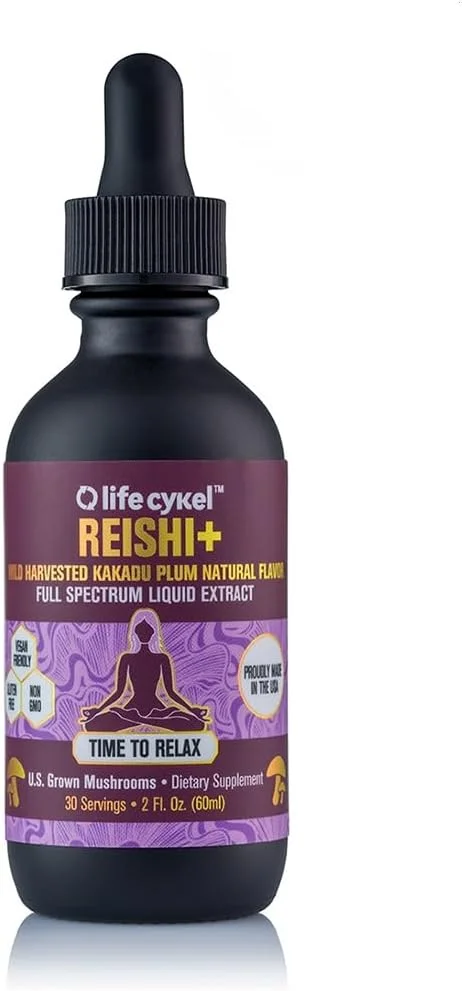
Life Cykel is an Australian brand using dual-extraction — both hot water and alcohol — which is the critical distinction when evaluating reishi products. Dual-extraction captures the polysaccharide fraction (beta-glucans) via hot water and the triterpene fraction (including ganoderic acids) via alcohol. Single-extraction products using hot water alone miss the triterpene fraction, which is where reishi's documented immunomodulatory activity sits. Wachtel-Galor's 2011 review of Ganoderma lucidum identifies triterpenoids alongside polysaccharides as the primary bioactive classes — a dual-extract is the format consistent with that evidence base.
The dropper format is practical for dose control. The 60ml bottle delivers approximately 60 daily servings at a 1ml dose (or 30 at 2ml), making it the most cost-efficient reishi delivery method in this group when used at lower doses. Diluted in 200–300ml of hot water, it functions as a functional mushroom tea with better extraction consistency than most tea bag products. Life Cykel publishes the substrate (Australian-grown) and extraction method on their packaging, which is a meaningful transparency commitment compared to many grey-market import products.
The limitation is the absence of a published beta-glucan percentage on the standard Amazon AU listing. For users who want a specific beta-glucan dose, a product that publishes this figure provides clearer dosing certainty. That said, dual-extraction methodology from a reputable Australian brand is a stronger quality signal than a single-extraction product with a stated beta-glucan percentage.
Pros
- Dual-extraction captures both beta-glucan and triterpene fractions
- Australian brand with transparent substrate and extraction methodology
- Dropper format enables precise dose control
- Caffeine-free — suitable any time of day
Cons
- Beta-glucan percentage not published on standard listing
- 60ml is a small bottle — requires regular reorder at higher doses
- Higher cost per serve than tea bag alternatives
- Liquid extract format not as convenient for travel as capsules or bags
#2 Budget Pick
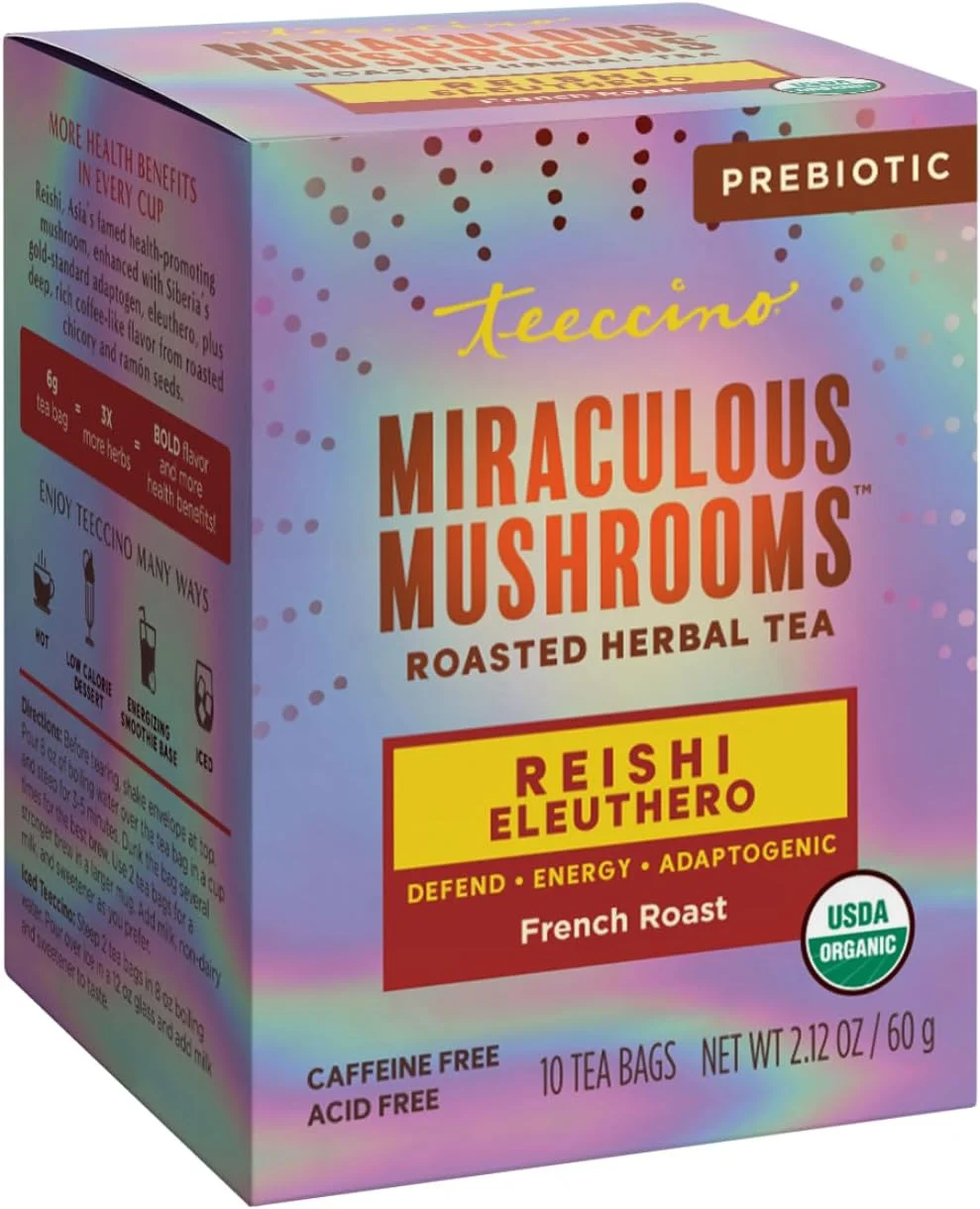
Teeccino Mushroom Herbal Tea is a reishi-forward blend combining functional mushrooms with eleuthero (Siberian ginseng) and chicory root. The chicory base creates a roasted, slightly bitter flavour profile that approximates coffee without any caffeine — making it a direct mushroom coffee alternative for anyone avoiding stimulants. Eleuthero is an adaptogen with a modest human evidence base for physical endurance and stress modulation, documented primarily in Soviet-era and Eastern European research.
The key limitation of any tea bag product is extraction quality. Hot water steeping extracts polysaccharides and water-soluble compounds reasonably well, but does not extract triterpenes — the alcohol-soluble bioactive class in reishi that accounts for a significant portion of its documented immunomodulatory activity. Tea bags are a practical entry point for mushroom tea, but users seeking the full compound profile of reishi should look at a dual-extract product.
At approximately $0.60–$0.80 per bag on Amazon AU (based on standard listing price), Teeccino is the most accessible entry point in this comparison. For someone transitioning away from coffee or exploring functional mushroom tea for the first time, the familiar flavour profile and caffeine-free claim makes it a practical starting point. The 25-bag format provides roughly a month of daily use.
Pros
- Caffeine-free coffee alternative — chicory base mimics roasted flavour
- Most affordable option in this comparison
- No preparation beyond hot water — minimal friction
- Eleuthero adds secondary adaptogenic compound
Cons
- Tea bag format: hot water only — misses triterpene fraction
- Reishi dose per bag not quantified on listing
- Blend dilutes the reishi with eleuthero and chicory
- Eleuthero evidence base weaker than reishi or lion's mane
#3 Upgrade Pick — Variety
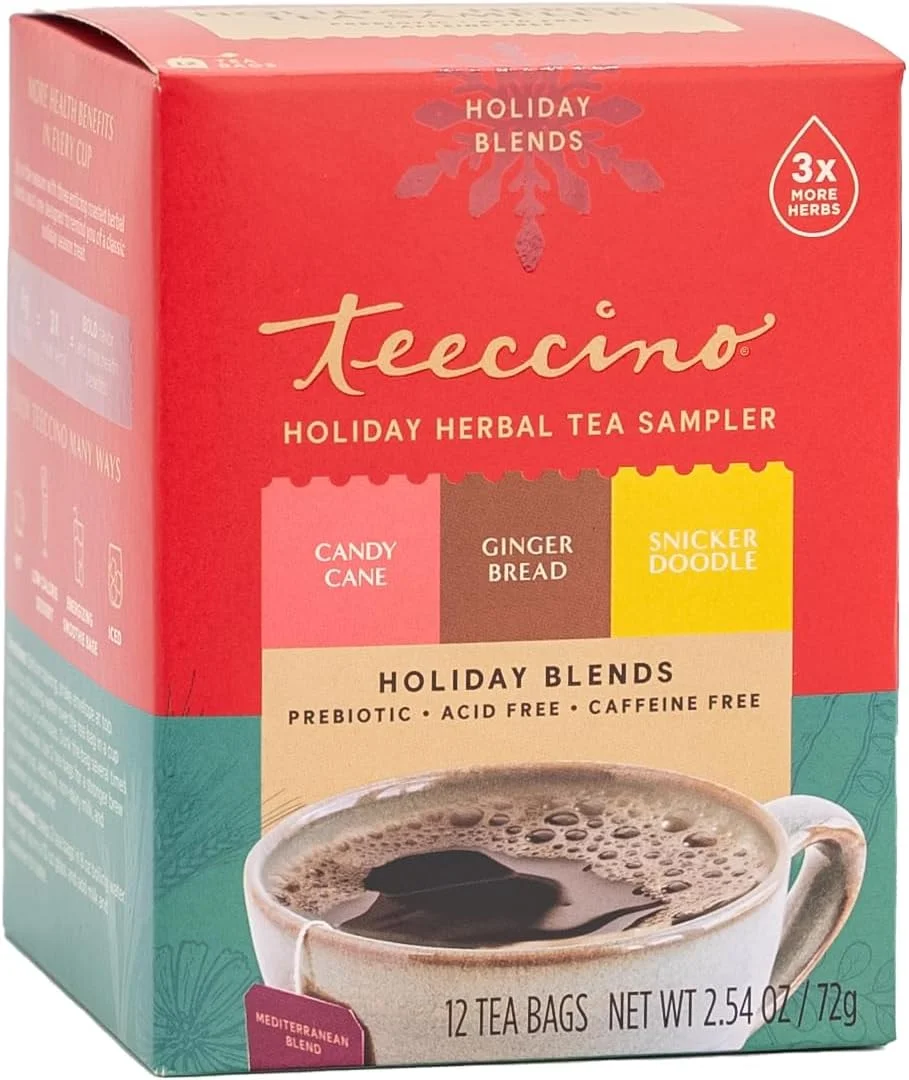
The Mushroom Tea Variety Pack covers four species including chaga and lion's mane — useful for establishing which functional mushroom profile suits a given goal before committing to a single-species product. Chaga (Inonotus obliquus) is rich in betulinic acid and beta-glucans and is highly water-soluble, making it one of the species that translates reasonably well to tea format without dual-extraction. Lion's mane in tea format is the weakest of the four for the reasons noted above — erinacines are fat-soluble and require dual-extraction for full compound capture.
A variety pack format is specifically valuable for new users of functional mushroom tea who want to identify preference and tolerance before investing in a single-species product. The per-bag cost is higher than Teeccino, but the multi-species coverage justifies the premium if species-matching to specific goals is the intent — for instance, chaga in the morning for antioxidant activity and reishi in the evening for immune support.
The primary limitation is the same as any tea bag product: extraction is hot-water-only, which is adequate for chaga and reishi polysaccharides but insufficient for full triterpene capture. For users who want to explore four mushroom species across a month before committing to a dual-extract single product, this is a sensible starting position.
Pros
- Four species including chaga and lion's mane — broadest species coverage
- Useful for identifying species preference before single-product commitment
- Chaga is well-suited to tea format (water-soluble compounds)
- Caffeine-free throughout the range
Cons
- Tea bag only — hot water extraction misses fat-soluble compounds
- Individual species dose per bag not published
- Higher cost per serve than Teeccino
- Lion's mane in tea format has limited bioavailability advantage over capsules
Decision Matrix
| Your Situation | Best Pick | Why |
|---|---|---|
| Caffeine-sensitive or managing anxiety | Mushroom Tea (any) | Zero caffeine; no cortisol spike; can be used any time of day |
| Want to replace morning coffee habit | Mushroom Coffee | Caffeine maintains alertness ritual; functional mushrooms stack on top |
| Evening immune support / wind-down | Life Cykel Reishi Liquid Extract | Dual-extract reishi; caffeine-free; evening-safe; best compound profile |
| Budget under $30 for a month | Teeccino Mushroom Herbal Tea | ~$0.60–$0.80 per bag; 25-bag pack; lowest cost entry to mushroom tea |
| Exploring multiple mushroom species | Mushroom Tea Variety Pack | Four species in one purchase; identify preference before committing |
| Immune modulation with full compound profile | Life Cykel Reishi Liquid Extract | Dual-extraction captures triterpenes and beta-glucans; Gao et al. 2004 evidence base |
| Acute cognitive focus needed | Mushroom Coffee (see our mushroom coffee guide) | Caffeine's acute cognitive effects dominate; lion's mane NGF is long-term not acute |
| Stacking with other adaptogens | Mushroom Tea (any) | Caffeine-free means no interaction with cortisol-modulating adaptogens like ashwagandha |
What to Look For When Buying Mushroom Tea
Extraction method
The single most important quality signal. Hot water extraction captures polysaccharides (beta-glucans) but not fat-soluble triterpenes. Dual-extraction (hot water plus alcohol) captures both fractions. For reishi specifically, the triterpene fraction is critical to the documented immunomodulatory activity. Tea bags use hot water only. Liquid extracts and encapsulated products may use dual-extraction — check the label.
Look for: "dual-extract" on labelFruiting body vs mycelium
Fruiting body extracts have a more established bioactive profile for functional use. Mycelium-on-grain products may contain 40–60% grain substrate by weight — a dilution problem that is not visible on the label. Reishi, chaga, and lion's mane products specifying "fruiting body" are more consistent with the evidence base than mycelium-on-grain alternatives. Some species (lion's mane) have relevant compounds in both fruiting body and mycelium; reishi evidence is primarily fruiting body.
Prefer: "fruiting body" over "mycelium"Dose transparency
The clinical trials with positive outcomes used specific doses: Gao et al. (2004) used 1.44g reishi polysaccharide extract daily; Mori et al. (2009) used 750mg lion's mane fruiting body powder daily. Products that do not publish a species-specific dose per serve make it impossible to compare against clinical evidence. A "proprietary blend" on the label with no individual species weights is a red flag for dose transparency.
Avoid: proprietary blend with no per-species doseCaffeine content for your goals
If immune support, stress adaptation, or evening use is the goal, caffeine-free mushroom tea is the more appropriate format. If morning alertness is the primary goal, mushroom coffee may be adequate. The mistake is adding caffeine to an adaptogenic protocol designed to reduce cortisol and HPA axis reactivity — the stimulant partially counteracts the adaptation effect. Read the adaptogen literature on our best adaptogens Australia guide before stacking.
Evening / adaptogenic use → caffeine-free onlyFrequently Asked Questions
Does mushroom tea have caffeine?
No — pure mushroom tea contains no caffeine. Functional mushrooms (reishi, chaga, lion's mane) are caffeine-free; the caffeine content in any mushroom drink comes solely from any added tea base (black, green, or matcha) or coffee. Products such as Teeccino Mushroom Herbal Tea are explicitly caffeine-free, using chicory root and carob as the base. Mushroom coffee products, by contrast, typically contain 50–80mg of caffeine per serve from the underlying coffee component — roughly half the caffeine of a standard espresso.
Is mushroom tea or mushroom coffee better for focus?
Mushroom coffee has the stronger acute focus effect, primarily due to caffeine. Caffeine's cognitive effects — improved reaction time, alertness, and short-term working memory — are among the most replicated findings in nutritional science. Lion's mane mushroom, present in some mushroom coffee blends, stimulates nerve growth factor (NGF) synthesis per Mori et al. (2009), but this is a long-term neurological mechanism, not an acute focus mechanism. For immediate focus, the caffeine in mushroom coffee dominates. For longer-term cognitive support, lion's mane tea taken consistently over weeks to months may be more relevant.
Which has more beta-glucans — mushroom tea or mushroom coffee?
Neither form guarantees a specific beta-glucan dose — it depends on the mushroom species, extract quality, and dose per serve. A dual-extract mushroom product (hot water plus alcohol extraction) will typically deliver more beta-glucans than a simple tea bag infusion, because hot water extraction specifically concentrates polysaccharides including beta-glucans. Liquid extracts like Life Cykel Reishi use dual-extraction methodology. Single-serve tea bags use hot water steeping and may deliver lower and more variable beta-glucan concentrations. Brand specifications are the best source for product-specific claims.
Can you drink mushroom tea every day?
Yes — daily consumption of mushroom tea (reishi, chaga, lion's mane) is consistent with how functional mushrooms were used in traditional medicine and with protocols in clinical research. Gao et al. (2004, Journal of Medicinal Food) used reishi supplementation continuously across the trial period. Mori et al. (2009) used daily lion's mane supplementation for 16 weeks. Neither trial reported adverse events from daily use. Reishi at high doses (above approximately 2g/day standardised extract) has occasional reports of mild gastrointestinal effects in sensitive individuals — relevant for liquid extract users, less so for tea bags.
How long does mushroom tea take to work?
There is no established onset time for acute effects from functional mushroom tea — unlike caffeine, mushroom bioactives are not stimulants with measurable acute cognitive effects. Clinical trials examining reishi's immune modulation (Gao et al., 2004) ran for 12 weeks. Mori et al. (2009) measured lion's mane cognitive outcomes at 16 weeks. The mechanism is cumulative and requires consistent daily use over weeks to months. Anyone reporting an immediate effect from mushroom tea alone (without caffeine) is likely experiencing a placebo response or the effect of the warm liquid itself.
What is the best mushroom for tea?
Reishi (Ganoderma lucidum) has the strongest evidence base for tea-format consumption. Its primary bioactives — triterpenoids and polysaccharides — are released effectively via hot water extraction, the same mechanism used in tea brewing. Wachtel-Galor (2011, Herbal Medicine) documents reishi's immunomodulatory and adaptogenic properties; Gao et al. (2004) demonstrated immune function benefits in a 12-week clinical trial (n=41). Chaga (Inonotus obliquus) is also water-soluble and widely used as a tea. Lion's mane in tea format has a weaker evidence case, since erinacines — key NGF-stimulating compounds in the mycelium — are more fat-soluble and may require dual-extraction rather than simple hot water steeping.
Is mushroom tea safe during pregnancy?
No established safety data exists for functional mushroom tea during pregnancy. Reishi, chaga, and lion's mane have not been studied in pregnant populations; the clinical trials available excluded pregnant participants. This is not evidence of harm, but it is evidence of a data gap. Standard medical advice is to avoid supplements without established pregnancy safety data. Anyone who is pregnant should consult their GP or obstetrician before using functional mushroom products of any form, including tea.
Does mushroom coffee actually contain real mushrooms?
Yes — reputable mushroom coffee products contain genuine mushroom extracts, typically lion's mane, chaga, reishi, or cordyceps. The key quality question is extract type: fruiting body extract versus mycelium-on-grain. Mycelium-on-grain products may contain substantial grain substrate by weight, reducing the effective mushroom content per serve. Brands such as Four Sigmatic and Mud/Wtr use fruiting body extract and publish their beta-glucan content. The word "mushroom coffee" alone does not guarantee any particular dose or extract quality — checking the supplement facts panel for fruiting body sourcing and listed beta-glucan percentages is the reliable approach.
Methodology
This article is a research-based comparison. Product information was sourced from Amazon AU listings (verified July 2026). Research claims are referenced to peer-reviewed publications: Wachtel-Galor S (2011) Herbal Medicine — Ganoderma lucidum review; Gao Y et al. (2004) Journal of Medicinal Food — reishi immune function (n=41); Mori K et al. (2009) Phytotherapy Research — lion's mane NGF stimulation (n=30, 16 weeks).
Testing status: Researched. research-based product evaluation, sensory testing, and independent compound verification have not yet been conducted. We do not make claims beyond what the cited research and brand specifications support. For our full evaluation framework, see how we test functional wellness products.

Related Guides
For a ranked list of the best mushroom tea products available in Australia, see our functional mushroom tea guide. If you have decided mushroom coffee is the right format for your morning routine, the best mushroom coffee Australia guide covers the leading brands by extract quality and dose transparency. For the broader adaptogen category — including ashwagandha, rhodiola, and reishi in non-tea formats — see best adaptogens Australia. For a specific look at the top mushroom tea products by extract quality, the functional mushroom tea Australia guide ranks Life Cykel, Teeccino, and variety packs side by side. For caffeine-free green tea alternatives in the functional category, see best green tea Australia. For reishi specifically — the most studied adaptogenic mushroom — see reishi tea Australia.