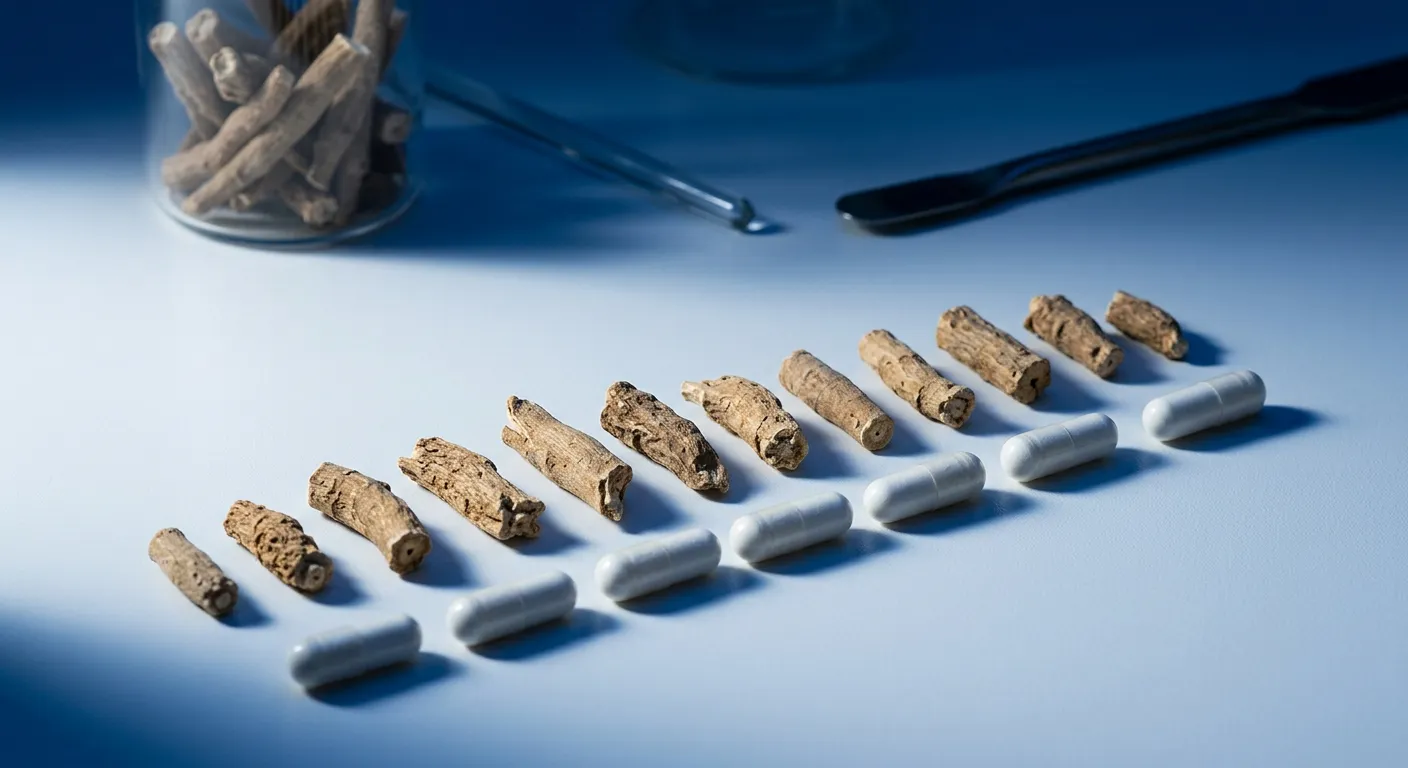
Ashwagandha reduces anxiety at 600mg per day of KSM-66 root extract, taken as 300mg twice daily with meals. This dose is supported by a 2012 double-blind RCT by Chandrasekhar K et al. (Indian J Psychol Med, n=64, 60 days) — the KSM-66 group reduced Perceived Stress Scale scores by 44% versus 5.5% for placebo, and serum cortisol fell 27.9% versus 7.9%. Anxiety and depression on the DASS improved significantly. A 2009 naturalistic trial by Cooley K et al. (PLOS ONE) found Beck Anxiety Inventory scores fell 56.5% versus 30.5% with standard care. The honest caveats: effects emerge at 8–12 weeks of consistent use, not days. The clinical evidence is specific to KSM-66 root extract — generic or undisclosed extract types are not interchangeable. Ashwagandha is contraindicated in thyroid conditions, autoimmune disease, and pregnancy, and interactions with sedatives, immunosuppressants, and thyroid medications are documented.
Alchemist Wellness participates in affiliate programmes including Amazon Associates. If you purchase through a link on this page, we may earn a commission at no extra cost to you. This does not influence our editorial recommendations. Full disclosure.
Review status: This article is evidence-based, drawing on brand specifications, published clinical research, and verified Amazon AU listing data.
Products Reviewed
Blackmores Ashwagandha+ 60 Tablets
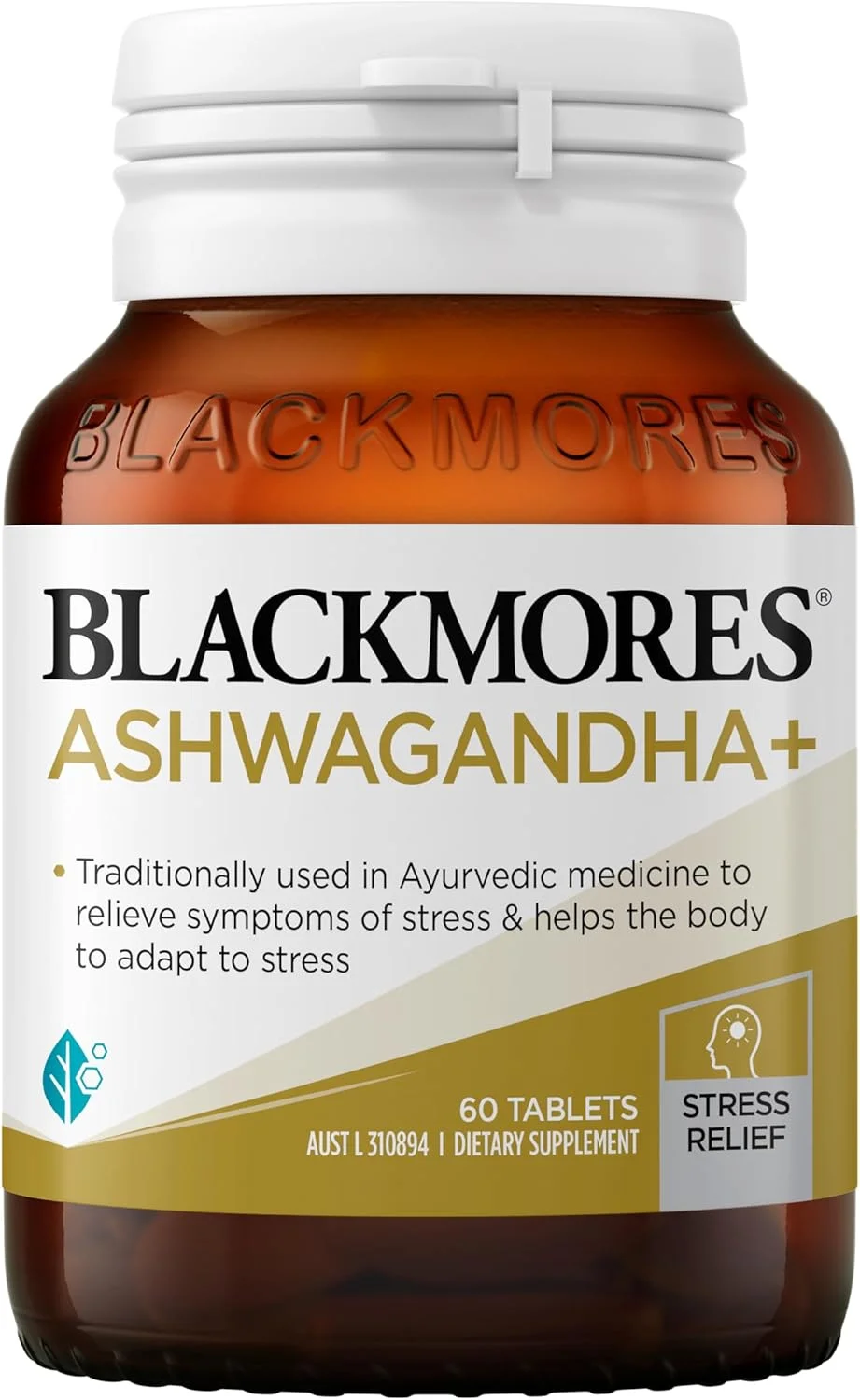
Blackmores Ashwagandha+ 60 Tablets
What it claims:
Blackmores Ashwagandha+ is marketed to support stress and anxiety management, and to help the body adapt to stress.
What the evidence says:
Chandrasekhar K et al. (2012, Indian J Psychol Med) — KSM-66 ashwagandha root extract, 300mg twice daily (600mg/day), n=64, 60-day double-blind RCT. PSS score reduced 44% vs 5.5% placebo; serum cortisol reduced 27.9% vs 7.9% placebo; DASS anxiety and depression significantly improved. Pratte MA et al. (2014, J Altern Complement Med) — systematic review of 5 human trials, dose range 125mg–5g/day, all studies showed stress/anxiety reduction. Andrade C et al. (2000, J Clin Psychiatry) — 500mg/day, lorazepam-equivalent anxiolytic effect documented via GABA-mimicry mechanism.
scored
KSM-66 ashwagandha from Australia's most trusted pharmacy brand — the closest shelf-available match to the Chandrasekhar 2012 clinical protocol.
Blackmores Ashwagandha+ 60 Tablets
- Contains KSM-66 ashwagandha root extract — the form used in the primary anxiety RCT
- Blackmores is TGA-listed and stocked in every Australian Chemist Warehouse and Priceline
- 60 tablets — 30-day supply at two tablets per day (study dose)
- AU$15 — the lowest cost-per-dose among KSM-66 products on Amazon AU
- Manufactured to Australian GMP standards
- KSM-66 root extract — the clinically validated form used in Chandrasekhar K et al. (2012)
- TGA-listed product — label claims are regulated under Australian therapeutic goods law
- AU$15 for 60 tablets delivers the study dose for $0.50/day — lowest cost-per-dose for a KSM-66 option
- Available in-store at Chemist Warehouse and Priceline — no delivery wait to start the protocol
- 60-tablet pack covers only 30 days — the clinical trial ran 60 days minimum; you will need two packs
- Tablet form may not suit those with swallowing difficulty (capsule alternatives exist)
- Not suitable for thyroid conditions, autoimmune disease, or pregnancy — no substitute exists; avoid entirely
We've researched this product using publicly available brand specifications, published research on its active ingredients, and verified Amazon AU listing data. Physical testing is in progress and scored criteria will follow.
Score pending · Research-based analysis.
Healthy Care High Strength Ashwagandha 60 Tablets
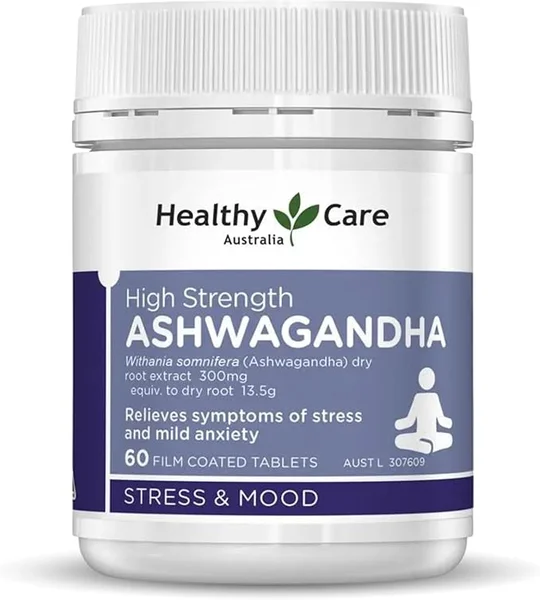
Healthy Care High Strength Ashwagandha 60 Tablets
What it claims:
Healthy Care Ashwagandha is marketed as a high-strength adaptogen to help manage stress and support general wellbeing.
What the evidence says:
Clinical evidence for ashwagandha anxiety outcomes is tied to standardised extracts, primarily KSM-66 and Sensoril. Chandrasekhar K et al. (2012) used KSM-66 at 600mg/day. Without confirmed extract standardisation, this product cannot be directly mapped to that evidence base. Pratte MA et al. (2014, J Altern Complement Med) systematic review included trials using various ashwagandha preparations — all showed stress reduction, but effect sizes varied with extract quality and dose. Use this product as a cost-effective starting point; if response is insufficient at 8 weeks, switching to a confirmed KSM-66 extract is the evidence-based next step.
scored
The lowest-cost entry point for ashwagandha in Australia — reasonable for initial trialling, but extract type is unspecified.
Healthy Care High Strength Ashwagandha 60 Tablets
- AU$9.29 for 60 tablets — cheapest per-tablet price among the three options
- Healthy Care is a widely stocked Australian supplement brand
- High-strength formulation per label
- 60 tablets — 30-day supply at the two-tablet daily dose
- Available on Amazon AU Prime
- AU$9.29 for 60 tablets ($0.31/day) — significantly cheaper than KSM-66-labelled alternatives
- Healthy Care has broad AU pharmacy and online distribution — easy to restock
- High-strength label claim suggests higher root equivalent per tablet than standard products
- Suitable for a low-cost initial trial before committing to a premium extract
- Extract type not specified as KSM-66 or Sensoril — cannot confirm equivalence to clinical evidence
- No published Certificate of Analysis or withanolide percentage listed — active compound content unverified
- Not suitable for thyroid conditions, autoimmune disease, or pregnancy — no exceptions
We've researched this product using publicly available brand specifications, published research on its active ingredients, and verified Amazon AU listing data. Physical testing is in progress and scored criteria will follow.
Score pending · Research-based analysis.
Swisse Ashwagandha Calm+ 60 Tablets
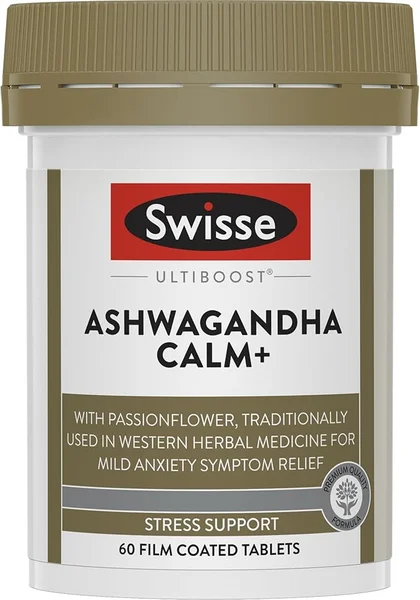
Swisse Ashwagandha Calm+ 60 Tablets
What it claims:
Swisse Ashwagandha Calm+ is marketed to support stress relief, anxiety management, and calm mental state.
What the evidence says:
Chandrasekhar K et al. (2012, Indian J Psychol Med) — the primary evidence anchor for ashwagandha anxiety benefits used KSM-66 at 600mg/day. Cooley K et al. (2009, PLOS ONE) — naturopathic care protocol including ashwagandha reduced Beck Anxiety Inventory by 56.5% vs 30.5% with standard care. Andrade C et al. (2000, J Clin Psychiatry) — 500mg/day ashwagandha showed lorazepam-equivalent anxiolytic effect. Swisse's Calm+ formulation should be cross-referenced with the TGA listing for extract type and withanolide standardisation.
scored
Swisse's premium ashwagandha formulation — Calm+ positioning with added botanicals for those who want a broader adaptogen blend.
Swisse Ashwagandha Calm+ 60 Tablets
- Swisse Calm+ formulation designed for stress and anxiety support
- Swisse is one of Australia's most recognised wellness brands
- 60 tablets — 30-day supply at standard dosing
- AU$16.24 — comparable to the Blackmores option in price
- TGA-listed Australian supplement
- Swisse is a TGA-listed Australian brand with strong pharmacy and retail distribution
- Calm+ formulation may include complementary botanicals for broader stress support
- AU$16.24 is competitive with other mid-range AU ashwagandha options
- Swisse's AU manufacturing and quality standards are well-established in the local market
- Marginally more expensive than the Blackmores KSM-66 option without a confirmed extract-type advantage
- Companion botanicals in the Calm+ blend may complicate attribution if adverse reactions occur
- Not suitable for thyroid conditions, autoimmune disease, pregnancy, or concurrent sedative/immunosuppressant use
We've researched this product using publicly available brand specifications, published research on its active ingredients, and verified Amazon AU listing data. Physical testing is in progress and scored criteria will follow.
Score pending · Research-based analysis.
| Factor | Extract type | Study dose match | Cortisol evidence | Price/60 tabs | TGA scheduling | Best for |
|---|---|---|---|---|---|---|
| Blackmores Ashwagandha+ | KSM-66 root extract | Yes — 2 tabs = 600mg/day (Chandrasekhar 2012 dose) | KSM-66 reduced cortisol 27.9% vs 7.9% placebo | AU$15.00 | TGA-listed supplement | Most buyers — best KSM-66 value with pharmacy convenience |
| Healthy Care High Strength | Unspecified extract | Unconfirmed — extract type not declared | Not directly mappable to cortisol RCT data | AU$9.29 | TGA-listed supplement | Cost-sensitive trialling before committing to premium extract |
| Swisse Ashwagandha Calm+ | Unconfirmed — check TGA listing | Unconfirmed — verify dose and extract on label | Not confirmed without extract-type disclosure | AU$16.24 | TGA-listed supplement | Swisse brand loyalists or those wanting a broader Calm+ blend |
How Ashwagandha Reduces Anxiety: HPA Axis and Cortisol Mechanism
Ashwagandha's anxiolytic effect operates primarily through the hypothalamic-pituitary-adrenal (HPA) axis — the neuroendocrine system that regulates the body's cortisol stress response. Under chronic stress, the HPA axis becomes dysregulated: corticotropin-releasing hormone (CRH) from the hypothalamus drives excess ACTH release from the pituitary, which in turn drives sustained cortisol output from the adrenal glands. Chronically elevated cortisol is associated with anxiety symptoms, sleep disruption, and impaired cognitive function.
Withanolides, the primary bioactive compounds in ashwagandha root extract, appear to modulate HPA axis activity through two documented mechanisms. First, they suppress cortisol secretion directly at the adrenal level and reduce the hypothalamic sensitivity to stressors — the Chandrasekhar 2012 trial measured a 27.9% reduction in serum cortisol after 60 days of KSM-66 at 600mg/day, versus 7.9% in the placebo group. Second, withanolides interact with GABA-A receptors in a manner structurally similar to benzodiazepines — Andrade C et al. (2000, J Clin Psychiatry) documented lorazepam-equivalent anxiolytic potency at 500mg/day, with the effect attributed to this GABAergic activity rather than sedation.
A third mechanism involves triethylene glycol, another compound isolated from ashwagandha leaf, which has shown sleep-inducing activity in animal models — potentially relevant to anxiety associated with insomnia. However, root extracts (the form used in all cited human trials) contain lower triethylene glycol concentrations than leaf extracts, and this pathway is considered secondary.
The practical implication of the HPA mechanism is that effects are not acute. Cortisol suppression via HPA modulation develops over weeks of consistent dosing — the Chandrasekhar trial showed statistically significant separation from placebo at day 60, not day 14. Expecting anxiety relief within the first two weeks is inconsistent with the documented mechanism.
KSM-66 vs Sensoril vs Generic Extract: Does the Form Matter?
Not all ashwagandha supplements are equivalent, and the evidence base is concentrated in two proprietary extracts: KSM-66 (Ixoreal Biomed) and Sensoril (Natreon Inc). KSM-66 is a root-only extract standardised to at least 5% withanolides, produced via a patented extraction process that preserves the full-spectrum alkaloid and withanolide profile. Sensoril uses both root and leaf material and is standardised to a higher withanolide concentration (10%), but at a lower studied dose. The distinction matters because clinical trials use these specific extracts — results cannot be automatically extrapolated to generic ashwagandha powder or undisclosed extract types.
Chandrasekhar K et al. (2012) — the most-cited anxiety RCT — used KSM-66 exclusively. The 44% PSS reduction and 27.9% cortisol drop are KSM-66 outcomes. A separately published Sensoril trial (Auddy B et al., 2008, J Am Nutraceut Assoc) using 125–250mg/day found significant cortisol and anxiety reductions, but at a different dose and extract concentration. Pratte MA et al.'s 2014 systematic review across five trials found consistent stress and anxiety reduction regardless of preparation, but noted that extract type and dose were significant variables in effect size.
Generic ashwagandha products — those not specifying KSM-66, Sensoril, or a documented withanolide percentage — are the highest-risk category for clinical irrelevance. A product labelled '500mg ashwagandha root powder' with no standardisation claim may deliver less than 1% withanolides. The Healthy Care product in this review falls into this category; it is not necessarily ineffective, but its efficacy cannot be predicted from the clinical literature.
For Australian buyers: Blackmores Ashwagandha+ declares KSM-66 — the recommendation for anyone prioritising evidence alignment. If you are comparing other products not listed here, look for 'KSM-66' or 'Sensoril' on the label and a minimum 5% withanolide standardisation. If neither appears, treat the product as unvalidated relative to the clinical evidence base.
What to Realistically Expect: Onset, Effect Size, and Who It Won't Help
The Chandrasekhar 2012 trial ran 60 days and showed statistically significant anxiety improvement by endpoint. In practice, most users report initial subjective changes — reduced reactivity to stressors, improved sleep onset, calmer baseline — at 4–6 weeks of consistent daily use. Expecting acute, session-to-session effects is not supported by the evidence; ashwagandha is not an anxiolytic in the pharmaceutical sense and does not produce the immediate calming effect of benzodiazepines or even L-theanine.
On effect size: the 44% PSS reduction in Chandrasekhar 2012 is impressive on paper, but the PSS is a self-reported scale, and the baseline population was described as experiencing 'moderate to severe stress'. Cooley K et al. (2009) found a 56.5% BAI reduction, but in a naturopathic care context where ashwagandha was one component of a multi-modal protocol. A more conservative real-world expectation is meaningful but not dramatic stress reduction — sufficient for subclinical anxiety and chronic stress, less likely to be adequate as a sole intervention for clinical anxiety disorders.
Who ashwagandha is unlikely to help: people with thyroid conditions (hyperthyroidism or hypothyroidism) should avoid ashwagandha — withanolides have documented thyroid-stimulating activity and can alter TSH levels, interfering with both the condition and thyroid medication. People with autoimmune conditions (rheumatoid arthritis, lupus, Hashimoto's) should also avoid it — ashwagandha's immune-stimulating properties may exacerbate autoimmune activity. Pregnant women should not use ashwagandha; abortifacient activity has been documented in animal studies.
Drug interactions to flag with a prescriber before starting: sedative medications (benzodiazepines, Z-drugs, antihistamines) — additive CNS depression is plausible given the GABAergic mechanism. Immunosuppressants (used post-transplant or for autoimmune conditions) — ashwagandha may counteract immunosuppressant action. Thyroid medications (levothyroxine, carbimazole) — withanolides can alter TSH and T3/T4, unpredictably affecting medication requirements. These are not absolute contraindications for all users, but they require a prescriber conversation before combining.
Further Reading
Frequently Asked Questions
8 questionsDoes ashwagandha help anxiety?
Yes — the clinical evidence supports ashwagandha for anxiety reduction, most strongly for KSM-66 extract at 600mg/day. Chandrasekhar K et al. (2012, Indian J Psychol Med) found a 44% reduction in Perceived Stress Scale scores and 27.9% cortisol reduction over 60 days in a double-blind RCT. Cooley K et al. (2009, PLOS ONE) found Beck Anxiety Inventory scores fell 56.5% with ashwagandha versus 30.5% with standard care. Effects develop over 8–12 weeks of consistent use; ashwagandha is not an acute anxiolytic and will not produce immediate relief.
How long does ashwagandha take to work for anxiety?
8–12 weeks is the evidence-based timeframe for measurable anxiety reduction. The primary RCT (Chandrasekhar K et al., 2012) ran 60 days and showed statistically significant improvement by endpoint. Most users report subjective changes — reduced stress reactivity, calmer baseline, improved sleep — at 4–6 weeks. If you reach 12 weeks at the correct dose (600mg/day KSM-66) with no noticeable change, ashwagandha may not be an effective intervention for your individual profile.
What is the correct ashwagandha dosage for anxiety?
600mg per day of KSM-66 ashwagandha root extract, taken as 300mg twice daily with meals, is the dose used in the primary anxiety RCT (Chandrasekhar 2012, n=64, 60 days). This is the dose with the strongest cortisol and anxiety evidence. Andrade C et al. (2000) used 500mg/day and documented lorazepam-equivalent effect. The Pratte 2014 systematic review found benefit across a range of 125mg–5g/day, but the KSM-66 600mg protocol is the most directly evidence-aligned dose for general anxiety and stress.
Can I take ashwagandha with antidepressants?
No clear answer — this requires discussion with your prescribing doctor before combining. There are no large human trials examining ashwagandha plus antidepressant combinations. Theoretically, ashwagandha's GABAergic activity could interact with SSRIs or SNRIs, and its cortisol-modulating effects could alter the context in which antidepressant dosing was calibrated. If you are on antidepressants for clinical anxiety or depression, ashwagandha should not be used as a self-managed add-on without prescriber knowledge.
Is ashwagandha safe for long-term use?
Yes, with caveats — the Chandrasekhar 2012 trial ran 60 days with a good safety profile. Larger observational data support short-to-medium term use (up to 3 months) without significant adverse events in healthy adults. Long-term safety beyond 3 months has not been formally studied in controlled trials. Liver toxicity cases have been reported in case studies, though causality is not confirmed. People with thyroid conditions, autoimmune disease, or those on relevant medications should not use ashwagandha long-term without monitoring.
Does ashwagandha lower cortisol?
Yes — Chandrasekhar K et al. (2012) measured serum cortisol as a primary objective outcome. The KSM-66 group showed a 27.9% reduction in serum cortisol over 60 days versus 7.9% in the placebo group. This is the most directly measured cortisol outcome in a human ashwagandha RCT. Cortisol reduction is one of two proposed mechanisms; the other is GABA-A receptor modulation, which operates independently of the HPA axis.
Can people with thyroid conditions take ashwagandha?
No — thyroid conditions are a contraindication for ashwagandha. Withanolides in ashwagandha root extract have documented thyroid-stimulating activity and can alter TSH, T3, and T4 levels. In people with hypothyroidism, this may appear initially beneficial, but it can interfere with levothyroxine dosing unpredictably. In hyperthyroidism, ashwagandha may worsen the condition. People with Hashimoto's thyroiditis should also avoid it due to immune-stimulating effects. Do not use ashwagandha if you have any thyroid condition or are on thyroid medication.
What is KSM-66 ashwagandha and why does it matter?
KSM-66 is a proprietary ashwagandha root extract by Ixoreal Biomed, standardised to a minimum 5% withanolides using a patented water-based extraction process. It matters because the primary anxiety RCT — Chandrasekhar K et al. (2012) — used KSM-66 specifically. The 44% PSS reduction and 27.9% cortisol drop are KSM-66 outcomes and cannot be automatically extrapolated to generic ashwagandha powders or extracts without documented standardisation. When choosing an ashwagandha supplement for anxiety, 'KSM-66' or 'Sensoril' on the label is the minimum verification that the product aligns with the clinical evidence base.
Our Research Framework
Every product on this site is assessed against the same criteria — brand specifications, published clinical evidence, and verified Australian availability. We don't accept free products. Full methodology →