Collagen supplements have genuine, evidence-backed benefits across four body systems. For skin, Proksch et al. (2014, n=114) found 2.5 g/day hydrolysed collagen significantly improved elasticity and reduced periorbital wrinkles in a 12-week double-blind RCT. For joints, Clark et al. (2008, n=147) demonstrated significant VAS pain reduction at 24 weeks; Shaw et al. (2017) found elevated collagen synthesis markers and reduced joint discomfort in athletes. Tendon and ligament integrity is supported by Dressler et al. (2018) in lateral ankle ligament rehabilitation. Hair and nail claims are widely marketed but lack robust human RCT data — treat them as provisional. Three honest caveats apply: benefits are real but modest in effect size; 12 to 24 weeks of consistent daily dosing is required before meaningful change; and vitamin C is a biochemically non-optional cofactor — without adequate ascorbic acid, proline hydroxylation stalls and synthesis is impaired. For osteoarthritis specifically, undenatured Type II collagen (40 mg) has a distinct evidence base from hydrolysed Type I/III collagen peptides.
Alchemist Wellness participates in affiliate programmes including Amazon Associates. If you purchase through a link on this page, we may earn a commission at no extra cost to you. This does not influence our editorial recommendations. Full disclosure.
Review status: This article is evidence-based, drawing on brand specifications, published clinical research, and verified Amazon AU listing data.
Products Reviewed
Vital Proteins Collagen Peptides 284g Unflavoured
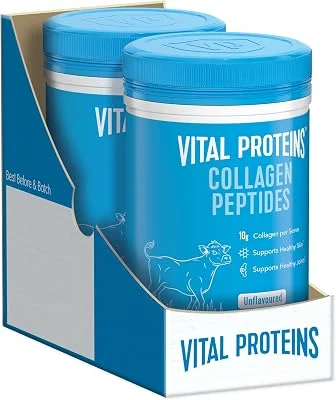
Vital Proteins Collagen Peptides 284g Unflavoured
What it claims:
Vital Proteins Collagen Peptides supports skin elasticity, joint comfort, and connective tissue integrity through its hydrolysed bovine collagen peptide profile.
What the evidence says:
Proksch E et al. (2014, Skin Pharmacol Physiol) — 2.5 g/day hydrolysed bovine collagen, n=114, 12-week double-blind RCT; significant improvement in skin elasticity and periorbital wrinkles. Clark KL et al. (2008, Curr Med Res Opin) — 10 g/day collagen hydrolysate, n=147, 24 weeks; significant VAS joint pain reduction. Shaw G et al. (2017, Am J Clin Nutr) — 5 g collagen hydrolysate + vitamin C, n=48 athletes, 24 weeks; elevated collagen synthesis markers, reduced joint discomfort. Vital Proteins delivers 10 g/serve — above the minimum studied dose. Note: these studies used specific hydrolysed formulations; results may not generalise to all products, and Vital Proteins has not published a product-specific CoA.
scored
The most widely available hydrolysed bovine collagen on Amazon AU, providing 10 g per serve — above the clinical dose range studied for skin elasticity and joint outcomes.
Vital Proteins Collagen Peptides 284g Unflavoured
- 284 g — approximately 28 serves at 10 g per serve
- Bovine hide collagen, hydrolysed to Type I and III peptides
- Unflavoured — dissolves in hot or cold liquids without clumping
- ~$1.80 per serve at the 10 g dose
- AUD $50.37 on Amazon AU
- 10 g per serve exceeds the 2.5–5 g minimum doses studied in published skin and joint trials
- Hydrolysed format: peptides absorbed as hydroxyproline-containing di- and tripeptides
- Unflavoured — stacks easily with vitamin C powder or ascorbic acid without taste conflict
- Bovine Type I and III collagen — the source form used across the majority of RCTs
- Widely available on Amazon AU with consistent stock
- No publicly available Certificate of Analysis — peptide molecular weight distribution and bioavailability claims cannot be independently verified
- Sourced from bovine hide, not cartilage — provides Type I/III, not Type II; less targeted for osteoarthritis or articular cartilage-specific goals
- No added vitamin C — Shaw et al. (2017) demonstrated the collagen-plus-vitamin-C combination drives synthesis; this product requires you to add it
- At $50.37/month ($600+/year) for a modest, slow-onset benefit with a minimum 12-week wait, the ongoing cost warrants realistic expectations
- 284 g jar is approximately 28 serves at 10 g — roughly one month supply, requiring recurring purchase
We've researched this product using publicly available brand specifications, published research on its active ingredients, and verified Amazon AU listing data. Physical testing is in progress and scored criteria will follow.
Score pending · Research-based analysis.
| Factor | Benefit area | Evidence quality | Study dose | Timeframe | Key study |
|---|---|---|---|---|---|
| Skin elasticity | Strong — double-blind RCT, n=114 | 2.5 g/day | 12 weeks | Proksch et al. 2014 | |
| Joint comfort | Strong — RCT (n=147) + meta-analysis | 5–10 g/day | 24 weeks | Clark 2008; Shaw 2017; Bruyère 2012 | |
| Tendon support | Moderate — small RCT, n=19 | 5 g/day (TENDOFORTE) | 24 weeks | Dressler et al. 2018 | |
| Hair and nails | Weak — no independent large RCT | Not established | Not established | No qualifying independent trial | |
| Gut health | Very weak — preclinical and anecdotal only | Not established | Not established | No human RCT |
The Four Evidence-Based Benefits of Collagen Supplementation
The strongest individual-trial evidence is for skin elasticity. Proksch E et al. (2014, Skin Pharmacol Physiol) ran a 12-week double-blind, placebo-controlled RCT in 114 women using 2.5 g/day of hydrolysed bovine collagen (Verisol). Primary outcome: Cutometer readings showed statistically significant improvement in skin elasticity versus placebo. Secondary outcomes — periorbital wrinkle depth, skin moisture, and skin roughness — also improved significantly. Effect sizes were moderate; this is not a dramatic cosmetic intervention, but the evidence is robust, independent, and replicable at a clinically practical dose.
For joint comfort, two complementary mechanisms have RCT support. Clark KL et al. (2008, Curr Med Res Opin) enrolled 147 athletes in a 24-week placebo-controlled trial using 10 g/day of collagen hydrolysate (CH-Alpha) and found significant reduction in VAS joint pain scores. Shaw G et al. (2017, Am J Clin Nutr) tested 5 g collagen hydrolysate plus vitamin C in 48 athletes over 24 weeks and found elevated circulating collagen synthesis markers and significantly reduced joint discomfort during activity. Bruyère O et al. (2012, Curr Med Res Opin) conducted a systematic review and meta-analysis of collagen hydrolysate in osteoarthritis, finding statistically significant pain reduction with a favourable number needed to treat (NNT). Taken together, the joint evidence is the most replicated in this category.
Tendon and ligament support is the most recent addition to the evidence base. Dressler P et al. (2018, J Sport Health Sci) used 5 g/day of specific bioactive collagen peptides (TENDOFORTE) in 19 participants recovering from lateral ankle ligament injuries over a 24-week rehabilitation period. The supplementation group showed significantly reduced re-injury risk. Sample size is small — this is not definitive evidence — but the trial design is rigorous and the result is mechanistically consistent with collagen peptides signalling fibroblast activity in tendon extracellular matrix.
Hair, nail, and gut claims occupy a separate and weaker evidence tier. The mechanisms are biologically plausible — collagen is a structural component of hair follicle basement membranes, nail plates, and intestinal epithelium — but the published human trials are predominantly small, short, and industry-funded with high risk of bias. No independent large RCT has confirmed hair or nail benefits as of 2024. Treat these claims as provisional rather than established. If your primary goal is hair, nails, or gut integrity, optimising dietary protein intake and micronutrient sufficiency has stronger evidence than collagen supplementation specifically.
Why Vitamin C Is a Non-Optional Cofactor
Collagen synthesis is gated by two enzymatic hydroxylation reactions. Prolyl hydroxylase converts proline to hydroxyproline; lysyl hydroxylase converts lysine to hydroxylysine. Both enzymes require vitamin C (ascorbic acid) as a reducing cofactor — without it, these reactions cannot proceed at adequate rates. Hydroxyproline and hydroxylysine are essential for the cross-linking that gives collagen fibrils their tensile strength. This is not a subtle nutritional nuance; it is a core biochemical dependency. Severe deficiency causes scurvy, which presents as collagen breakdown. Subclinical insufficiency blunts synthesis without obvious symptoms, quietly reducing the return on any collagen supplement you take.
Shaw G et al. (2017, Am J Clin Nutr) made this dependency explicit in their study design. The intervention was vitamin C-enriched gelatin delivering 5 g collagen equivalents, tested directly against placebo. The study measured circulating hydroxyproline-containing peptides as a collagen synthesis proxy and found significantly elevated markers in the collagen-plus-vitamin-C arm versus control. The authors concluded that vitamin C is required to drive the full synthesis response. Most retail collagen products — including Vital Proteins Collagen Peptides — do not include vitamin C. The product as purchased is biochemically incomplete without a separate ascorbic acid source.
The practical protocol is straightforward. Take your collagen serve alongside a meaningful vitamin C source. Shaw et al. used vitamin C-enriched gelatin rather than isolated ascorbic acid, but the biochemistry does not require co-formulation — any dietary or supplemental source works. A 250 ml glass of fresh orange juice provides approximately 50–60 mg ascorbic acid. A 500 mg ascorbic acid capsule covers the range used in most supplementation trials. For Australians with adequate fruit and vegetable intake, baseline vitamin C may already be sufficient. If your diet is low in fresh produce, add a low-cost ascorbic acid supplement to the protocol — it is one of the cheapest and most evidence-supported additions you can make to any collagen stack.
Choosing the Right Collagen Type for Your Goal
Hydrolysed bovine collagen peptides (Type I and III) are the form used in the majority of clinical trials and the most widely available product category on the Australian market. Type I collagen is the most abundant structural protein in skin, tendons, ligaments, and bone. Type III co-localises with Type I in skin and vasculature. For skin elasticity, general joint comfort (non-osteoarthritic), and tendon support, hydrolysed Type I/III bovine collagen at 2.5–10 g/day has the strongest evidence base. Vital Proteins Collagen Peptides falls into this category at 10 g/serve.
For osteoarthritis specifically, undenatured Type II collagen (UC-II, 40 mg/day) has a distinct and separate evidence base. Bruyère O et al. (2012) and subsequent osteoarthritis trials used undenatured — not hydrolysed — Type II collagen at doses two orders of magnitude lower than peptide products. The proposed mechanism is oral tolerance: presenting undenatured cartilage antigens to gut-associated lymphoid tissue to down-regulate the immune component of cartilage degradation. This is fundamentally different from the precursor-substrate mechanism of hydrolysed peptides. Do not substitute 10 g of hydrolysed Type I/III bovine collagen for UC-II if your goal is osteoarthritis management — they are different interventions with different targets.
Marine collagen (primarily Type I from fish skin and scales) is marketed on the basis of smaller average peptide size — approximately 300–500 Da versus higher-molecular-weight fractions in some bovine products — claimed to improve intestinal absorption. Some pharmacokinetic data support higher circulating hydroxyproline after marine versus bovine at matched doses, but the clinical relevance of this difference has not been established in outcome trials. The majority of joint-specific and skin-specific RCTs used bovine collagen. Marine collagen is a reasonable substitute for those avoiding bovine products on dietary or religious grounds and may have equivalent skin benefits, but it is not evidence-superior to bovine for joint or tendon outcomes. The evidence gap between bovine and marine is far smaller than the marketing suggests.
Further Reading
Frequently Asked Questions
8 questionsWhat are the benefits of collagen supplements?
Four evidence-based benefits are supported by human RCTs: improved skin elasticity and reduced wrinkle depth (Proksch et al. 2014, n=114, 12 weeks), reduced joint pain and discomfort during activity (Clark et al. 2008, n=147; Shaw et al. 2017, n=48), reduced re-injury risk in lateral ankle ligament rehabilitation (Dressler et al. 2018), and potential gut lining support (plausible mechanism, no qualifying human RCT). Hair and nail benefits are widely claimed but lack robust independent evidence. All benefits are modest in effect size, require 12–24 weeks of consistent dosing, and depend on adequate vitamin C intake.
Does collagen really work for skin?
Yes, at a specific dose and duration. Proksch E et al. (2014, Skin Pharmacol Physiol) conducted a 12-week double-blind RCT in 114 women using 2.5 g/day hydrolysed bovine collagen. Cutometer readings showed statistically significant improvement in skin elasticity versus placebo; periorbital wrinkle depth, skin moisture, and skin roughness also improved significantly. Effect sizes were moderate — this is not a dramatic cosmetic result. You need at least 12 weeks of consistent daily use and adequate vitamin C for proline hydroxylation to proceed. Missing either condition blunts the outcome.
Which collagen type is best for joints?
Two types have distinct evidence bases for joint health, and they are not interchangeable. Hydrolysed Type I/III bovine collagen peptides (5–10 g/day) reduced VAS joint pain in Clark et al. (2008) and elevated collagen synthesis markers in Shaw et al. (2017), working by supplying amino acid precursors for connective tissue repair. Undenatured Type II collagen (UC-II, 40 mg/day) has a separate evidence base for osteoarthritis, working via oral tolerance to down-regulate cartilage degradation. For general athletic joint discomfort, hydrolysed Type I/III is the evidence-backed choice. For osteoarthritis, discuss UC-II specifically with a GP or sports medicine physician.
How long does collagen take to work?
12 weeks is the minimum studied timeframe before measurable skin improvements appear (Proksch et al. 2014). Joint studies ran 24 weeks (Clark et al. 2008; Shaw et al. 2017). Tendon remodelling in Dressler et al. (2018) also occurred across a 24-week rehabilitation period. Plan for a minimum three-month commitment before drawing conclusions. Inconsistent dosing, skipping days, or supplementing without vitamin C will extend the time to any observable response — all published trials used strict daily dosing protocols.
Is vitamin C necessary when taking collagen?
Yes — biochemically non-negotiable. Prolyl hydroxylase and lysyl hydroxylase, the enzymes that convert proline and lysine to their hydroxy forms during collagen synthesis, are both vitamin C-dependent. Without adequate ascorbic acid, the triple-helix cross-linking that gives collagen fibrils tensile strength cannot proceed at adequate rates. Shaw G et al. (2017) explicitly tested collagen plus vitamin C versus placebo and found significantly elevated collagen synthesis markers in the combination arm. Most retail collagen products including Vital Proteins do not include vitamin C — add a 250–500 mg ascorbic acid supplement or fresh citrus to your protocol.
Is collagen worth taking?
Yes, for specific goals with realistic expectations. The evidence for skin elasticity, joint comfort, and tendon support is peer-reviewed and replicated across independent RCTs. Effect sizes are moderate, onset is slow (12–24 weeks), and benefits reverse on discontinuation. Collagen is a nutritional substrate, not a pharmaceutical — it supports the body's own synthesis capacity rather than overriding it. At approximately $50/month, it sits in the lower cost tier for supplements with this level of evidence behind them. If your expectation is dramatic visible change within weeks, collagen will disappoint. If your expectation is modest, steady improvement over three to six months, the evidence supports that outcome.
What is the correct collagen dosage?
2.5 g/day showed significant skin elasticity improvement in Proksch et al. (2014). 5 g/day (combined with vitamin C) elevated collagen synthesis markers and reduced joint discomfort in Shaw et al. (2017). 10 g/day was used for articular cartilage and joint pain outcomes in Clark et al. (2008). Most Australian products including Vital Proteins are dosed at 10–11 g per serve, which exceeds the minimum studied threshold for all outcome categories. Lower doses may be sufficient for skin; joint and tendon goals likely require the full 10 g. Taking less than 2.5 g/day is unlikely to produce measurable effects based on published trials.
Can collagen supplements improve hair and nails?
No robust human RCT confirms hair or nail benefits from collagen supplementation as of 2024. The proposed mechanism is plausible — collagen peptides provide proline and cysteine precursors for keratin synthesis — and small studies report improvements in nail brittleness and hair growth rate. However, these trials are predominantly industry-funded, use small samples, and carry a high risk of bias. No independent large RCT has replicated these findings. If hair or nail health is your primary goal, the evidence base is insufficient to recommend collagen over optimising dietary protein intake, iron status, and biotin adequacy — all of which have stronger human evidence for these outcomes.
Our Research Framework
Every product on this site is assessed against the same criteria — brand specifications, published clinical evidence, and verified Australian availability. We don't accept free products. Full methodology →