
The clinical dose for collagen peptides is two and a half to ten grams per day of hydrolysed collagen, taken with food, for a minimum of twelve weeks. Proksch and colleagues used two and a half grams daily over twelve weeks in one hundred and fourteen participants and found statistically significant connective tissue improvement. Shaw and colleagues used five grams combined with vitamin C over twenty-four weeks in forty-eight athletes and found reduced joint discomfort and higher collagen synthesis markers in circulation. Vital Proteins Collagen Peptides delivers ten grams per serve, which sits at the upper end of the studied range. The honest caveat is that vitamin C is required as a cofactor for collagen synthesis — taking collagen without a dietary source of vitamin C means you are likely missing a synergistic effect documented in the Shaw trial. Two and a half grams is the minimum effective dose with published human evidence; below that, no trial has confirmed benefit.
Alchemist Wellness participates in affiliate programmes including Amazon Associates. If you purchase through a link on this page, we may earn a commission at no extra cost to you. This does not influence our editorial recommendations. Full disclosure.
Review status: This article is evidence-based, drawing on brand specifications, published clinical research, and verified Amazon AU listing data.
Products Reviewed
Vital Proteins Collagen Peptides
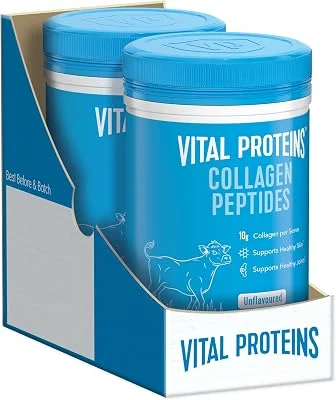
Vital Proteins Collagen Peptides
What it claims:
Vital Proteins Collagen Peptides supports connective tissue health, joint comfort, and skin elasticity through hydrolysed bovine collagen peptides that stimulate endogenous collagen synthesis.
What the evidence says:
Proksch E et al. (2014, Skin Pharmacol Physiol) — 2.5g/day, n=114, 12 weeks, significant connective tissue improvement. Shaw G et al. (2017, Am J Clin Nutr) — 5g + vitamin C, n=48 athletes, 24 weeks, reduced joint discomfort, increased collagen synthesis markers. Bruyère O et al. (2012, Curr Med Res Opin) — meta-analysis, collagen hydrolysate in osteoarthritis, statistically significant pain reduction. Note: studies used specific hydrolysed formulations; results may not generalise to all collagen products.
scored
The most accessible hydrolysed bovine collagen on Amazon AU, dosed above the clinical threshold at ten grams per serve.
Vital Proteins Collagen Peptides
- 284g — approximately 28 serves at 10g per serve
- Bovine hide collagen, hydrolysed to Type I and III peptides
- Unflavoured — dissolves in hot or cold liquids
- 10g per serve exceeds the 2.5–5g doses studied in joint and skin trials
- AUD $50.37 on Amazon AU
- 10g per serve exceeds the minimum 2.5g studied in published trials
- Hydrolysed format — peptides absorbed as hydroxyproline dipeptides and tripeptides
- Unflavoured and fully soluble — adds to coffee, smoothies, or water without changing texture
- Type I and III bovine collagen — the collagen types most studied for connective tissue outcomes
- Amazon AU Prime delivery — verified Australian stock
- No publicly available Certificate of Analysis — cannot independently verify peptide molecular weight or hydroxyproline content
- Bovine hide source provides Type I and III, not Type II — less targeted for articular cartilage specifically
- No added vitamin C — Shaw et al. (2017) found collagen plus vitamin C outperformed collagen alone
- 284g jar lasts 28 days at 10g per serve — monthly recurring cost of approximately fifty dollars
We've researched this product using publicly available brand specifications, published research on its active ingredients, and verified Amazon AU listing data. Physical testing is in progress and scored criteria will follow.
Score pending · Research-based analysis.
| Factor | Dose | Trial | Duration | Outcome | Vital Proteins serves |
|---|---|---|---|---|---|
| Minimum studied | 2.5g/day | Proksch 2014 — connective tissue, n=114 | 12 weeks | Significant improvement vs placebo | 1/4 serve (or split one serve across 4 days) |
| Joint + exercise | 5g + vitamin C | Shaw 2017 — athletes, n=48 | 24 weeks | Reduced joint discomfort, higher synthesis markers | 1/2 serve daily |
| Common supplement dose | 10g/day | Most commercial products | Ongoing | Reflects upper study range | 1 full serve daily |
| Osteoarthritis trials | 10g/day | Bruyère 2012 meta-analysis | Varies | Modest pain reduction vs placebo | 1 full serve daily |
| Maximum studied | 15g/day | Some skin trials | 12 weeks | Diminishing returns above 10g | 1.5 serves — no added benefit confirmed |
Why Vitamin C Is Not Optional
Collagen synthesis is a two-step biochemical process. The body first assembles a collagen precursor chain from amino acids including proline and lysine. It then hydroxylates proline and lysine — a step that is entirely dependent on vitamin C as a cofactor. Without sufficient vitamin C, the hydroxylation step is impaired and the resulting collagen structure is weaker and less stable. This is why scurvy — severe vitamin C deficiency — presents as connective tissue breakdown.
Shaw and colleagues specifically designed their 2017 trial to test this interaction. Participants received either five grams of collagen hydrolysate with vitamin C-enriched gelatin, or a placebo, one hour before exercise. The collagen plus vitamin C group showed significantly higher collagen synthesis markers in circulation and reported lower joint discomfort scores. The collagen-without-vitamin-C condition was not tested in isolation, so the independent contribution of each component is not fully disentangled, but the evidence strongly suggests the combination outperforms collagen alone.
The practical protocol: take your collagen serve alongside a dietary source of vitamin C. Fresh orange juice, kiwifruit, capsicum, or a 250 to 500 milligram ascorbic acid supplement all provide sufficient vitamin C without adding significant calories. Timing one hour before exercise, as used in the Shaw trial, is the most evidence-aligned approach for athletes.
How Long Does Collagen Take to Work — and What to Expect
Twelve weeks is the minimum studied period before measurable outcomes appear in the best-powered trials. Proksch and colleagues saw statistically significant connective tissue improvement at twelve weeks; Shaw and colleagues ran twenty-four weeks. Some participants in joint discomfort trials report subjective improvement at six to eight weeks, but this falls short of the timeframe used to generate the published evidence.
The type of effect you should expect depends on your goal. For joint discomfort and exercise recovery, the Shaw trial documents reduced pain scores and higher collagen synthesis markers in athletes — an effect that is real but moderate in magnitude. For skin connective tissue, the Proksch trial documents measurable changes in dermis density on ultrasound — again, real and statistically significant, but not a dramatic cosmetic transformation. Collagen supplementation is a nutritional intervention, not a pharmaceutical.
Setting the correct expectation matters for compliance. If a user expects joint pain to resolve within two weeks and stops supplementing when it does not, they never reach the twelve-week window where benefit is documented. Building the habit as a long-term daily practice — like a multivitamin — rather than a short-course treatment is the evidence-aligned approach.
Collagen Type Matters for Your Goal
Most of the joint and connective tissue evidence uses Type I and III bovine collagen hydrolysate — the type in Vital Proteins. This is appropriate for general connective tissue, skin, tendons, and ligament support. Articular cartilage — the smooth cartilage lining joint surfaces — is predominantly Type II collagen. For osteoarthritis or specifically cartilage-focused goals, undenatured Type II collagen supplements have a separate evidence base at much lower doses of around forty milligrams per day.
Marine collagen is predominantly Type I from fish skin and scales. It has a smaller average peptide size than bovine collagen, which is claimed to improve absorption rate. The clinical relevance of this difference in actual joint or skin outcomes has not been established in head-to-head trials against bovine collagen. The existing evidence base for joint outcomes primarily uses bovine sources.
The practical hierarchy: for general connective tissue, skin, and joint support, hydrolysed bovine collagen at five to ten grams daily with vitamin C is the most evidence-backed choice. For cartilage-specific osteoarthritis support, Type II collagen or UC-II at forty milligrams is the more targeted option and warrants a conversation with a GP or sports medicine doctor.
Further Reading
Frequently Asked Questions
8 questionsHow much collagen should I take per day?
Two and a half to ten grams of hydrolysed collagen peptides daily, taken with food. Proksch et al. (2014) used two and a half grams over twelve weeks for connective tissue outcomes. Shaw et al. (2017) used five grams plus vitamin C for joint and exercise recovery outcomes. Most commercial products including Vital Proteins are formulated at ten grams per serve, which sits at the upper end of the studied range. Below two and a half grams daily, no human trial has confirmed benefit.
When is the best time to take collagen?
For exercise recovery and joint support, Shaw et al. (2017) gave collagen one hour before exercise — this timing is associated with higher collagen synthesis markers during the post-exercise repair window. For general connective tissue and skin goals, timing is not established as critical; morning consistency is more practically important than precise timing. Take with a vitamin C source regardless of timing.
Do I need to take vitamin C with collagen?
Yes — vitamin C is a cofactor for collagen synthesis and taking collagen without it is likely suboptimal. Shaw et al. (2017) found the combination of five grams of collagen plus vitamin C produced higher collagen synthesis markers than the placebo condition. Vitamin C is required for the hydroxylation of proline and lysine — the step that gives collagen its structural stability. A dietary source (fresh citrus, kiwifruit, capsicum) or 250 to 500 milligrams of ascorbic acid alongside your collagen serve is sufficient.
How long does collagen take to work?
Twelve weeks at minimum for measurable connective tissue outcomes. Proksch et al. (2014) found significant improvement at twelve weeks; Shaw et al. (2017) ran twenty-four weeks. Some participants report subjective joint comfort improvement at six to eight weeks. The expectation should be a slow, sustained benefit over three to six months of consistent daily use — not a short-course treatment that delivers rapid results.
Is ten grams of collagen per day too much?
No. Ten grams per day sits at the upper end of doses used in published human trials and is considered safe. Some skin-focused trials have used fifteen grams daily without reported adverse effects. Proksch et al. (2014) used two and a half grams; most joint trials used five to ten grams. There is no established upper limit for collagen peptides, but there is no confirmed benefit from exceeding ten to fifteen grams per day either — it does not appear to accelerate results.
What is the difference between collagen powder and collagen capsules?
Dose delivery. Collagen capsules typically provide 500mg to 2g per serve — meaningfully below the two and a half gram minimum studied in clinical trials. To reach the five to ten gram study dose, you would need ten to twenty capsules per day. Collagen powder allows you to measure and consume the clinically studied dose in a single daily serve. For hitting the evidence-based dose, powder is the practical format. Capsules may suit people who travel or want precise dosing below one gram.
Can I take collagen every day long term?
Yes. Collagen hydrolysate has been used in trials of up to twenty-four weeks without safety signals. No studies have identified adverse effects from long-term daily collagen supplementation at doses of two and a half to fifteen grams. It is a food-derived protein supplement, not a pharmaceutical. People with fish or bovine allergies should verify the source before purchasing. Consult a GP if you are pregnant, breastfeeding, or managing kidney disease — collagen is high in specific amino acids that affect nitrogen load.
Does collagen type matter?
Yes, for specific goals. Type I and III hydrolysed bovine collagen is the type used in most published connective tissue, skin, and joint trials — appropriate for general support. Articular cartilage is predominantly Type II; undenatured Type II collagen at around forty milligrams per day has a separate evidence base specifically for osteoarthritis. Marine collagen is primarily Type I. For general connective tissue support, hydrolysed bovine Type I and III at five to ten grams daily is the best-evidenced choice.
Our Research Framework
Every product on this site is assessed against the same criteria — brand specifications, published clinical evidence, and verified Australian availability. We don't accept free products. Full methodology →