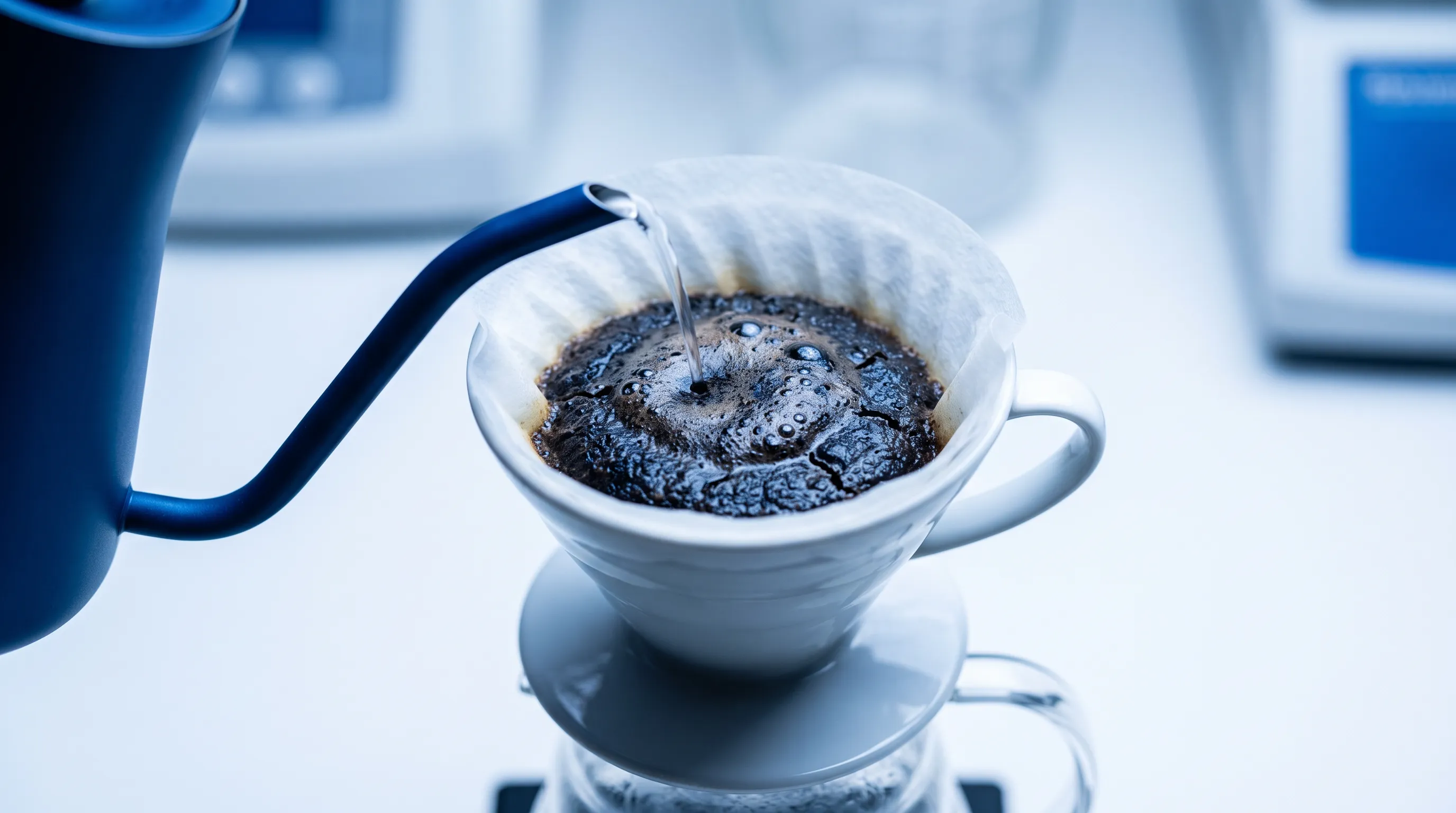
The Bodum Chambord French Press ($29.95–$40.46 AUD) is the most practical starting point for manual brewing: coarse grind, 4-minute steep, no paper filters required, available on Amazon AU. For precision pour-over, the Fellow Stagg EKG gooseneck kettle ($299 AUD) is the reference-grade tool — 1°C temperature accuracy and a gooseneck spout make it the single highest-impact gear upgrade for filter coffee quality.
Brew method determines cup character more than equipment does. French press metal filters leave oils intact: fuller body, moderate sediment, suits dark roasts well. Paper-filter pour-over strips those oils for a cleaner, brighter result with more origin-flavour clarity. Moka pot uses stovetop pressure to produce espresso-style concentration (~150ml per serve) — a structurally different drink, not a pour-over substitute. All seven products reviewed in this guide ship via Amazon AU.
This article contains affiliate links. We earn a commission if you purchase through our links, at no extra cost to you. Our rankings are never influenced by commissions. Full disclosure →
All 7 Manual Brew Products Compared
| Product | Method | Capacity | Grind Size | Brew Time | Sediment | Best For | Buy |
|---|---|---|---|---|---|---|---|
| Fellow Stagg EKG Our Pick | Kettle (pour over tool) | 0.9L | Medium-fine | 3–4 min | None (with filter) | Serious home barista | |
| Bodum Pour Over | Pour over | 1L | Medium-fine | 3–4 min | Low (metal filter) | Daily use, no paper filters | |
| Bodum Chambord 3-cup | French press | 350ml | Coarse | 4 min steep | Moderate | 1–2 cups, classic build | |
| Bodum Columbia 8-cup Upgrade | French press | 1L | Coarse | 4 min steep | Moderate | 2–4 cups, heat retention | |
| Bodum Brazil 8-cup Budget | French press | 1L | Coarse | 4 min steep | Moderate | Budget, plastic frame | |
| Bialetti Moka Express 3-cup | Stovetop / Moka | ~150ml | Medium-fine | 4–5 min | None | Espresso-style, bold cup | |
| Secura French Press 4-cup | French press | 1L | Coarse | 4 min steep | Moderate | Outdoors, no glass risk |
How We Evaluate Brew Gear
Manual brew gear is evaluated on four practical variables that determine everyday cup quality.
Temperature accuracy
Professional extraction standards require 90–96°C. At 85°C, coffee under-extracts — sour, thin, underdeveloped. At 100°C, over-extraction risks bitterness. Temperature-controlled kettles like the Fellow Stagg EKG solve this completely. Standard kettles require timing from boil or guessing, which varies day to day. Consistency in temperature is the largest single controllable variable in home coffee quality.
Target: 93°C (199°F) for pour over extractionBrew time and grind coarseness
Pour over target: 3–4 minutes total (including 30-45s bloom). French press target: 4 minutes immersion steep. Grind coarseness controls both. Too fine = slow extraction → over-extracted, bitter. Too coarse = fast extraction → under-extracted, sour. The grind size range for each method is distinct: coarse (sea salt) for French press; medium-fine (table salt) for pour over; medium (between the two) for Moka pots.
French press: coarse · Pour over: medium-fine · Moka: medium-fineSediment and filter type
French press and stovetop Moka produce sediment-free cups at different points. French press uses a metal mesh plunger — oils and fine particles pass through, producing a heavier body with fine sediment at cup base. Paper-filtered pour over removes oils entirely for a clean, light cup. Metal-filtered pour over (like Bodum Pour Over) falls in between — some oils pass, less fine sediment than French press.
Clean: paper pour over · Heavy: French press · No sediment: Moka potBuild quality and heat retention
French press frames are the main build variable — chrome-framed borosilicate glass (Chambord) is classic and durable but drops heat faster than insulated stainless. The Bodum Columbia's double-wall stainless steel holds temperature through the 4-minute steep, meaning the brew starts and ends at closer to the same temperature. The Secura French Press eliminates the glass-break risk entirely — meaningful for camping or travel.
Best heat retention: double-wall stainless steelProducts Reviewed
The Fellow Stagg EKG is the most important piece of equipment in any serious pour over setup. Temperature precision to ±1°C eliminates the single largest source of extraction inconsistency in home brewing. The gooseneck spout provides the slow, controlled pour rate required for proper pour over bloom and extraction — a standard wide-mouth kettle cannot replicate this regardless of price. The LCD dial and 60-minute hold mean you can set 93°C and walk away, returning to a kettle still ready to brew.
The 0.9L capacity suits 1–4 cups per session. At the standard 1:15 coffee-to-water ratio, a full 0.9L kettle brews approximately four 250ml cups (using ~60g of coffee). The matte black finish and industrial-minimal design make it a permanent countertop presence rather than something to hide in a cupboard.
Pros
- Temperature accurate to ±1°C — the best controllable variable in home pour over
- 60-minute hold keeps water at target temperature through long sessions
- Gooseneck spout enables the slow, precise pour required for bloom
- Design-forward — functional and aesthetically strong on a kitchen bench
- Verified AU listing on Amazon AU
Cons
- Premium price — significantly more than a standard electric kettle
- 0.9L capacity smaller than 1.7L standard kettles — relevant for large households
- Overkill for French press or stovetop methods where ±5°C has minimal impact
The Bodum Pour Over uses a permanent stainless steel micro-mesh filter, which means no paper filter running costs and a cup that sits between the cleanliness of paper-filtered pour over and the body of French press. The metal filter allows some coffee oils to pass through, producing a more textured cup than paper, while still catching the majority of sediment. For daily pour over without the paper filter habit, this is the most convenient AU-available option.
Pros
- Permanent filter — no ongoing paper filter costs
- 1L capacity serves 2–4 cups per brew
- Metal filter allows some oils through — more body than paper pour over
- Bodum build quality and borosilicate glass carafe
Cons
- Metal filter passes more fine sediment than paper — some cup residue expected
- Temperature-controlled kettle needed to extract consistently at 93°C
- Glass carafe — handle with care, no carry option
The Bodum Chambord is the most imitated French press design in the world. The chrome-framed borosilicate glass construction has been unchanged since 1974 — a reliable sign that it works. The 350ml (3-cup) size is ideal for a single large cup or two smaller cups, making it the right size for solo brewing without the over-built capacity of 1L presses. The three-part plunger provides a finer seal than single-mesh designs, reducing sediment in the cup.
Pros
- Iconic design, unchanged for 50+ years — battle-tested build quality
- 350ml perfect for 1–2 cups without waste
- 3-part plunger reduces sediment vs single-mesh competitors
- Borosilicate glass — thermal shock resistant and dishwasher safe
Cons
- Glass can break if dropped — not suitable for outdoor use
- No insulation — coffee cools faster than double-wall stainless
- Chrome frame can show water spots over time
The Bodum Columbia is the premium French press for buyers who want the Bodum plunger system without glass. The double-wall insulated stainless steel exterior maintains brew temperature through the 4-minute steep far better than glass-frame alternatives, and the no-glass construction eliminates the single most common failure mode of French press ownership. Best for households brewing 2–4 cups at once.
Pros
- Double-wall insulation — best heat retention of the French press options tested
- No glass — break risk eliminated entirely
- 1L capacity for 2–4 cup batches
- Premium build materials and Bodum reliability
Cons
- Higher price than Chambord and Brazil for similar 1L capacity
- Opaque walls mean you can't visually monitor brew — use a timer
- Heavier than glass-frame alternatives
The Bodum Brazil is the entry point into the Bodum French press range — the same borosilicate glass carafe and plunger system as the Chambord, but with a BPA-free plastic frame instead of chrome steel. The plastic frame reduces cost and weight at the expense of premium feel. For buyers who want Bodum brew quality without the Chambord price, the Brazil delivers the same fundamental cup. Best suited to a first French press, a secondary press for travel, or anyone who doesn't want to spend on chrome hardware.
Pros
- Budget entry point to the Bodum French press range
- Same borosilicate glass and plunger as the Chambord
- Lightweight — plastic frame reduces carry weight
- BPA-free plastic — no leaching concern with hot liquids
Cons
- Plastic frame looks and feels cheaper than chrome or stainless alternatives
- No insulation — coffee cools quickly
- Glass still breakable despite plastic outer frame
The Bialetti Moka Express has been produced in the same aluminium octagonal form since 1933. It uses steam pressure (1–2 bar) to push hot water through a medium-fine ground coffee puck, producing a concentrated, intense brew with full body and no sediment. This is not espresso — true espresso requires 9+ bars of pressure — but it produces a much stronger cup than pour over or French press, suited to milk drinks, black coffee drinkers who prefer intensity, or anyone without room or budget for an espresso machine.
Important: the standard aluminium Moka Express is not compatible with induction cooktops. Australians with induction hobs need either the Bialetti Moka Induction (stainless base) or an induction adaptor plate. Gas and standard electric hotplates work with all models.
Pros
- Strong, concentrated brew — espresso-like body without an espresso machine
- No sediment — clean cup despite full-body extraction
- Low cost — accessible entry point to concentrated coffee at home
- Durable aluminium — the same design proven since 1933
Cons
- Not induction-compatible in standard aluminium model — check cooktop type before buying
- Output is small (~150ml for 3-cup) — may need multiple rounds for larger servings
- Less nuanced than pour over — bold flavour profile may not suit light-roast specialty coffee
The Secura French Press solves the single most common French press failure: glass breakage. Triple-layer stainless steel construction — inner wall, vacuum insulation layer, outer wall — eliminates glass risk while providing better heat retention than the Chambord. For camping, travel, or any environment where glass is a liability, the Secura is the obvious French press choice. The 1L capacity and full stainless build make it one of the most practical outdoor coffee options on Amazon AU.
Pros
- No glass — zero break risk, ideal for camping and outdoor use
- Triple-layer vacuum insulation — excellent heat retention
- 1L capacity serves 2–4 cups per brew
- Stainless steel filter mesh — no replacement parts needed
Cons
- Opaque walls — cannot monitor brew visually, use a timer
- Heavier than glass-frame French press alternatives
- Design less refined than the Bodum Chambord for countertop display
Which Brew Method Is Right for You?
| Your situation | Best pick | Why |
|---|---|---|
| Want the cleanest, most nuanced cup at home | Fellow EKG + pour over dripper | Temperature precision at 93°C + paper filter = cleanest extraction in manual brewing |
| Daily brewer, no paper filter habit | Bodum Pour Over | Permanent filter — no running filter cost, convenient daily use, body between French press and paper |
| French press fan — classic design, 1–2 cups | Bodum Chambord 3-cup | 350ml is right for solo brewing; chrome-glass build is the most refined in the range |
| French press fan — 2–4 cups, heat retention matters | Bodum Columbia | Double-wall stainless keeps the brew hotter longer; upgrade pick over Chambord for larger households |
| First French press, budget priority | Bodum Brazil | Same glass and plunger as Chambord at lower cost. BPA-free plastic frame is the only compromise |
| Wants espresso-style intensity without a machine | Bialetti Moka Express | Steam-pressure brewing at 1–2 bar produces the most concentrated cup of any method here |
| Camping, outdoors, or travel coffee | Secura French Press | Triple-layer stainless — no glass risk, best heat retention, built for outdoor use |
| Upgrading from a standard kettle for pour over | Fellow Stagg EKG | Temperature control eliminates the biggest extraction inconsistency. The gooseneck pour is the rest of the upgrade |
Frequently Asked Questions
What is the best pour over coffee maker in Australia?
This article contains affiliate links. We earn a commission if you purchase through our links, at no extra cost to you. Our rankings are never influenced by commissions. Full disclosure →
What temperature should pour over coffee be brewed at?
Professional barista standards specify 90–96°C for pour over coffee extraction, with 93°C (199°F) being the most common target. Below 85°C leads to under-extraction — sour, flat, underdeveloped. Above 96°C risks over-extraction — bitter, astringent. The Fellow Stagg EKG allows precise temperature control and hold at 93°C through the entire pour. A standard kettle without temperature control typically boils to 100°C and cools unpredictably, making consistent extraction difficult.
What grind size should I use for pour over coffee?
Pour over requires a medium to medium-fine grind — approximately sea salt texture, finer than French press but coarser than espresso. On most burr grinder scales, this is roughly setting 15–25 of 40. The correct grind depends on your specific grinder, coffee, and roast. Too fine clogs the filter and over-extracts; too coarse under-extracts with weak results. Start at medium-fine, then adjust: if the brew takes over 4 minutes, go coarser. Under 3 minutes, go finer.
What is the difference between a French press and pour over?
French press is an immersion brew — grounds steep in water, then a metal mesh plunger separates them, producing a fuller-bodied cup with oils and moderate sediment. Pour over is a filter brew — hot water flows through grounds and a paper or metal filter, producing a cleaner, brighter, more nuanced cup with less sediment. Pour over allows more extraction precision via temperature and pour rate; French press is simpler but less controllable. Both produce excellent coffee — the choice is about body vs clarity preference.
How long should pour over coffee take to brew?
Total pour over brew time should be 3–4 minutes, including a 30–45 second bloom pour. The bloom uses approximately twice the weight of grounds in water (30g coffee → 60ml water) and allows CO2 to degas from fresh coffee before main extraction. Under 2.5 minutes typically indicates under-extraction (grind too coarse). Over 5 minutes indicates over-extraction or too fine a grind. Adjust grind size before adjusting water temperature or pour rate.
Is a French press or pour over better for a single cup?
For a single cup (250–300ml), both work well. The Bodum Chambord 3-cup (350ml) is sized perfectly for solo brewing. For pour over, the Bodum Pour Over or a V60 size 01 both work for single serves. French press is faster and simpler (total time under 5 minutes including steep). Pour over takes 3–4 minutes of active attention but produces a cleaner, more precise cup. If you're in a hurry: French press. If cup quality matters most: pour over.
What is a Moka pot and how does it differ from pour over?
A Moka pot uses steam pressure to push hot water through fine-ground coffee, producing a strong, concentrated, espresso-like brew with full body and no sediment. The Bialetti Moka Express operates at 1–2 bars of pressure — not the 9+ bars of true espresso, but much more intense than drip or pour over. Moka pot coffee suits milk drinks or anyone preferring a bold, intense flavour. Pour over produces a lighter, more nuanced cup suited to single-origin and specialty coffee where origin character is the point.
Can I use a French press without a kettle?
Yes, but with a compromise. French press is more tolerant of temperature variation than pour over — the immersion steep allows extraction to continue and compensate somewhat for sub-optimal water temperature. Using boiled water that has cooled 30–60 seconds (approximately 93–96°C) works well for French press. For pour over, temperature control matters significantly — water at 85°C versus 93°C produces noticeably different results. If brewing both methods, the Fellow Stagg EKG is worth the investment for the consistency it provides in pour over specifically.
Related Guides
For more on the brew gear category, visit the Brew Gear hub. If you're exploring functional coffee, see our best mushroom coffee guide. Read about how we evaluate and our editorial process. If you want a dedicated review of the Fellow Stagg EKG — the kettle paired with pour-over in most serious setups — see the Fellow Stagg EKG review. For pairing with a milk frother to make collagen lattes or adaptogen drinks, the best milk frother Australia guide covers five options by powder dissolution performance.