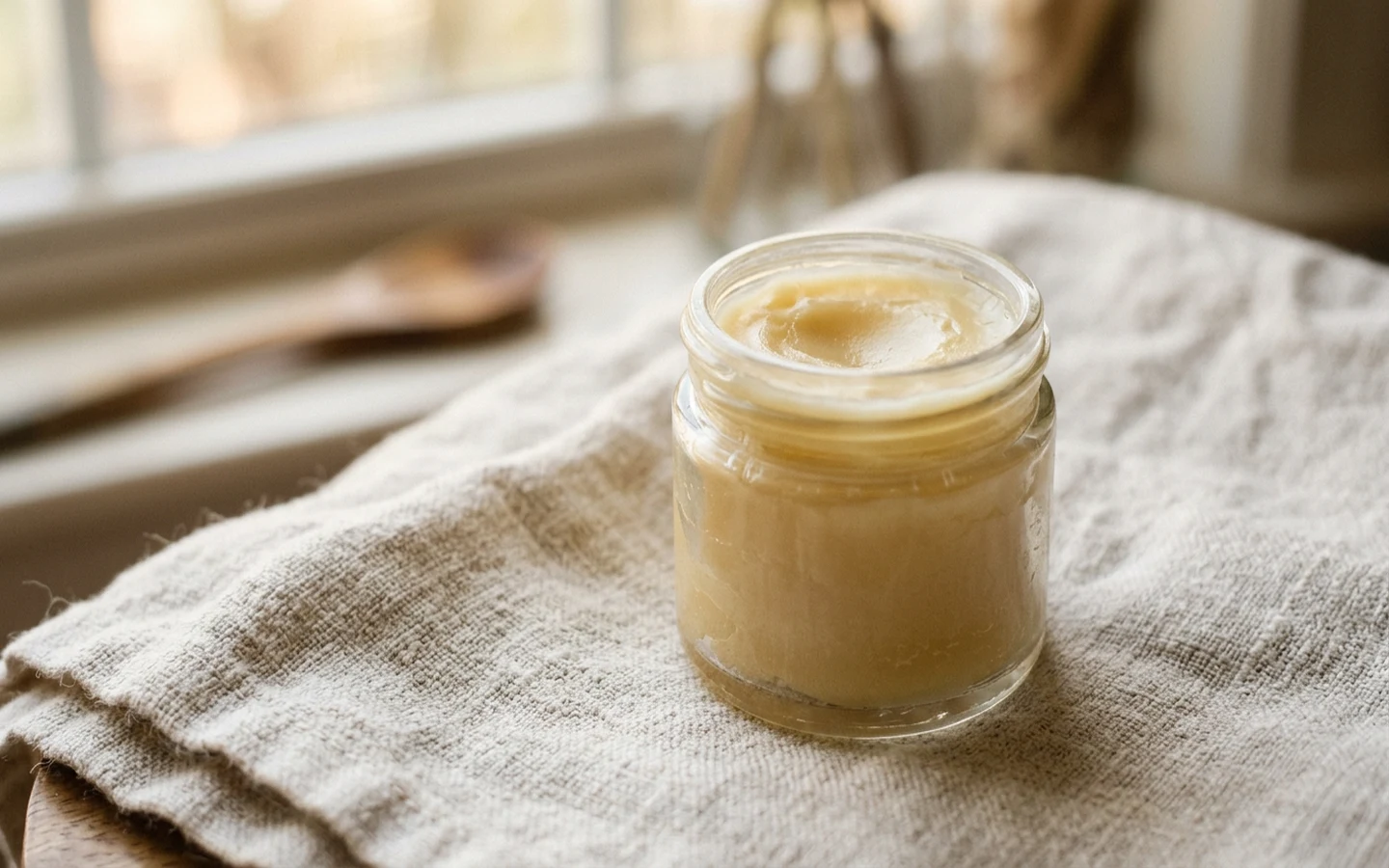
Grass-fed tallow skincare is a single-ingredient moisturiser whose fatty acid profile — oleic acid (~50%), palmitic acid (~26%), stearic acid (~14%) — closely mirrors the lipid composition of the human stratum corneum. The 'grass-fed' distinction matters: pasture-raised tallow contains higher concentrations of conjugated linoleic acid (CLA) and a more favourable omega-6 to omega-3 ratio than grain-fed tallow, which could be relevant to anti-inflammatory skin function, though topical CLA evidence remains limited. The underlying skin science is sound: oleic acid's role in epidermal barrier repair is documented in Fluhr JW et al. (2008, Skin Pharmacol Physiol), and the ceramide-lipid barrier model in Elias PM (2014, J Clin Invest) supports why skin-identical fatty acids may outperform synthetic emollients for barrier-compromised skin. No tallow-specific clinical trials exist for any sourcing category. RICHGRAND Grass-Fed Tallow Balm ($18.99, 60ml, Amazon AU) is the only verified grass-fed option currently available on Amazon AU.
Alchemist Wellness participates in affiliate programmes including Amazon Associates. If you purchase through a link on this page, we may earn a commission at no extra cost to you. This does not influence our editorial recommendations. Full disclosure.
Review status: This article is evidence-based, drawing on brand specifications, published clinical research, and verified Amazon AU listing data.
Products Reviewed
RICHGRAND Grass-Fed Tallow Balm

RICHGRAND Grass-Fed Tallow Balm
What it claims:
Grass-fed tallow provides superior skincare benefits due to its CLA content, better omega fatty acid ratio, and skin-identical lipid composition, making it a more biologically compatible moisturiser than synthetic alternatives.
What the evidence says:
Oleic acid and epidermal barrier repair: Fluhr JW et al. (2008, Skin Pharmacol Physiol). Ceramide-lipid barrier model supporting skin-identical lipid hypothesis: Elias PM (2014, J Clin Invest). CLA anti-inflammatory properties in vitro: Wang LS & Bhattacharya B (2013 review) — but topical absorption and clinical skin outcomes not established. No RCTs comparing grass-fed vs grain-fed tallow for skincare outcomes exist.
scored
The only verified grass-fed tallow balm on Amazon AU — the right choice if source quality matters for your skincare routine.
RICHGRAND Grass-Fed Tallow Balm
- 60ml — Australian grass-fed beef tallow
- Oleic (~50%), palmitic (~26%), stearic (~14%) fatty acid profile
- Higher CLA content vs grain-fed tallow
- Single ingredient — no preservatives, fragrance, or synthetic additives
- AUD $18.99 on Amazon AU
- Grass-fed source — higher CLA and better omega-6:omega-3 ratio than grain-fed
- Single ingredient removes preservatives, fragrance, and synthetic emollients entirely
- Fatty acid profile matches stratum corneum lipids: oleic, palmitic, stearic
- No synthetic additives that could disrupt a compromised barrier
- Verified Australian stock on Amazon AU with Prime delivery
- Oleic acid is comedogenic in some acne-prone individuals — patch-test carefully
- 60ml is small for whole-body use; primarily suited to face and targeted areas
- No tallow-specific clinical trials — evidence is mechanistic, not trial-confirmed
- Mild fat odour possible; dissipates on absorption
We've researched this product using publicly available brand specifications, published research on its active ingredients, and verified Amazon AU listing data. Physical testing is in progress and scored criteria will follow.
Score pending · Research-based analysis.
| Factor | Grass-Fed Tallow | Grain-Fed Tallow | Synthetic Moisturiser |
|---|---|---|---|
| CLA content | Higher — pasture foraging increases CLA | Lower — grain diet reduces CLA | Zero — no animal-derived lipids |
| Omega-6:omega-3 ratio | More balanced (closer to 3:1) | Higher omega-6, less balanced | N/A — synthetic origin |
| Oleic acid (~%) | ~50% | ~50% | Varies — glycerin, dimethicone |
| Skin-identical lipids | Yes — oleic, palmitic, stearic | Yes — same profile | No — synthetic emollients |
| Synthetic additives | None | None (if pure rendered) | Usually present |
| Evidence for source superiority | Indirect — CLA literature | No specific advantage claimed | Extensive TEWL studies |
| AU availability | RICHGRAND on Amazon AU | Limited/unverified AU listings | Widely available |
| Price (60ml) | $18.99 | Varies — less verified | $8–$35 |
Does Grass-Fed Actually Matter for Tallow Skincare?
The argument for grass-fed tallow over grain-fed rests on three nutritional differences that could be relevant to skin function: higher conjugated linoleic acid (CLA) content, a more balanced omega-6 to omega-3 ratio, and higher fat-soluble vitamin content (A, D, E, K2). Whether these translate to meaningfully better skin outcomes is a different question.
The CLA advantage is the most cited. Wang LS & Bhattacharya B (2013) reviewed in vitro evidence for CLA's anti-inflammatory properties. Grass-fed beef consistently shows 2–5× higher CLA concentrations than grain-fed (McAfee AJ et al., 2011, Meat Science). If topical CLA has anti-inflammatory effects on skin, grass-fed tallow would have an advantage. However, there are no published trials testing topical grass-fed tallow against grain-fed tallow for any skin outcome. The argument is biologically plausible, not clinically confirmed.
The omega ratio argument follows similar logic. Grain-fed beef fat has a higher omega-6 to omega-3 ratio — typically 10:1 or higher. Grass-fed is closer to 3:1, similar to what the skin's own lipid synthesis uses. Again, this is a mechanistic argument from nutritional science applied to topical use without direct trial evidence.
The practical conclusion: grass-fed tallow is the more defensible choice if source quality matters to you, and it removes any concern about the fat quality from grain-fed production. But don't expect a dramatic observable difference in skin outcome — the core mechanism (skin-identical fatty acids) is the same in both.
The Fatty Acid Science Behind Tallow Skincare
Whether grass-fed or grain-fed, tallow's primary advantage over synthetic moisturisers is the same: it supplies oleic acid, palmitic acid, and stearic acid in proportions that approximate the skin's own stratum corneum composition. Elias PM (2014, J Clin Invest) documented the ceramide-lipid barrier model — the stratum corneum's lamellar bodies are built from ceramides, cholesterol, and free fatty acids including oleic and palmitic acids in a tightly maintained ratio.
Fluhr JW et al. (2008, Skin Pharmacol Physiol) demonstrated that oleic acid, which makes up approximately 50% of tallow's fatty acid profile, has documented epidermal barrier modulation properties. Palmitic acid (~26%) and stearic acid (~14%) are both structural components of the stratum corneum. The hypothesis is that supplying these lipids topically can support barrier repair in people whose barrier is compromised — through age, eczema, over-washing, or environmental damage.
No tallow-specific clinical trials confirm this mechanism in controlled settings. The evidence base is drawn from fatty acid and lipid barrier research, not from tallow-specific intervention trials. This distinction matters when communicating expectations to a new user.
How to Use Grass-Fed Tallow for Best Results
Tallow is an occlusive moisturiser — it seals moisture in. Apply immediately after washing while skin is still damp, using the soak-and-seal method documented by Eichenfield LF et al. (2014, J Am Acad Dermatol) as effective for barrier-compromised skin. The moisture in the epidermis is what you're sealing; tallow doesn't add water, it prevents its loss.
Use sparingly. A pea-sized portion covers the full face; tallow's dense lipid content means a 60ml jar lasts 1–2 months for facial use. Warm between palms before applying — it softens immediately at skin temperature. For body use it depletes faster, so a 60ml jar is better suited to targeted areas (hands, elbows, dry patches) than full-body daily moisturising.
Storage: keep in a cool, dark place away from heat sources. Grass-fed tallow is shelf-stable at room temperature for 6–12 months due to its saturated fat content, but prolonged heat accelerates rancidity. The RICHGRAND product has no preservatives, so hygiene matters: use a clean spatula or wash hands before dipping in.
Frequently Asked Questions
8 questionsIs grass-fed tallow better for skin than regular tallow?
Possibly, based on mechanism — grass-fed tallow contains higher CLA (conjugated linoleic acid) concentrations and a more balanced omega-6:omega-3 ratio than grain-fed. Both have the same core fatty acid profile (oleic, palmitic, stearic) that makes tallow a skin-compatible moisturiser. No clinical trial has directly compared grass-fed versus grain-fed tallow for skin outcomes. The advantage is biologically plausible but not trial-confirmed.
What makes tallow good for skin?
Tallow's fatty acid profile — oleic acid (~50%), palmitic acid (~26%), stearic acid (~14%) — closely mirrors the lipid composition of the human stratum corneum. The skin's outer barrier layer (stratum corneum) is built from ceramides, cholesterol, and free fatty acids in ratios that tallow approximates. This is the skin-identical lipid hypothesis: supplying lipids the skin recognises supports barrier repair more directly than synthetic emollients that form a surface film (Elias PM, 2014, J Clin Invest).
Does grass-fed tallow have more CLA?
Yes. Grass-fed beef consistently shows 2–5 times higher conjugated linoleic acid (CLA) content than grain-fed beef (McAfee AJ et al., 2011, Meat Science). Whether this higher CLA concentration translates to measurable skin benefits when applied topically is not established by clinical trials. CLA has documented anti-inflammatory properties in vitro; its topical absorption and skin efficacy in humans has not been rigorously studied.
Where can I buy grass-fed tallow balm in Australia?
RICHGRAND Grass-Fed Tallow Balm is available on Amazon AU with Prime delivery — it is currently the only verified grass-fed tallow balm with confirmed Australian stock on Amazon AU. Some farmers markets and naturopathic pharmacies stock small-batch grass-fed tallow products, but sourcing and rendering quality varies. For consistent, verified grass-fed sourcing, the RICHGRAND listing on Amazon AU is the most reliable option.
Can I use tallow balm on my face every day?
Yes, for dry and barrier-compromised skin types. Apply a very small amount (smaller than a pea-sized portion) to damp skin after cleansing. Night application is preferable to avoid the slight sheen during daylight. Avoid for oily or acne-prone skin — oleic acid (~50% of tallow's fatty acid content) is comedogenic for some individuals. RICHGRAND contains no preservatives, so store hygienically and in a cool location.
Is tallow better than commercial moisturisers?
For dry, barrier-compromised, or chemically-sensitive skin, tallow's skin-identical fatty acids and zero-additive profile offer a biologically coherent advantage over synthetic emollients. For normal skin or acne-prone skin, conventional moisturisers have a stronger clinical evidence base. No head-to-head RCT has compared beef tallow against a commercial moisturiser. The preference for tallow is mechanistically sound but not yet clinically proven in a controlled trial.
How long does a 60ml tallow balm last?
For facial use only: 1–2 months with daily application, using a pea-sized amount per session. For targeted body areas (hands, elbows, dry patches): 2–4 weeks. For full-body daily use: 1–2 weeks. Tallow is dense — a small amount goes further than most commercial creams. Store at room temperature away from direct heat; shelf-stable for 6–12 months without preservatives.
Does tallow balm smell?
Well-rendered, deodorised tallow has a faint, neutral fat smell — not a strong beef odour. It typically dissipates within minutes of application as the product absorbs into skin. RICHGRAND is rendered and deodorised to minimise scent. If a strong or rancid odour is present, the product has degraded and should not be used. For fragrance-sensitive individuals, night application allows full absorption before any social context.
Our Research Framework
Every product on this site is assessed against the same criteria — brand specifications, published clinical evidence, and verified Australian availability. We don't accept free products. Full methodology →