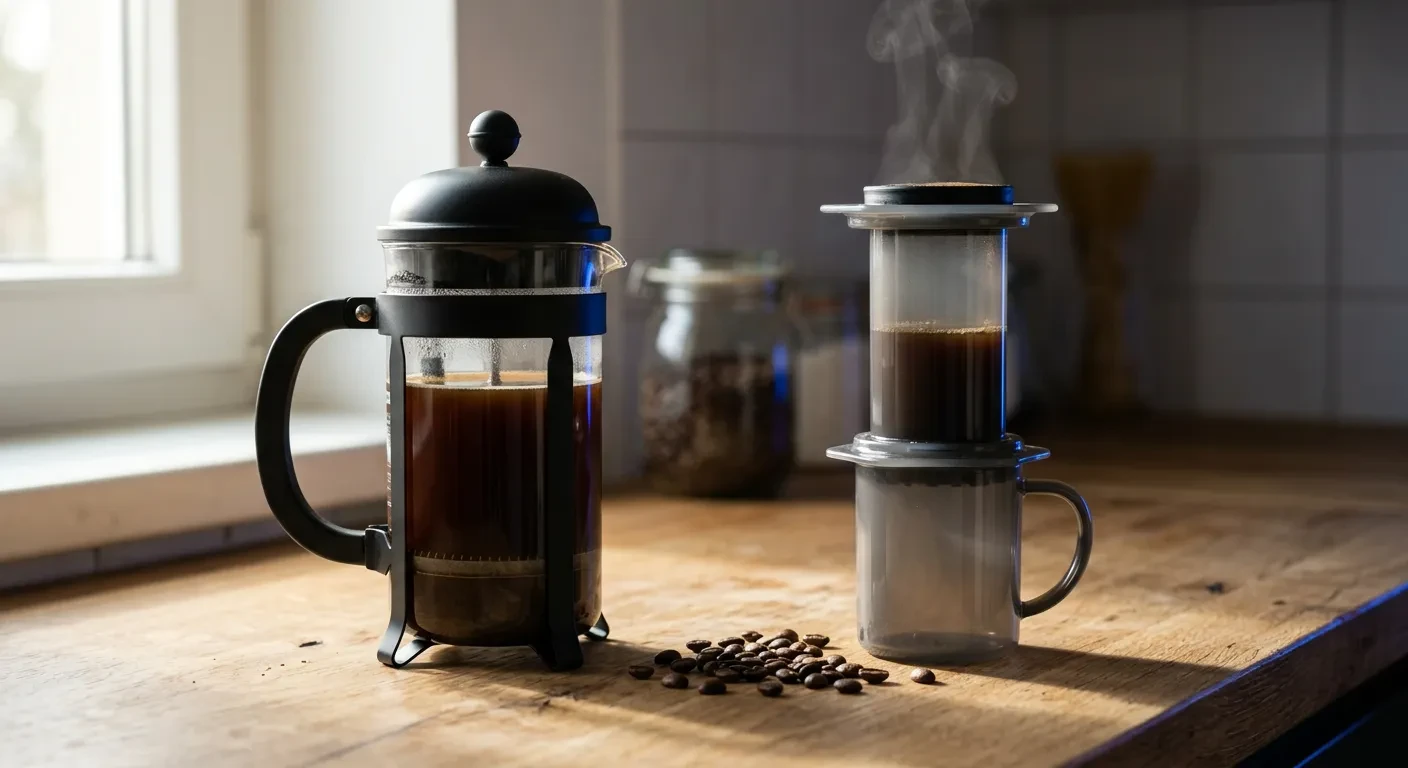
For most home brewers, the Bodum Chambord French Press is the stronger everyday choice — it produces a rich, full-bodied cup with zero plastic contact and costs around $55 AUD on Amazon AU. The AeroPress Go is the better pick if you travel frequently or want a clean, sediment-free result in under two minutes. French Press uses full immersion brewing for four minutes with coarse grounds, delivering natural oils and body that faster methods tend to strip away. AeroPress uses pressure-assisted extraction with a paper or metal filter, which removes fine particles and produces a brighter, cleaner cup. The core trade-off is texture versus convenience. French Press rewards patience but is less forgiving with grind size and produces sediment at the bottom of the cup. AeroPress is more forgiving on grind, faster to brew, and packs flat into carry-on luggage. Neither is objectively superior — your daily habits and lifestyle determine the winner.
Alchemist Wellness participates in affiliate programmes including Amazon Associates. If you purchase through a link on this page, we may earn a commission at no extra cost to you. This does not influence our editorial recommendations. Full disclosure.
Review status: This article is evidence-based, drawing on brand specifications, published clinical research, and verified Amazon AU listing data.
Products Reviewed
Bodum Chambord French Press 500ml

Bodum Chambord French Press 500ml
What it claims:
Bodum markets the Chambord as a premium, design-forward French Press with superior heat retention from borosilicate glass and a durable stainless steel frame built to last decades.
What the evidence says:
Borosilicate glass does offer better thermal shock resistance than soda-lime glass, which is well-supported by materials science. The stainless steel frame genuinely eliminates plastic from the brew path. Sediment is inherent to all French Press brewing and is not a Bodum-specific flaw.
scored
The Chambord's borosilicate glass and stainless steel frame make it the most durable, zero-plastic French Press at this price point in Australia.
Bodum Chambord French Press 500ml
- 500ml capacity (serves 2 standard cups)
- Borosilicate glass carafe — heat-resistant and odour-neutral
- Stainless steel frame and plunger — no plastic in the brew path
- Requires coarse grind (8–10 on most burr grinders)
- 4-minute full immersion brew time
- Rich, full-bodied cup with natural coffee oils intact
- No plastic contact with brew water or grounds
- Elegant stainless aesthetic holds up on a bench or table
- Widely stocked at David Jones and Amazon AU
- Borosilicate glass is more heat-resistant than standard glass carafes
- Fine sediment settles at the bottom of every cup — unavoidable with French Press
- Glass carafe breaks if dropped — poor travel companion
- Grind size is critical; too fine and the plunger clogs or bypasses
We've researched this product using publicly available brand specifications, published research on its active ingredients, and verified Amazon AU listing data. We haven't tested it hands-on.
Score pending · Research-based analysis.
AeroPress Go Portable Coffee Press

AeroPress Go Portable Coffee Press
What it claims:
AeroPress positions the Go as a pressure-assisted brewer that delivers espresso-style concentration with a cleaner cup than French Press, all in a compact format designed for travel.
What the evidence says:
Pressure-assisted extraction with a fine filter does produce a measurably cleaner cup than immersion brewing without filtration. The 'espresso-style' claim is contested; AeroPress does not reach true espresso pressures (7–9 bar). BPA-free certification is independently verifiable.
scored
The AeroPress Go produces a cleaner, sediment-free cup in under two minutes and survives a backpack better than any French Press on the market.
AeroPress Go Portable Coffee Press
- BPA-free and phthalate-free polypropylene body
- 1–2 minute total brew time
- Produces approximately 240ml per press
- Accepts paper or reusable metal filters
- Compact design with travel mug included
- Produces a clean, sediment-free cup — no grit at the bottom
- Fastest hands-on brew time of any manual brewer at this price
- Near-indestructible plastic body — ideal for travel and camping
- Forgiving across a wide range of grind sizes and water temperatures
- Reusable metal filter available, eliminating ongoing paper filter cost
- Plastic body — BPA-free, but some drinkers prefer zero plastic contact
- Small single-serve capacity; inconvenient when brewing for two or more
- Paper filters add a recurring consumable cost unless you buy metal
We've researched this product using publicly available brand specifications, published research on its active ingredients, and verified Amazon AU listing data. We haven't tested it hands-on.
Score pending · Research-based analysis.
Brew Method: What Actually Happens Inside Each Device
French Press is a full immersion brewer. Coarse grounds sit submerged in hot water for four minutes, absorbing heat and releasing compounds freely. Because there is no paper filter, all of the coffee's natural oils remain in the final cup, contributing to the thick mouthfeel that French Press drinkers seek. The metal plunger mesh is porous enough to let fine particles through, which is why sediment is unavoidable.
AeroPress works differently. Water passes through a bed of grounds under gentle manual pressure, and the brew exits through a paper or metal filter into your cup. A paper filter catches the fine particles and most of the oils, producing a notably cleaner and brighter result. With a metal filter, you recover some of that body while keeping the speed advantage.
Neither method is technically superior. Full immersion extracts different flavour compounds than pressure-assisted filtration, and preferences differ by the drinker. The mechanism matters because it dictates what ends up in your cup — not just the taste, but the texture and the way the cup changes as it cools.
Grind Size, Water Temperature, and Common Mistakes
French Press is the method most sensitive to grind size. Too fine and the grounds slip through the mesh, creating a muddy cup and a plunger that barely moves. Too coarse and you under-extract, producing a thin, sour brew. The target is a consistent coarse grind — roughly the texture of raw sugar — and a burr grinder is strongly recommended.
AeroPress is more forgiving. It works acceptably across medium-fine to medium-coarse grinds, which means you can use a cheaper hand grinder or even pre-ground coffee in a pinch and still produce a drinkable cup. Water temperature has more room too — AeroPress recipes often use 80–85°C water to reduce bitterness.
The most common mistake with both brewers is rushing the bloom step — pouring a small amount of hot water onto the grounds and waiting 30 seconds before adding the rest. Skipping this results in uneven extraction and a flat-tasting cup. Both methods benefit from this step. It takes 30 seconds and costs nothing.
Which Should You Buy in Australia?
Buy the Bodum Chambord if you brew at home most mornings, value full-bodied coffee with natural oils, and prefer zero plastic in the brew path. At around $55 AUD on Amazon AU, it is excellent value for a glass and stainless French Press. The sediment is real and unavoidable — if that bothers you after a week of use, you belong in the AeroPress camp.
Buy the AeroPress Go if you travel regularly, camp, or simply want the fastest path from beans to a clean cup without sediment. The plastic body is BPA-free and the device is built to last years. At around $60 AUD, it includes the travel mug and a starting supply of paper filters. A reusable metal filter alongside it for around $20 removes the ongoing consumable cost.
Both devices are available on Amazon AU with standard Prime delivery. If you brew for two or more people most days, the Chambord's 500ml capacity gives it a practical edge. If you brew solo and move around, the AeroPress Go is the obvious choice.
Frequently Asked Questions
9 questionsDoes French Press coffee have more caffeine than AeroPress?
No clear winner — both methods extract comparable caffeine per gram of coffee. Dose, grind size, water temperature, and brew time matter more than the device. A stronger AeroPress concentrate will contain more caffeine than a lightly dosed French Press. Neither method is inherently higher caffeine by design.
Is the AeroPress Go worth buying for travel in Australia?
Yes, the AeroPress Go is one of the best-value travel brewers on Amazon AU at around $60. It packs into its own travel mug, weighs under 400g, and survives checked luggage without breaking. If you travel interstate or camp regularly, it pays for itself quickly compared to buying café coffee on the road.
Does French Press coffee have more sediment than other brew methods?
Yes, French Press consistently produces more sediment than paper-filtered methods because the metal mesh plunger allows fine coffee particles to pass through. This is intrinsic to the brew method, not a defect. If you dislike sediment, AeroPress with a paper filter is a cleaner alternative.
How long does a French Press take to brew?
Four minutes is the standard recommendation for a full French Press brew. Total hands-on time including boiling water and pressing runs five to six minutes. AeroPress is roughly half that at one to two minutes of active brew time, making it significantly faster for busy mornings.
Can you use AeroPress without paper filters?
Yes, reusable metal disk filters from brands like Able Disk are compatible with both the standard AeroPress and AeroPress Go. Metal filters produce a slightly fuller-bodied, oilier cup — closer in texture to a clean French Press. They pay for themselves within a few weeks of regular use and eliminate the ongoing paper filter cost.
Is the Bodum Chambord dishwasher safe?
Yes, Bodum states the Chambord's components are dishwasher safe, though hand-washing the glass carafe is recommended to extend its lifespan. Borosilicate glass is thermally stable, but repeated dishwasher cycling can stress the seal between the glass and the stainless steel frame over time.
Which is better for cold brew — French Press or AeroPress?
Yes, French Press is generally the better tool for traditional cold brew, since it handles large volumes and long steep times (12–24 hours in the fridge) naturally. AeroPress can produce a quick cold concentrate in under three minutes, but the yield per batch is small. For brewing for multiple people, French Press wins on volume.
Can you make espresso with an AeroPress?
No, the AeroPress cannot produce true espresso, which requires 7–9 bar of pressure. The AeroPress generates roughly 0.35–0.75 bar during pressing. It can produce a concentrated, espresso-style brew suitable for milk drinks, but it is not a substitute for an espresso machine in terms of crema, texture, or extraction chemistry.
Which method is easier to clean — French Press or AeroPress?
AeroPress is easier to clean. The plunger ejects the spent puck directly into a bin in one press, and rinsing the chamber takes under 30 seconds. French Press requires disassembling the plunger, rinsing grounds from the carafe, and cleaning the mesh filter separately — typically two to three minutes longer per clean cycle.
Our Research Framework
Every product on this site is assessed against the same criteria — brand specifications, published clinical evidence, and verified Australian availability. We don't accept free products. Full methodology →